OCR · A-Level · Physics
Course version: H556 · Version from Sept 2015
Charge: (g) Kirchhoff’s first law; conservation of charge.
Kirchhoff's first law states that the sum of currents entering a junction equals the sum of currents leaving it, so the algebraic sum of currents at a junction is zero.
Checked against the OCR H556 specification (opens in a new tab) on .
- Point 7 of 7
Study notes
From the checked teaching notes for this specification point.
The idea
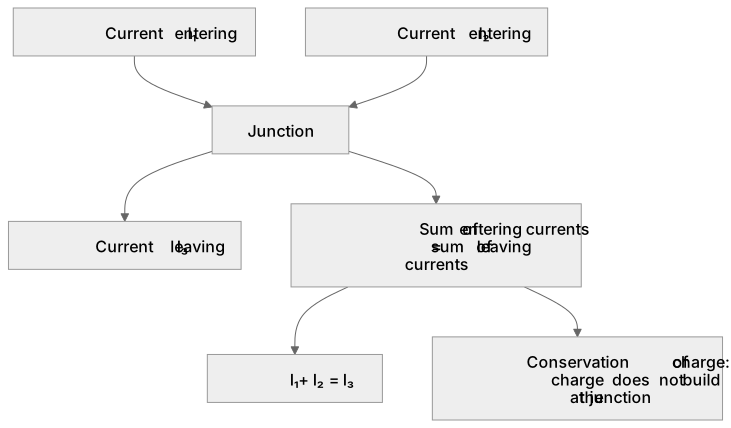
Kirchhoff's first law states that the sum of currents entering a junction equals the sum of currents leaving it, so the algebraic sum of currents at a junction is zero. It is a statement of conservation of charge: charge cannot accumulate at a junction in a steady circuit, so the rate at which charge arrives must equal the rate at which it leaves. For a junction with currents I₁ and I₂ entering and I₃ leaving, I₁ + I₂ = I₃. The law applies to any junction in a network, including parallel branches, and is used with Kirchhoff's second law to solve circuit problems. It holds for conventional current directions, and the same result follows from electron flow because the magnitudes are unchanged.
What earns the marks
- Kirchhoff's first law: the sum of currents entering a junction equals the sum of currents leaving it.
- The law follows from conservation of charge: charge does not build up at a junction in a steady state.
- For a junction, the algebraic sum of currents is zero when entering currents are taken as positive and leaving currents as negative.
- The law applies to any junction in a circuit, including junctions in parallel networks.
Common mistakes and how to put them right
Thinking that current is used up as it passes through components.
Put it right: Charge is conserved, so the current entering a junction equals the current leaving it.
Applying the law only to simple series circuits.
Put it right: It applies to every junction, including those in parallel branches.
Ignoring the direction of each current when writing the equation.
Put it right: Assign a positive sign to one direction and a negative sign to the opposite direction before summing.
Exam tips
- Label each current at the junction with an arrow before writing the equation, so the signs are unambiguous.
- Write the equation as sum of entering currents equals sum of leaving currents, then substitute the known values.
- Use the law to find an unknown branch current in a parallel circuit by subtracting the known branch currents from the total current.
Try the lesson
The start of the Charge: (g) Kirchhoff’s first law; conservation of charge. lesson, made from checked teaching notes for this specification point.
Listen
Kirchhoff's first law states that the sum of currents entering a junction equals the sum of currents leaving it, so the algebraic sum of currents at a junction is zero. It is a statement of conservation of charge: charge cannot accumulate at a junction in a steady circuit, so the rate at which charge arrives must equal the rate at which it leaves. For a junction with currents I₁ and I₂ entering and I₃ leaving, I₁ + I₂ = I₃. The law applies to any junction in a network, including parallel branches, and is used with Kirchhoff's second law to solve circuit problems. It holds for conventional current directions, and the same result follows from electron flow because the magnitudes are unchanged. A strong answer earns marks for these points. Kirchhoff's first law: the sum of currents entering a junction equals the sum of currents leaving it. The law follows from conservation of charge: charge does not build up at a junction in a steady state. For a junction, the algebraic sum of currents is zero when entering currents are taken as positive and leaving currents as negative. The law applies to any junction in a circuit, including junctions in parallel networks. Exam tip: Label each current at the junction with an arrow before writing the equation, so the signs are unambiguous.
See it
Label the diagram
Some boxes have lost their names. Pick the right name for each number.
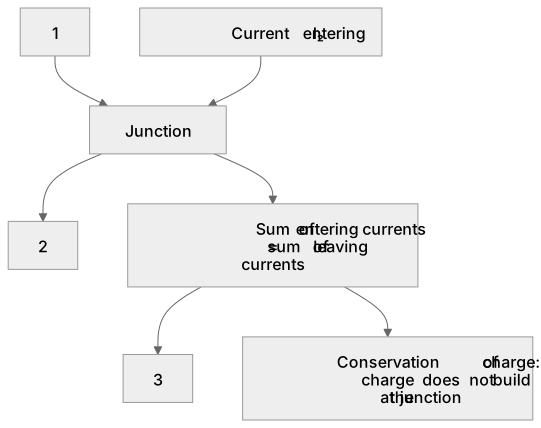
1Box 1
2Box 2
3Box 3
There is more to this lesson
The full lesson goes on to check your understanding and help you earn the marks. Create a free account to carry on, with your progress saved.
A week of Premium from your first lesson · Then the free plan continues · No card, no charge
Test your understanding of Charge: (g) Kirchhoff’s first law; conservation of charge.
Active recall beats re-reading. Take an instant quiz now to test what you’ve learned and lock it into long-term memory.
A week of Premium from your first lesson · Then the free plan continues · No card, no charge