OCR · A-Level · Physics
Course version: H556 · Version from Sept 2015
Collisions: (a) the principle of conservation of momentum
The principle of conservation of momentum states that, for a system with no resultant external force, total momentum before an interaction equals total momentum after it.
Checked against the OCR H556 specification (opens in a new tab) on .
- Point 1 of 3
Study notes
From the checked teaching notes for this specification point.
The idea
The principle of conservation of momentum states that, for a system with no resultant external force, total momentum before an interaction equals total momentum after it. Momentum is a vector, p = mv, so assign a positive direction and give opposing velocities negative signs. For two bodies A and B: m_A u_A + m_B u_B = m_A v_A + m_B v_B. This applies to collisions, explosions and recoil, provided external forces such as friction or a driving force are negligible during the interaction.
For example: A 2.0 kg trolley at 3.0 m s⁻¹ colliding with a stationary 1.0 kg trolley and sticking gives total momentum 6.0 kg m s⁻¹ before and after, so the combined 3.0 kg moves at 2.0 m s⁻¹.
What earns the marks
- Total momentum of a system remains constant when no resultant external force acts on it.
- Momentum is a vector quantity, so direction must be represented by positive and negative signs.
- The conservation equation equates the vector sum of momenta before and after an interaction.
- The principle applies to collisions, explosions and recoil where external forces are negligible during the interaction.
Common mistakes and how to put them right
Treating momentum as a scalar and adding speeds regardless of direction.
Put it right: The correct approach is to assign signs to velocities along a chosen axis.
Assuming momentum is conserved when a significant external force acts, such as friction during a long slide.
Put it right: The correct condition is that the resultant external force is zero or negligible.
Forgetting to include a stationary body's zero momentum in the before total.
Put it right: The correct equation includes every body in the system.
Exam tips
- Draw a before-and-after diagram and mark the positive direction on it.
- Write the full conservation equation before substituting numbers, so no term is omitted.
- Check that the final velocity's sign is physically sensible for the direction chosen.
Try the lesson
The start of the Collisions: (a) the principle of conservation of momentum lesson, made from checked teaching notes for this specification point.
Listen
The principle of conservation of momentum states that, for a system with no resultant external force, total momentum before an interaction equals total momentum after it. Momentum is a vector, p = mv, so assign a positive direction and give opposing velocities negative signs. For two bodies A and B: m_A u_A + m_B u_B = m_A v_A + m_B v_B. This applies to collisions, explosions and recoil, provided external forces such as friction or a driving force are negligible during the interaction. For example, a 2.0 kg trolley at 3.0 m s⁻¹ colliding with a stationary 1.0 kg trolley and sticking gives total momentum 6.0 kg m s⁻¹ before and after, so the combined 3.0 kg moves at 2.0 m s⁻¹. A strong answer earns marks for these points. Total momentum of a system remains constant when no resultant external force acts on it. Momentum is a vector quantity, so direction must be represented by positive and negative signs. The conservation equation equates the vector sum of momenta before and after an interaction. The principle applies to collisions, explosions and recoil where external forces are negligible during the interaction. Exam tip: Draw a before-and-after diagram and mark the positive direction on it.
See it
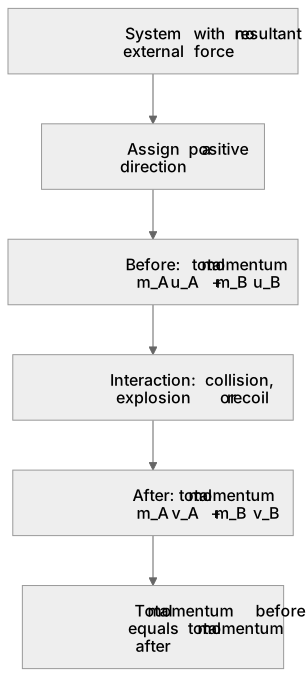
Put it in order
Put these steps in the order they happen.
- 1. Before: total momentum = m_A u_A + m_B u_B
- 2. Assign a positive direction
- 3. System with no resultant external force
- 4. Total momentum before equals total momentum after
- 5. After: total momentum = m_A v_A + m_B v_B
- 6. Interaction: collision, explosion or recoil
Label the diagram
Some boxes have lost their names. Pick the right name for each number.
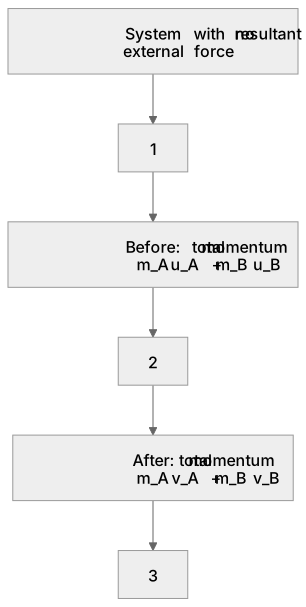
1Box 1
2Box 2
3Box 3
There is more to this lesson
The full lesson goes on to check your understanding and help you earn the marks. Create a free account to carry on, with your progress saved.
A week of Premium from your first lesson · Then the free plan continues · No card, no charge
Test your understanding of Collisions: (a) the principle of conservation of momentum
Active recall beats re-reading. Take an instant quiz now to test what you’ve learned and lock it into long-term memory.
A week of Premium from your first lesson · Then the free plan continues · No card, no charge