OCR · A-Level · Physics
Course version: H556 · Version from Sept 2015
(b) collisions and interaction of bodies in one dimension and in two…
Full specification wording
Collisions: (b) collisions and interaction of bodies in one dimension and in two dimensions
Momentum conservation applies along each perpendicular direction independently.
Checked against the OCR H556 specification (opens in a new tab) on .
- Point 2 of 3
Study notes
From the checked teaching notes for this specification point.
The idea
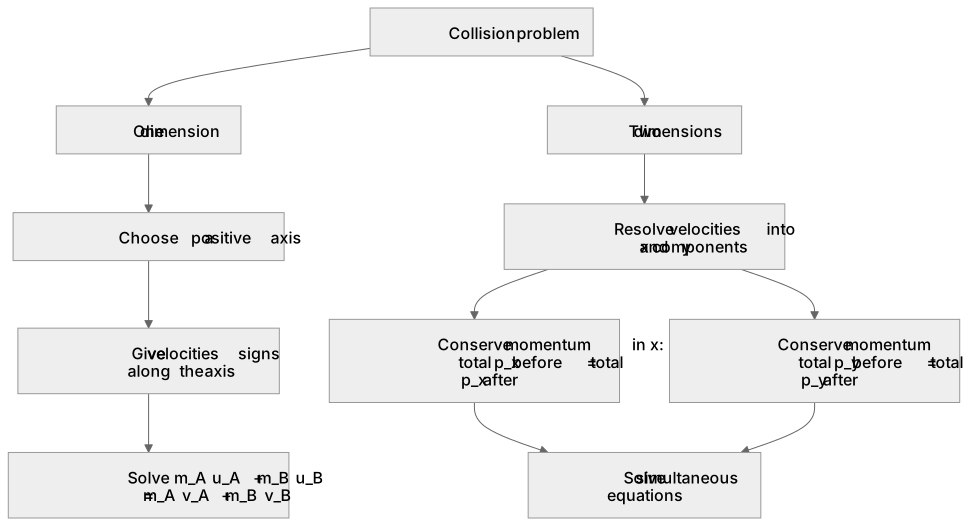
Momentum conservation applies along each perpendicular direction independently. In one dimension, choose a positive axis and solve m_A u_A + m_B u_B = m_A v_A + m_B v_B. In two dimensions, resolve all velocities into x and y components, then conserve momentum separately in each direction: total p_x before equals total p_x after, and total p_y before equals total p_y after. For example, a ball moving east at 4.0 m s⁻¹ striking a stationary ball and deflecting at 30° requires x and y equations to find both final velocities. Draw a vector diagram, resolve with sine and cosine, and solve the simultaneous equations.
What earns the marks
- Momentum is conserved independently in each perpendicular direction for a system with no resultant external force.
- In one dimension, velocities are given signs along a single chosen axis.
- In two dimensions, resolve velocities into components and write separate conservation equations for x and y.
- Vector diagrams or component tables help track before and after momenta in two dimensions.
Common mistakes and how to put them right
Conserving momentum only along the original direction of motion in a two-dimensional collision.
Put it right: The correct method conserves momentum along both perpendicular axes.
Mixing up sine and cosine when resolving a velocity at an angle.
Put it right: The correct component adjacent to the angle uses cosine and the perpendicular component uses sine.
Adding component magnitudes without signs.
Put it right: The correct approach assigns positive and negative directions on each axis.
Exam tips
- Draw a clear before-and-after diagram with axes labelled and angles marked.
- Make a component table for x and y momenta before and after the collision.
- Solve the simpler axis equation first, then substitute into the other to find the remaining unknown.
Try the lesson
The start of the Collisions: (b) collisions and interaction of bodies in one dimension and in two dimensions lesson, made from checked teaching notes for this specification point.
Listen
Momentum conservation applies along each perpendicular direction independently. In one dimension, choose a positive axis and solve m_A u_A + m_B u_B = m_A v_A + m_B v_B. In two dimensions, resolve all velocities into x and y components, then conserve momentum separately in each direction: total p_x before equals total p_x after, and total p_y before equals total p_y after. For example, a ball moving east at 4.0 m s⁻¹ striking a stationary ball and deflecting at 30° requires x and y equations to find both final velocities. Draw a vector diagram, resolve with sine and cosine, and solve the simultaneous equations. A strong answer earns marks for these points. Momentum is conserved independently in each perpendicular direction for a system with no resultant external force. In one dimension, velocities are given signs along a single chosen axis. In two dimensions, resolve velocities into components and write separate conservation equations for x and y. Vector diagrams or component tables help track before and after momenta in two dimensions. Exam tip: Draw a clear before-and-after diagram with axes labelled and angles marked.
See it
Label the diagram
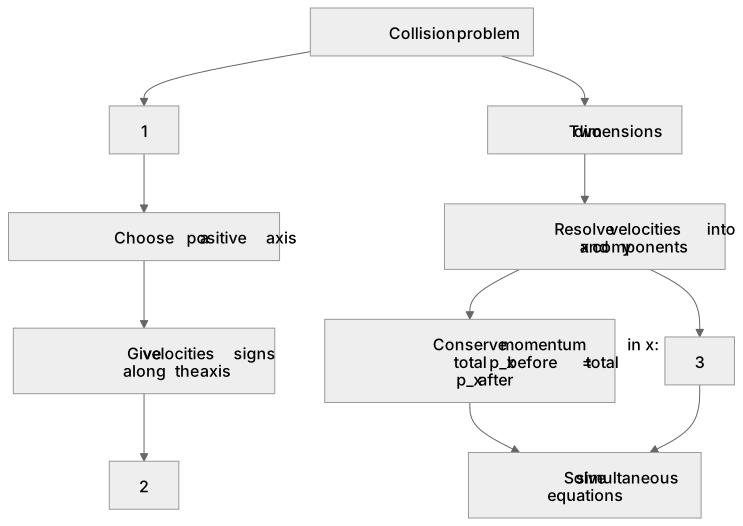
Some boxes have lost their names. Pick the right name for each number.
1Box 1
2Box 2
3Box 3
There is more to this lesson
The full lesson goes on to check your understanding and help you earn the marks. Create a free account to carry on, with your progress saved.
A week of Premium from your first lesson · Then the free plan continues · No card, no charge
Test your understanding of Collisions: (b) collisions and interaction of bodies in one dimension and in two dimensions
Active recall beats re-reading. Take an instant quiz now to test what you’ve learned and lock it into long-term memory.
A week of Premium from your first lesson · Then the free plan continues · No card, no charge