OCR · A-Level · Physics
Course version: H556 · Version from Sept 2015
Collisions: (c) perfectly elastic collision and inelastic collision.
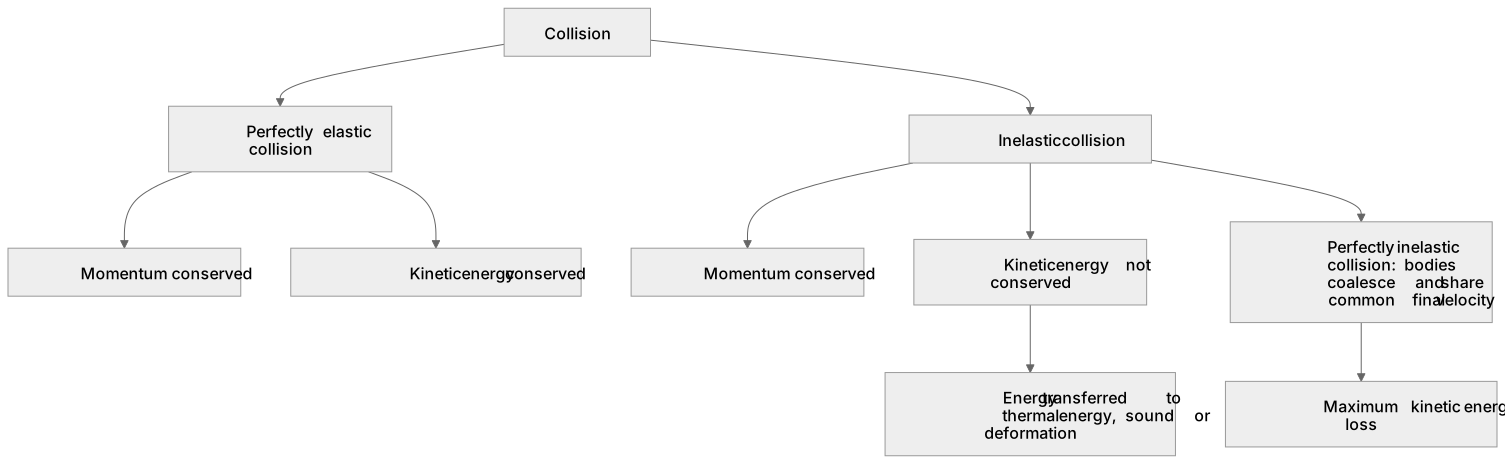
In a perfectly elastic collision, both momentum and kinetic energy are conserved.
Checked against the OCR H556 specification (opens in a new tab) on .
- Point 3 of 3
- 4 key terms
Study notes
From the checked teaching notes for this specification point.
The idea
In a perfectly elastic collision, both momentum and kinetic energy are conserved. In an inelastic collision, momentum is conserved but kinetic energy is not; some is transferred to thermal energy, sound or deformation. A special case is a perfectly inelastic collision, where bodies stick together and move with a common velocity, giving maximum kinetic energy loss. For example, two identical trolleys approaching at equal speeds and sticking together have zero total momentum and stop, converting all kinetic energy. To test elasticity, calculate total ½mv² before and after; equal values indicate a perfectly elastic collision, while a decrease indicates an inelastic one.
What earns the marks
- A perfectly elastic collision conserves both momentum and kinetic energy.
- An inelastic collision conserves momentum but not kinetic energy.
- In a perfectly inelastic collision the bodies coalesce and share a common final velocity.
- Kinetic energy may be transferred to thermal energy, sound or deformation in an inelastic collision.
Common mistakes and how to put them right
Assuming kinetic energy is always conserved in collisions.
Put it right: The correct test is to compare total kinetic energy before and after, since only perfectly elastic collisions conserve it.
Believing momentum is lost in an inelastic collision.
Put it right: The correct principle is that momentum is conserved whenever no resultant external force acts.
Treating a collision as perfectly elastic because the bodies bounce apart.
Put it right: The correct criterion is numerical conservation of kinetic energy, not the appearance of bouncing.
Exam tips
- Calculate total kinetic energy before and after to classify a collision as elastic or inelastic.
- Use conservation of momentum first to find unknown velocities, then test kinetic energy.
- State clearly which quantity is conserved and which is not when explaining a collision.
Try the lesson
The start of the Collisions: (c) perfectly elastic collision and inelastic collision. lesson, made from checked teaching notes for this specification point.
Listen
In a perfectly elastic collision, both momentum and kinetic energy are conserved. In an inelastic collision, momentum is conserved but kinetic energy is not; some is transferred to thermal energy, sound or deformation. A special case is a perfectly inelastic collision, where bodies stick together and move with a common velocity, giving maximum kinetic energy loss. For example, two identical trolleys approaching at equal speeds and sticking together have zero total momentum and stop, converting all kinetic energy. To test elasticity, calculate total ½mv² before and after; equal values indicate a perfectly elastic collision, while a decrease indicates an inelastic one. A strong answer earns marks for these points. A perfectly elastic collision conserves both momentum and kinetic energy. An inelastic collision conserves momentum but not kinetic energy. In a perfectly inelastic collision the bodies coalesce and share a common final velocity. Kinetic energy may be transferred to thermal energy, sound or deformation in an inelastic collision. Exam tip: Calculate total kinetic energy before and after to classify a collision as elastic or inelastic.
See it
Key words
Say what each word means before you turn the card.
Perfectly elastic collision
Try answering aloud or in your head before turning the card.
Inelastic collision
Try answering aloud or in your head before turning the card.
Perfectly inelastic collision
Try answering aloud or in your head before turning the card.
Conservation of momentum
Try answering aloud or in your head before turning the card.
See every definition
- Perfectly elastic collision
- A collision in which both momentum and kinetic energy are conserved.
- Inelastic collision
- A collision in which momentum is conserved but kinetic energy is not; some is transferred to thermal energy, sound or deformation.
- Perfectly inelastic collision
- A special case in which the bodies stick together and move with a common velocity, giving maximum kinetic energy loss.
- Conservation of momentum
- Momentum is conserved whenever no resultant external force acts.
There is more to this lesson
The full lesson goes on to check your understanding and help you earn the marks. Create a free account to carry on, with your progress saved.
A week of Premium from your first lesson · Then the free plan continues · No card, no charge
Test your understanding of Collisions: (c) perfectly elastic collision and inelastic collision.
Active recall beats re-reading. Take an instant quiz now to test what you’ve learned and lock it into long-term memory.
A week of Premium from your first lesson · Then the free plan continues · No card, no charge