OCR · A-Level · Physics
Course version: H556 · Version from Sept 2015
(c) the equation d = 1/p, where p is the parallax in seconds of arc and d…
Full specification wording
Cosmology: (c) the equation d = 1/p, where p is the parallax in seconds of arc and d is the distance in parsec
The equation d = 1/p gives the distance d in parsecs to a star when its parallax p is measured in seconds of arc.
Checked against the OCR H556 specification (opens in a new tab) on .
- Point 5 of 17
Study notes
From the checked teaching notes for this specification point.
The idea
The equation d = 1/p gives the distance d in parsecs to a star when its parallax p is measured in seconds of arc. The relationship is inverse: a larger parallax means a nearer star, and a smaller parallax means a more distant star. For example, a star with p = 0.1″ lies at d = 1/0.1 = 10 pc, while Proxima Centauri with p ≈ 0.77″ lies at about 1.3 pc. In multiple-choice questions you may be asked to calculate d from p, to find p from d, to convert the result to metres or light-years, or to recognise that the equation only works when p is in seconds of arc.
What earns the marks
- States the equation d = 1/p with d in parsecs and p in seconds of arc.
- Applies the inverse relationship correctly, so a smaller parallax gives a larger distance.
- Substitutes a parallax value in seconds of arc and evaluates d without a unit error.
- Converts a distance in parsecs to metres or light-years when required.
- Recognises that the equation assumes the parallax angle is measured with a baseline of 1 au.
Common mistakes and how to put them right
Substituting the parallax in degrees or arcminutes instead of seconds of arc.
Put it right: The equation only gives parsecs when p is in seconds of arc.
Inverting the relationship and writing d = p.
Put it right: The correct form is d = 1/p, so a parallax of 0.5″ gives 2 pc, not 0.5 pc.
Forgetting to convert a distance in parsecs to metres when the question asks for an SI answer.
Put it right: Multiply by about 3.09 × 10¹⁶ m pc⁻¹.
Using the total angular shift over six months as p.
Put it right: The parallax angle is half that shift, so the calculated distance would be too small by a factor of two.
Exam tips
- Write down d = 1/p and label the units before substituting, so you can see immediately whether p is in seconds of arc.
- If the question gives p in milliarcseconds, convert to seconds of arc by dividing by 1000 before using the equation.
- Check the reasonableness of your answer: nearby stars have distances of a few parsecs, so a result of thousands of parsecs should prompt a unit check.
- When converting to metres, use 1 pc ≈ 3.09 × 10¹⁶ m and keep the calculation in standard form to avoid power-of-ten slips.
Try the lesson
The start of the Cosmology: (c) the equation d = 1/p, where p is the parallax in seconds of arc and d is the distance in parsec lesson, made from checked teaching notes for this specification point.
Listen
The equation d = 1/p gives the distance d in parsecs to a star when its parallax p is measured in seconds of arc. The relationship is inverse: a larger parallax means a nearer star, and a smaller parallax means a more distant star. For example, a star with p = 0.1″ lies at d = 1/0.1 = 10 pc, while Proxima Centauri with p ≈ 0.77″ lies at about 1.3 pc. In multiple-choice questions you may be asked to calculate d from p, to find p from d, to convert the result to metres or light-years, or to recognise that the equation only works when p is in seconds of arc. A strong answer earns marks for these points. States the equation d = 1/p with d in parsecs and p in seconds of arc. Applies the inverse relationship correctly, so a smaller parallax gives a larger distance. Substitutes a parallax value in seconds of arc and evaluates d without a unit error. Converts a distance in parsecs to metres or light-years when required. Exam tip: Write down d = 1/p and label the units before substituting, so you can see immediately whether p is in seconds of arc.
See it
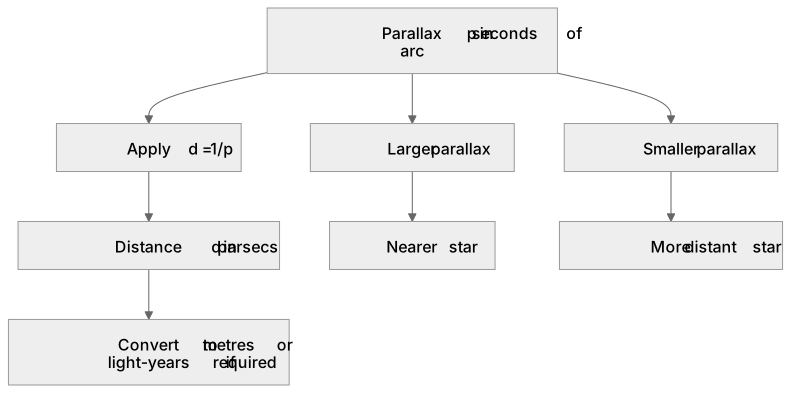
Label the diagram
Some boxes have lost their names. Pick the right name for each number.
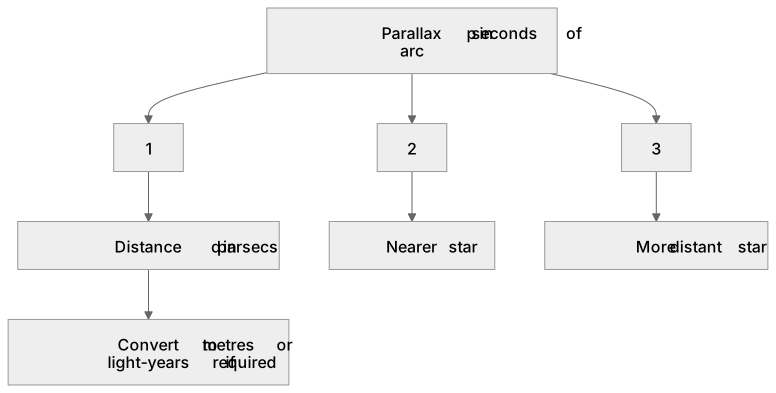
1Box 1
2Box 2
3Box 3
There is more to this lesson
The full lesson goes on to check your understanding and help you earn the marks. Create a free account to carry on, with your progress saved.
A week of Premium from your first lesson · Then the free plan continues · No card, no charge
Test your understanding of Cosmology: (c) the equation d = 1/p, where p is the parallax in seconds of arc and d is the distance in parsec
Active recall beats re-reading. Take an instant quiz now to test what you’ve learned and lock it into long-term memory.
A week of Premium from your first lesson · Then the free plan continues · No card, no charge