OCR · A-Level · Physics
Course version: H556 · Version from Sept 2015
(d) the Cosmological principle; universe is homogeneous, isotropic and the…
Full specification wording
Cosmology: (d) the Cosmological principle; universe is homogeneous, isotropic and the laws of physics are universal
The Cosmological principle states that, on sufficiently large scales, the universe is homogeneous and isotropic, and that the laws of physics are universal.
Checked against the OCR H556 specification (opens in a new tab) on .
- Point 6 of 17
- 4 key terms
Study notes
From the checked teaching notes for this specification point.
The idea
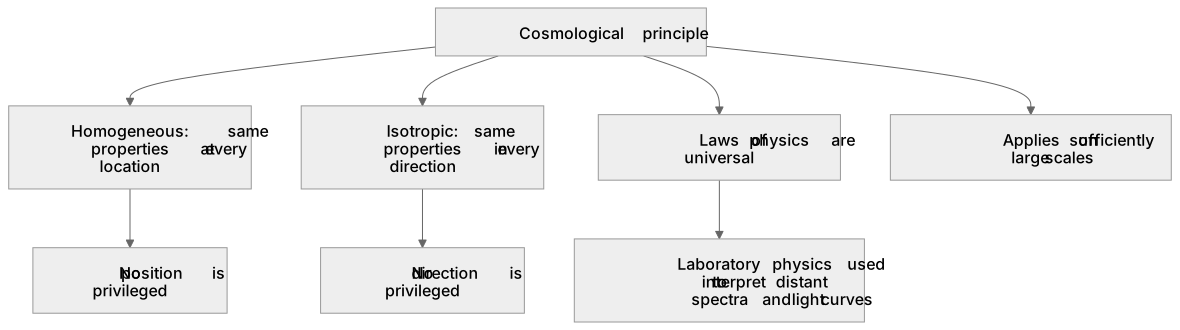
The Cosmological principle states that, on sufficiently large scales, the universe is homogeneous and isotropic, and that the laws of physics are universal. Homogeneous means the distribution of matter and energy is the same everywhere, so no location is special. Isotropic means the universe looks the same in every direction from any observation point. Universal laws mean the same physical principles apply throughout space and time, allowing astronomers to interpret distant spectra and light curves using laboratory physics. In multiple-choice questions you may be asked to distinguish homogeneity from isotropy, to identify evidence such as the smooth cosmic microwave background, or to explain why the principle underpins cosmological models.
What earns the marks
- States the Cosmological principle: on large scales the universe is homogeneous and isotropic.
- Defines homogeneous as the same properties at every location, so no position is privileged.
- Defines isotropic as the same properties in every direction, so no direction is privileged.
- States that the laws of physics are universal, applying everywhere and at all times.
- Applies the principle to justify using laboratory physics to interpret distant astronomical observations.
Common mistakes and how to put them right
Treating homogeneous and isotropic as synonyms.
Put it right: Homogeneity is about sameness from place to place, while isotropy is about sameness in all directions from one place.
Claiming the universe is homogeneous and isotropic on all scales.
Put it right: The principle applies on sufficiently large scales, since galaxies and clusters are unevenly distributed locally.
Assuming the laws of physics might differ in distant regions.
Put it right: The principle asserts they are universal, which is why spectral lines from distant galaxies can be identified.
Confusing the Cosmological principle with the steady state theory.
Put it right: The principle describes large-scale uniformity and does not by itself require a unchanging universe.
Exam tips
- Learn a one-line definition of each term and a contrasting example: a uniform pattern on a wall is homogeneous, while a starry sky that looks the same in every direction is isotropic.
- When a question describes an observation, ask whether it concerns position (homogeneity) or direction (isotropy) before choosing an option.
- Link the universal-laws clause to practical astronomy, such as identifying hydrogen lines in a distant galaxy's spectrum using laboratory wavelengths.
- Remember the qualifier 'on sufficiently large scales'; options that apply the principle to individual galaxies or the solar system are usually wrong.
Try the lesson
The start of the Cosmology: (d) the Cosmological principle; universe is homogeneous, isotropic and the laws of physics are universal lesson, made from checked teaching notes for this specification point.
Listen
The Cosmological principle states that, on sufficiently large scales, the universe is homogeneous and isotropic, and that the laws of physics are universal. Homogeneous means the distribution of matter and energy is the same everywhere, so no location is special. Isotropic means the universe looks the same in every direction from any observation point. Universal laws mean the same physical principles apply throughout space and time, allowing astronomers to interpret distant spectra and light curves using laboratory physics. In multiple-choice questions you may be asked to distinguish homogeneity from isotropy, to identify evidence such as the smooth cosmic microwave background, or to explain why the principle underpins cosmological models. A strong answer earns marks for these points. States the Cosmological principle: on large scales the universe is homogeneous and isotropic. Defines homogeneous as the same properties at every location, so no position is privileged. Defines isotropic as the same properties in every direction, so no direction is privileged. States that the laws of physics are universal, applying everywhere and at all times. Exam tip: Learn a one-line definition of each term and a contrasting example: a uniform pattern on a wall is homogeneous, while a starry sky that looks the same in every direction is isotropic.
See it
Key words
Say what each word means before you turn the card.
Cosmological principle
Try answering aloud or in your head before turning the card.
Homogeneous
Try answering aloud or in your head before turning the card.
Isotropic
Try answering aloud or in your head before turning the card.
Universal laws
Try answering aloud or in your head before turning the card.
See every definition
- Cosmological principle
- On sufficiently large scales, the universe is homogeneous and isotropic, and the laws of physics are universal.
- Homogeneous
- The distribution of matter and energy is the same everywhere, so no location is special.
- Isotropic
- The universe looks the same in every direction from any observation point.
- Universal laws
- The same physical principles apply throughout space and time, allowing astronomers to interpret distant spectra and light curves using laboratory physics.
Label the diagram
Some boxes have lost their names. Pick the right name for each number.

1Box 1
2Box 2
3Box 3
There is more to this lesson
The full lesson goes on to check your understanding and help you earn the marks. Create a free account to carry on, with your progress saved.
A week of Premium from your first lesson · Then the free plan continues · No card, no charge
Test your understanding of Cosmology: (d) the Cosmological principle; universe is homogeneous, isotropic and the laws of physics are universal
Active recall beats re-reading. Take an instant quiz now to test what you’ve learned and lock it into long-term memory.
A week of Premium from your first lesson · Then the free plan continues · No card, no charge