OCR · A-Level · Physics
Course version: H556 · Version from Sept 2015
(k) experimental evidence for the Big Bang theory from microwave…
Full specification wording
Cosmology: (k) experimental evidence for the Big Bang theory from microwave background radiation at a temperature of 2.7 K
The cosmic microwave background radiation (CMBR) is a faint, almost perfectly uniform microwave signal coming from every direction in space.
Checked against the OCR H556 specification (opens in a new tab) on .
- Point 13 of 17
- 4 key terms
Study notes
From the checked teaching notes for this specification point.
The idea
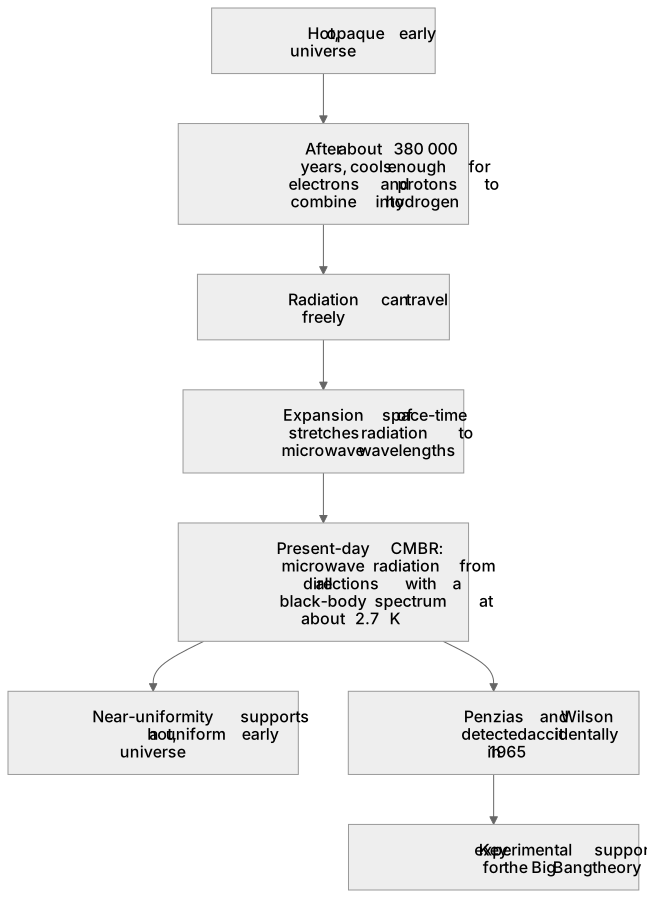
The cosmic microwave background radiation (CMBR) is a faint, almost perfectly uniform microwave signal coming from every direction in space. Its spectrum matches that of a black body at about 2.7 K, which is the cooled remnant of the hot early universe. In the Big Bang model, the young universe was opaque and hot; after about 380 000 years it cooled enough for electrons and protons to combine into hydrogen, so radiation could travel freely. That radiation has since been stretched by the expansion of space-time to microwave wavelengths, giving the 2.7 K temperature today. Penzias and Wilson detected it accidentally in 1965, and it is now mapped in detail by satellites such as COBE and Planck.
What earns the marks
- The CMBR is microwave radiation arriving from all directions with a black-body spectrum at about 2.7 K.
- As space-time expanded, the radiation was stretched and cooled to its present 2.7 K.
- Its near-uniformity supports the idea that the early universe was hot and uniform.
- Penzias and Wilson's 1965 detection provided key experimental support for the Big Bang.
Common mistakes and how to put them right
Treating the CMBR as coming from a particular star or galaxy.
Put it right: It is a uniform background from all directions, not a local source.
Saying the radiation was simply 'left over' without explaining cooling.
Put it right: Expansion of space-time stretched the wavelengths and lowered the temperature to 2.7 K.
Confusing the CMBR with visible starlight.
Put it right: Its peak is in the microwave region, consistent with a 2.7 K black body.
Exam tips
- Quote the temperature as 2.7 K and state that the spectrum is that of a black body.
- Explain the link between expansion, wavelength stretching and the drop in temperature.
- Mention the near-uniformity of the CMBR as evidence that the early universe was hot and uniform.
Try the lesson
The start of the Cosmology: (k) experimental evidence for the Big Bang theory from microwave background radiation at a temperature of 2.7 K lesson, made from checked teaching notes for this specification point.
Listen
The cosmic microwave background radiation (CMBR) is a faint, almost perfectly uniform microwave signal coming from every direction in space. Its spectrum matches that of a black body at about 2.7 K, which is the cooled remnant of the hot early universe. In the Big Bang model, the young universe was opaque and hot; after about 380 000 years it cooled enough for electrons and protons to combine into hydrogen, so radiation could travel freely. That radiation has since been stretched by the expansion of space-time to microwave wavelengths, giving the 2.7 K temperature today. Penzias and Wilson detected it accidentally in 1965, and it is now mapped in detail by satellites such as COBE and Planck. A strong answer earns marks for these points. The CMBR is microwave radiation arriving from all directions with a black-body spectrum at about 2.7 K. As space-time expanded, the radiation was stretched and cooled to its present 2.7 K. Its near-uniformity supports the idea that the early universe was hot and uniform. Penzias and Wilson's 1965 detection provided key experimental support for the Big Bang. Exam tip: Quote the temperature as 2.7 K and state that the spectrum is that of a black body.
See it
Key words
Say what each word means before you turn the card.
Cosmic microwave background radiation
Try answering aloud or in your head before turning the card.
Black-body radiation and temperature
Try answering aloud or in your head before turning the card.
Expansion and cooling of the universe
Try answering aloud or in your head before turning the card.
Experimental evidence for cosmological models
Try answering aloud or in your head before turning the card.
See every definition
- Cosmic microwave background radiation
- A faint, almost perfectly uniform microwave signal coming from every direction in space, with a black-body spectrum at about 2.7 K.
- Black-body radiation and temperature
- The spectrum of the cosmic microwave background radiation matches that of a black body at about 2.7 K.
- Expansion and cooling of the universe
- As space-time expanded, the radiation was stretched to microwave wavelengths and cooled to its present 2.7 K.
- Experimental evidence for cosmological models
- Penzias and Wilson's 1965 detection provided key experimental support for the Big Bang, and it is now mapped in detail by satellites such as COBE and Planck.
Label the diagram
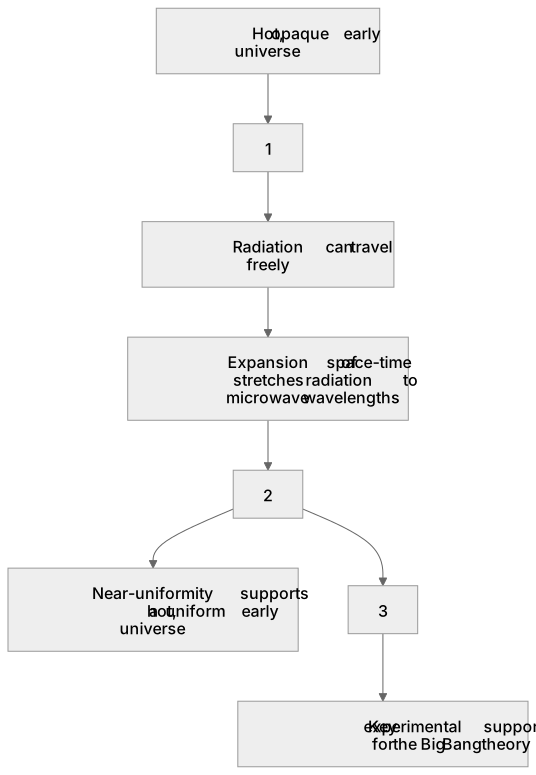
Some boxes have lost their names. Pick the right name for each number.
1Box 1
2Box 2
3Box 3
There is more to this lesson
The full lesson goes on to check your understanding and help you earn the marks. Create a free account to carry on, with your progress saved.
A week of Premium from your first lesson · Then the free plan continues · No card, no charge
Test your understanding of Cosmology: (k) experimental evidence for the Big Bang theory from microwave background radiation at a temperature of 2.7 K
Active recall beats re-reading. Take an instant quiz now to test what you’ve learned and lock it into long-term memory.
A week of Premium from your first lesson · Then the free plan continues · No card, no charge