OCR · A-Level · Physics
Course version: H556 · Version from Sept 2015
(l) the idea that the Big Bang gave rise to the expansion of space-time
Full specification wording
Cosmology: (l) the idea that the Big Bang gave rise to the expansion of space-time
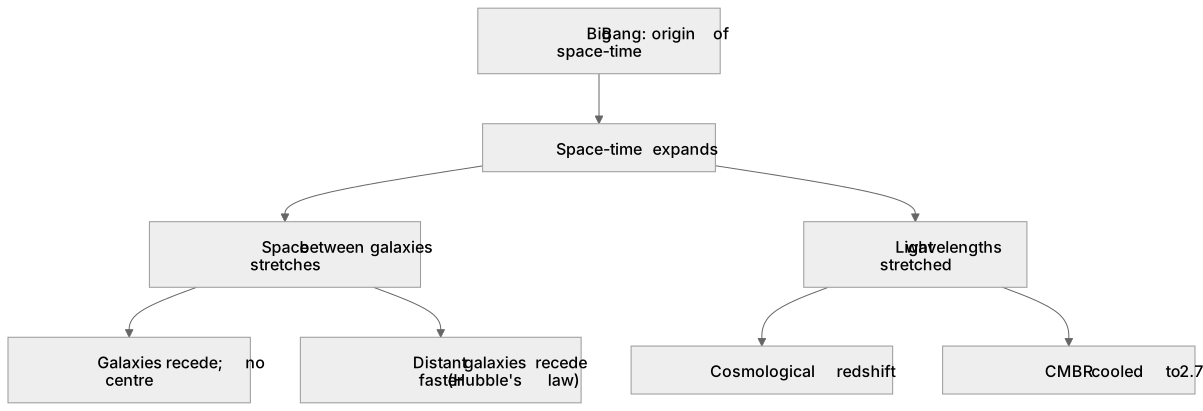
In the standard cosmological model, the Big Bang marks the origin of space-time itself, not an explosion of matter inside a pre-existing space.
Checked against the OCR H556 specification (opens in a new tab) on .
- Point 14 of 17
- 4 key terms
Study notes
From the checked teaching notes for this specification point.
The idea
In the standard cosmological model, the Big Bang marks the origin of space-time itself, not an explosion of matter inside a pre-existing space. Immediately after the origin, space-time began to expand, and it continues to expand today. Galaxies are not flying through space away from a centre; rather, the space between them stretches, so distant galaxies recede faster, in line with Hubble's law. A useful analogy is a rising raisin cake or a balloon with dots: as the surface stretches, every dot moves away from every other, and no dot is the centre. This expansion also stretches the wavelength of light travelling through space, producing cosmological redshift and cooling the CMBR to 2.7 K.
What earns the marks
- The Big Bang is the origin of space-time, not an explosion of matter into pre-existing space.
- Space-time has been expanding since the Big Bang, and continues to expand.
- Galaxies recede because the space between them stretches, not because they move through space from a centre.
- The expansion explains Hubble's law: more distant galaxies have greater recession speeds.
- Expansion stretches light wavelengths, producing redshift and cooling the CMBR to 2.7 K.
Common mistakes and how to put them right
Saying galaxies move through space away from a central point.
Put it right: That space-time itself expands, so there is no centre or edge.
Treating the Big Bang as an explosion at a location in space.
Put it right: It is the origin of space-time, so asking where it happened is not meaningful in the model.
Assuming the expansion only affects galaxies.
Put it right: It also stretches light wavelengths, causing cosmological redshift and the 2.7 K CMBR.
Exam tips
- Use the phrase 'expansion of space-time' and avoid 'explosion' or 'moving through space'.
- Support the idea with Hubble's law: recession speed is proportional to distance because space stretches uniformly.
- Link the expansion to observable consequences such as redshift and the cooled CMBR.
Try the lesson
The start of the Cosmology: (l) the idea that the Big Bang gave rise to the expansion of space-time lesson, made from checked teaching notes for this specification point.
Listen
In the standard cosmological model, the Big Bang marks the origin of space-time itself, not an explosion of matter inside a pre-existing space. Immediately after the origin, space-time began to expand, and it continues to expand today. Galaxies are not flying through space away from a centre; rather, the space between them stretches, so distant galaxies recede faster, in line with Hubble's law. A useful analogy is a rising raisin cake or a balloon with dots: as the surface stretches, every dot moves away from every other, and no dot is the centre. This expansion also stretches the wavelength of light travelling through space, producing cosmological redshift and cooling the CMBR to 2.7 K. A strong answer earns marks for these points. The Big Bang is the origin of space-time, not an explosion of matter into pre-existing space. Space-time has been expanding since the Big Bang, and continues to expand. Galaxies recede because the space between them stretches, not because they move through space from a centre. The expansion explains Hubble's law: more distant galaxies have greater recession speeds. A common slip: Saying galaxies move through space away from a central point. Instead, that space-time itself expands, so there is no centre or edge. Exam tip: Use the phrase 'expansion of space-time' and avoid 'explosion' or 'moving through space'.
See it
Key words
Say what each word means before you turn the card.
Expansion of space-time
Try answering aloud or in your head before turning the card.
Hubble's law and recession of galaxies
Try answering aloud or in your head before turning the card.
Cosmological redshift
Try answering aloud or in your head before turning the card.
Origin and evolution of the universe
Try answering aloud or in your head before turning the card.
See every definition
- Expansion of space-time
- Space-time began to expand immediately after the Big Bang and continues to expand today, so the space between galaxies stretches.
- Hubble's law and recession of galaxies
- Distant galaxies recede faster because the space between them stretches, so more distant galaxies have greater recession speeds.
- Cosmological redshift
- Expansion stretches the wavelength of light travelling through space, producing cosmological redshift.
- Origin and evolution of the universe
- The Big Bang marks the origin of space-time itself, not an explosion of matter inside a pre-existing space.
Label the diagram
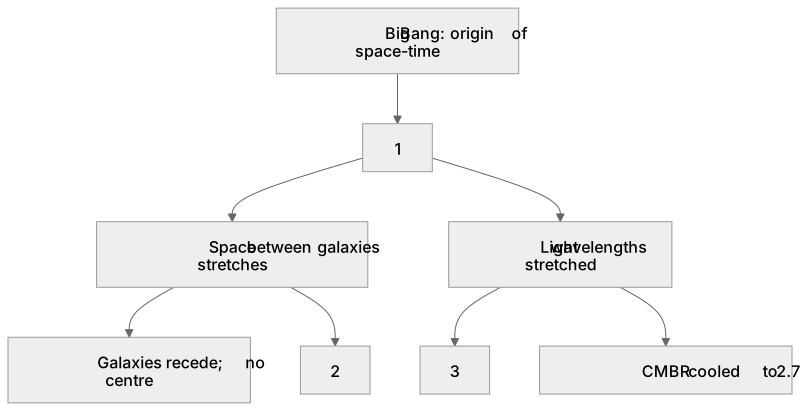
Some boxes have lost their names. Pick the right name for each number.
1Box 1
2Box 2
3Box 3
There is more to this lesson
The full lesson goes on to check your understanding and help you earn the marks. Create a free account to carry on, with your progress saved.
A week of Premium from your first lesson · Then the free plan continues · No card, no charge
Test your understanding of Cosmology: (l) the idea that the Big Bang gave rise to the expansion of space-time
Active recall beats re-reading. Take an instant quiz now to test what you’ve learned and lock it into long-term memory.
A week of Premium from your first lesson · Then the free plan continues · No card, no charge