OCR · A-Level · Physics
Course version: H556 · Version from Sept 2015
(o) current ideas; universe is made up of dark energy, dark matter, and a…
Full specification wording
Cosmology: (o) current ideas; universe is made up of dark energy, dark matter, and a small percentage of ordinary matter.
Current cosmological models describe the universe as dominated by components that cannot be seen directly.
Checked against the OCR H556 specification (opens in a new tab) on .
- Point 17 of 17
- 4 key terms
Study notes
From the checked teaching notes for this specification point.
The idea
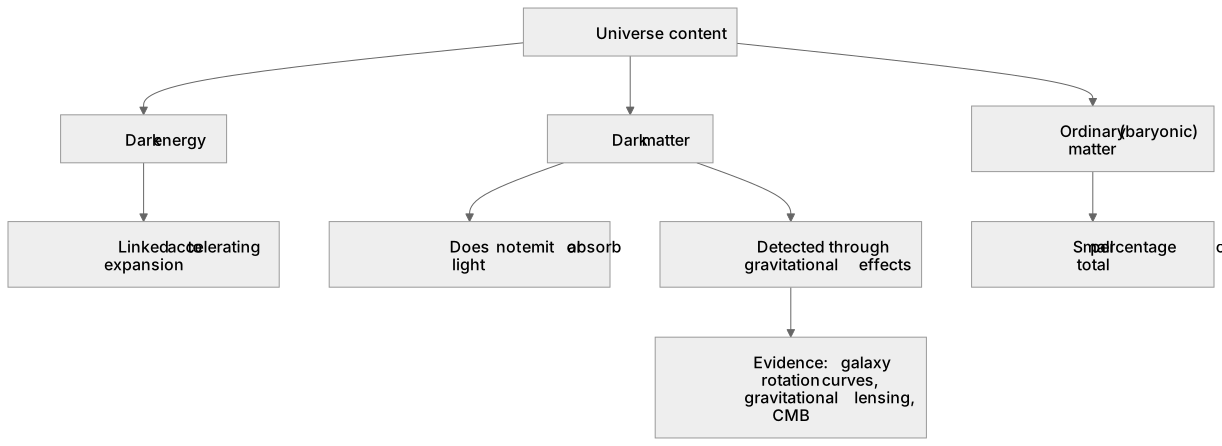
Current cosmological models describe the universe as dominated by components that cannot be seen directly. Ordinary (baryonic) matter, the atoms of stars, planets and gas, makes up only a small percentage of the total content, roughly 5%. Dark matter, roughly 27%, does not emit or absorb light but exerts gravity; evidence includes galaxy rotation curves and gravitational lensing. Dark energy, roughly 68%, is associated with the accelerating expansion of the universe. These proportions come from combining observations such as the CMB, supernova distances and galaxy surveys, and they remain an active area of research.
What earns the marks
- States that ordinary (baryonic) matter is only a small percentage of the universe's content, of the order of 5%.
- Describes dark matter as matter that does not emit or absorb light but is detected through its gravitational effects.
- Describes dark energy as the component linked to the accelerating expansion of the universe.
- Gives approximate proportions: dark energy about 68%, dark matter about 27% and ordinary matter about 5%.
- Supports the ideas with evidence such as galaxy rotation curves, gravitational lensing or the CMB.
Common mistakes and how to put them right
Confusing dark matter with dark energy.
Put it right: Dark matter clumps gravitationally, while dark energy is linked to accelerated expansion.
Describing dark matter as simply black or invisible ordinary matter.
Put it right: It is a distinct, non-luminous form of matter.
Claiming ordinary matter is the largest component.
Put it right: It is only a small percentage of the total.
Treating the quoted percentages as exact, fixed values rather than current best estimates with uncertainties.
Exam tips
- Learn the approximate proportions and use them to compare the three components.
- For each component, give one piece of observational evidence and what it shows.
- Use cautious language such as 'current models suggest' because these ideas are still being tested.
Try the lesson
The start of the Cosmology: (o) current ideas; universe is made up of dark energy, dark matter, and a small percentage of ordinary matter. lesson, made from checked teaching notes for this specification point.
Listen
Current cosmological models describe the universe as dominated by components that cannot be seen directly. Ordinary (baryonic) matter, the atoms of stars, planets and gas, makes up only a small percentage of the total content, roughly 5%. Dark matter, roughly 27%, does not emit or absorb light but exerts gravity; evidence includes galaxy rotation curves and gravitational lensing. Dark energy, roughly 68%, is associated with the accelerating expansion of the universe. These proportions come from combining observations such as the CMB, supernova distances and galaxy surveys, and they remain an active area of research. A strong answer earns marks for these points. States that ordinary (baryonic) matter is only a small percentage of the universe's content, of the order of 5%. Describes dark matter as matter that does not emit or absorb light but is detected through its gravitational effects. Describes dark energy as the component linked to the accelerating expansion of the universe. Gives approximate proportions: dark energy about 68%, dark matter about 27% and ordinary matter about 5%. Exam tip: Learn the approximate proportions and use them to compare the three components.
See it
Key words
Say what each word means before you turn the card.
Composition of the universe
Try answering aloud or in your head before turning the card.
Dark matter and its gravitational evidence
Try answering aloud or in your head before turning the card.
Dark energy and accelerated expansion
Try answering aloud or in your head before turning the card.
Observational cosmology and current models
Try answering aloud or in your head before turning the card.
See every definition
- Composition of the universe
- The universe is made up of dark energy, dark matter, and a small percentage of ordinary matter.
- Dark matter and its gravitational evidence
- Matter that does not emit or absorb light but exerts gravity, with evidence including galaxy rotation curves and gravitational lensing.
- Dark energy and accelerated expansion
- The component associated with the accelerating expansion of the universe.
- Observational cosmology and current models
- These proportions come from combining observations such as the CMB, supernova distances and galaxy surveys, and they remain an active area of research.
Label the diagram
Some boxes have lost their names. Pick the right name for each number.
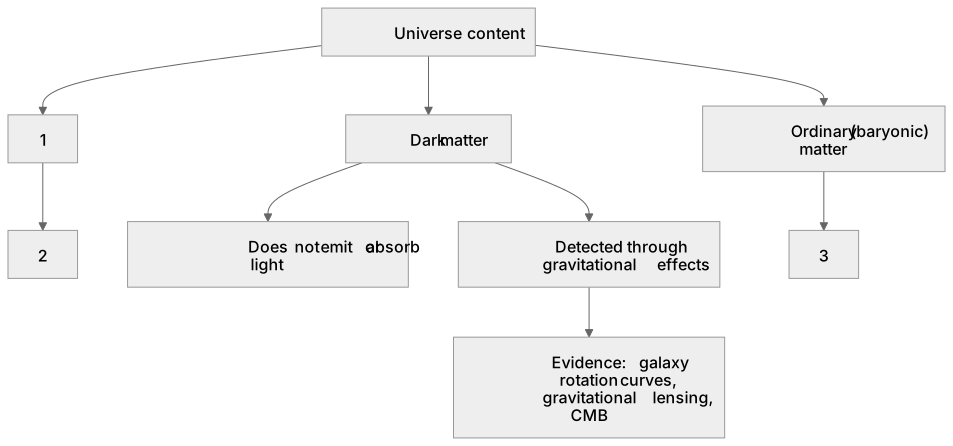
1Box 1
2Box 2
3Box 3
There is more to this lesson
The full lesson goes on to check your understanding and help you earn the marks. Create a free account to carry on, with your progress saved.
A week of Premium from your first lesson · Then the free plan continues · No card, no charge
Test your understanding of Cosmology: (o) current ideas; universe is made up of dark energy, dark matter, and a small percentage of ordinary matter.
Active recall beats re-reading. Take an instant quiz now to test what you’ve learned and lock it into long-term memory.
A week of Premium from your first lesson · Then the free plan continues · No card, no charge