OCR · A-Level · Physics
Course version: H556 · Version from Sept 2015
Cosmology: (n) evolution of the universe after the Big Bang to the present
After the Big Bang the universe expanded and cooled, passing through a sequence of stages.
Checked against the OCR H556 specification (opens in a new tab) on .
- Point 16 of 17
- 4 key terms
Study notes
From the checked teaching notes for this specification point.
The idea
After the Big Bang the universe expanded and cooled, passing through a sequence of stages. In the first minutes, protons and neutrons formed and fused into light nuclei such as hydrogen, helium and traces of lithium (Big Bang nucleosynthesis). After roughly 380 000 years the universe cooled enough for electrons and nuclei to combine into neutral atoms, so radiation could travel freely; this radiation is now the cosmic microwave background (CMB), cooled to about 2.7 K. Gravity then pulled matter into stars and galaxies, and later expansion accelerated. Evidence for this sequence includes the CMB, the observed abundances of light elements, and the redshifting of distant galaxies.
What earns the marks
- Describes an initial hot, dense state that has expanded and cooled over about 1.4 × 10¹⁰ years.
- Places Big Bang nucleosynthesis in the first minutes, forming light nuclei such as hydrogen and helium.
- States that recombination at about 380 000 years released radiation that is now the cosmic microwave background at about 2.7 K.
- Explains that gravitational clumping of matter formed stars and galaxies, and that expansion later accelerated.
- Links at least one piece of evidence (CMB, light-element abundances or galactic redshift) to the model.
Common mistakes and how to put them right
Describing the Big Bang as an explosion of matter into empty space.
Put it right: It was the expansion of space itself, with matter and energy spread throughout.
Placing the formation of stars and galaxies before recombination.
Put it right: Galaxies formed after the CMB was released.
Claiming the CMB comes from the Big Bang itself rather than from recombination about 380 000 years later.
Treating the 2.7 K CMB temperature as its original value.
Put it right: It has cooled as the universe expanded.
Exam tips
- Use a clear time sequence: nucleosynthesis, recombination and the CMB, then galaxy formation and accelerated expansion.
- Name the evidence explicitly and say what each observation supports.
- Keep numerical values approximate and sensible; exact figures are not required, but the order of events is.
Try the lesson
The start of the Cosmology: (n) evolution of the universe after the Big Bang to the present lesson, made from checked teaching notes for this specification point.
Listen
After the Big Bang the universe expanded and cooled, passing through a sequence of stages. In the first minutes, protons and neutrons formed and fused into light nuclei such as hydrogen, helium and traces of lithium (Big Bang nucleosynthesis). After roughly 380 000 years the universe cooled enough for electrons and nuclei to combine into neutral atoms, so radiation could travel freely; this radiation is now the cosmic microwave background (CMB), cooled to about 2.7 K. Gravity then pulled matter into stars and galaxies, and later expansion accelerated. Evidence for this sequence includes the CMB, the observed abundances of light elements, and the redshifting of distant galaxies. A strong answer earns marks for these points. Describes an initial hot, dense state that has expanded and cooled over about 1.4 × 10¹⁰ years. Places Big Bang nucleosynthesis in the first minutes, forming light nuclei such as hydrogen and helium. States that recombination at about 380 000 years released radiation that is now the cosmic microwave background at about 2.7 K. Explains that gravitational clumping of matter formed stars and galaxies, and that expansion later accelerated. Exam tip: Use a clear time sequence: nucleosynthesis, recombination and the CMB, then galaxy formation and accelerated expansion.
See it
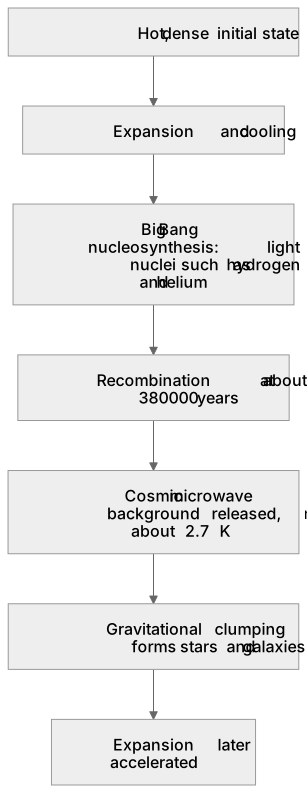
Put it in order
Put these steps in the order they happen.
- 1. Expansion later accelerated
- 2. Gravitational clumping forms stars and galaxies
- 3. Big Bang nucleosynthesis: light nuclei such as hydrogen and helium
- 4. Cosmic microwave background released, now about 2.7 K
- 5. Hot, dense initial state
- 6. Expansion and cooling
- 7. Recombination at about 380 000 years
Key words
Say what each word means before you turn the card.
Big Bang nucleosynthesis
Try answering aloud or in your head before turning the card.
Cosmic microwave background
Try answering aloud or in your head before turning the card.
Recombination
Try answering aloud or in your head before turning the card.
Evolution of the universe
Try answering aloud or in your head before turning the card.
See every definition
- Big Bang nucleosynthesis
- In the first minutes, protons and neutrons formed and fused into light nuclei such as hydrogen, helium and traces of lithium.
- Cosmic microwave background
- Radiation released at recombination, when electrons and nuclei combined into neutral atoms so radiation could travel freely, now cooled to about 2.7 K.
- Recombination
- After roughly 380 000 years the universe cooled enough for electrons and nuclei to combine into neutral atoms, so radiation could travel freely.
- Evolution of the universe
- After the Big Bang the universe expanded and cooled, passing through a sequence of stages up to the present.
Label the diagram
Some boxes have lost their names. Pick the right name for each number.
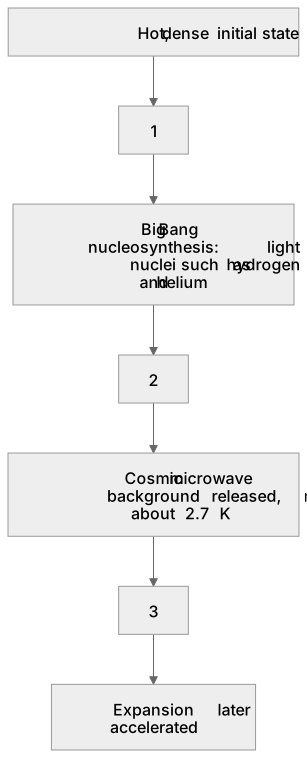
1Box 1
2Box 2
3Box 3
There is more to this lesson
The full lesson goes on to check your understanding and help you earn the marks. Create a free account to carry on, with your progress saved.
A week of Premium from your first lesson · Then the free plan continues · No card, no charge
Test your understanding of Cosmology: (n) evolution of the universe after the Big Bang to the present
Active recall beats re-reading. Take an instant quiz now to test what you’ve learned and lock it into long-term memory.
A week of Premium from your first lesson · Then the free plan continues · No card, no charge