OCR · A-Level · Physics
Course version: H556 · Version from Sept 2015
Damping: (c) resonance; natural frequency
Every oscillatory system has a natural frequency, the frequency at which it oscillates freely once displaced.
Checked against the OCR H556 specification (opens in a new tab) on .
- Point 3 of 5
- 4 key terms
Study notes
From the checked teaching notes for this specification point.
The idea
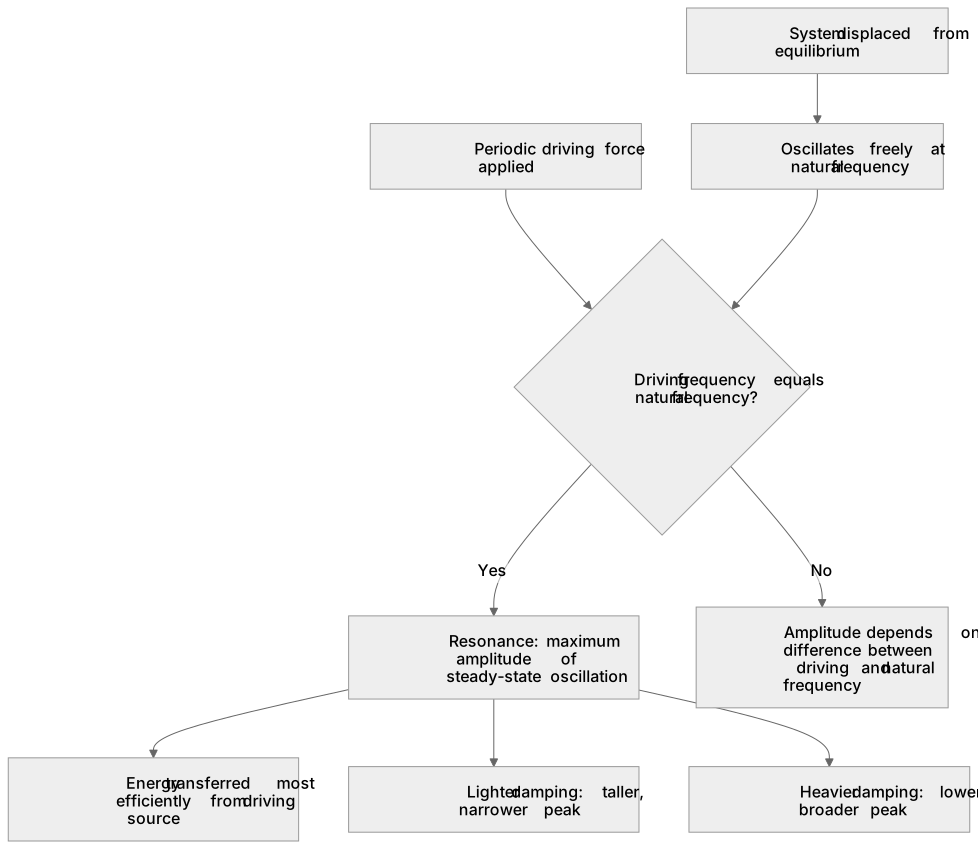
Every oscillatory system has a natural frequency, the frequency at which it oscillates freely once displaced. Resonance occurs when a periodic driving force is applied at a frequency equal to the natural frequency, producing a maximum amplitude of the steady-state oscillation. The sharpness and height of the resonant peak depend on the damping: lighter damping gives a taller, narrower peak, while heavier damping gives a lower, broader one.
For example: A mass on a spring driven at its natural frequency swings with maximum amplitude, and adding a damping vane reduces that maximum.
What earns the marks
- The natural frequency of a system is the frequency at which it oscillates freely after being displaced from equilibrium.
- Resonance occurs when the driving frequency equals the natural frequency, giving maximum amplitude of the steady-state oscillation.
- The amplitude of the driven oscillation depends on the difference between the driving frequency and the natural frequency.
- Increasing the damping lowers and broadens the resonant peak, while decreasing the damping makes the peak taller and narrower.
- At resonance, energy is transferred most efficiently from the driving source to the oscillating system.
Common mistakes and how to put them right
Defining resonance as any large oscillation.
Put it right: Resonance specifically requires the driving frequency to equal the natural frequency.
Confusing natural frequency with driving frequency.
Put it right: The natural frequency belongs to the system itself, while the driving frequency is set by the external periodic force.
Thinking that damping increases the height of the resonant peak.
Put it right: Greater damping lowers and broadens the peak; lighter damping gives a taller, narrower peak.
Assuming resonance always causes destructive effects.
Put it right: Resonance can be useful, for example in musical instruments, as well as hazardous, for example in structures.
Exam tips
- State clearly that resonance occurs when driving frequency equals natural frequency, and link this to maximum amplitude.
- When describing the effect of damping on the resonant peak, mention both height and width to show full understanding.
- Use a labelled amplitude–frequency graph to support your explanation, marking the natural frequency and the peak.
Try the lesson
The start of the Damping: (c) resonance; natural frequency lesson, made from checked teaching notes for this specification point.
Listen
Every oscillatory system has a natural frequency, the frequency at which it oscillates freely once displaced. Resonance occurs when a periodic driving force is applied at a frequency equal to the natural frequency, producing a maximum amplitude of the steady-state oscillation. The sharpness and height of the resonant peak depend on the damping: lighter damping gives a taller, narrower peak, while heavier damping gives a lower, broader one. For example, a mass on a spring driven at its natural frequency swings with maximum amplitude, and adding a damping vane reduces that maximum. A strong answer earns marks for these points. The natural frequency of a system is the frequency at which it oscillates freely after being displaced from equilibrium. Resonance occurs when the driving frequency equals the natural frequency, giving maximum amplitude of the steady-state oscillation. The amplitude of the driven oscillation depends on the difference between the driving frequency and the natural frequency. Increasing the damping lowers and broadens the resonant peak, while decreasing the damping makes the peak taller and narrower. A common slip: Defining resonance as any large oscillation. Instead, resonance specifically requires the driving frequency to equal the natural frequency. Exam tip: State clearly that resonance occurs when driving frequency equals natural frequency, and link this to maximum amplitude.
See it
Key words
Say what each word means before you turn the card.
Natural frequency of an oscillatory system
Try answering aloud or in your head before turning the card.
Resonance and maximum amplitude
Try answering aloud or in your head before turning the card.
The effect of damping on the resonant peak
Try answering aloud or in your head before turning the card.
Energy transfer at resonance
Try answering aloud or in your head before turning the card.
See every definition
- Natural frequency of an oscillatory system
- The frequency at which a system oscillates freely once displaced.
- Resonance and maximum amplitude
- Occurs when a periodic driving force is applied at a frequency equal to the natural frequency, producing a maximum amplitude of the steady-state oscillation.
- The effect of damping on the resonant peak
- Lighter damping gives a taller, narrower peak, while heavier damping gives a lower, broader one.
- Energy transfer at resonance
- At resonance, energy is transferred most efficiently from the driving source to the oscillating system.
Label the diagram
Some boxes have lost their names. Pick the right name for each number.
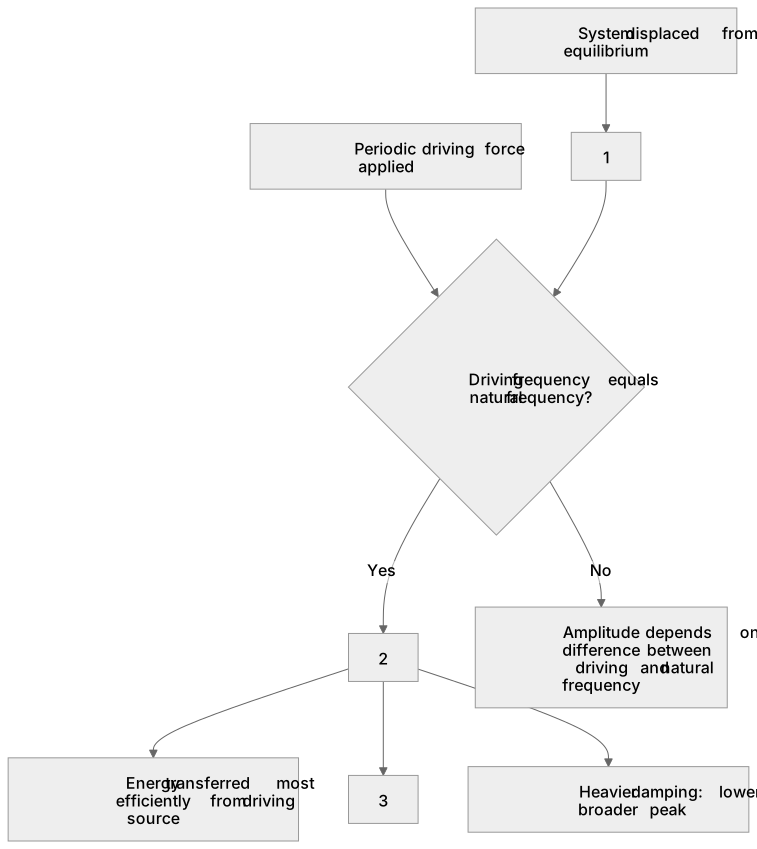
1Box 1
2Box 2
3Box 3
There is more to this lesson
The full lesson goes on to check your understanding and help you earn the marks. Create a free account to carry on, with your progress saved.
A week of Premium from your first lesson · Then the free plan continues · No card, no charge
Test your understanding of Damping: (c) resonance; natural frequency
Active recall beats re-reading. Take an instant quiz now to test what you’ve learned and lock it into long-term memory.
A week of Premium from your first lesson · Then the free plan continues · No card, no charge