OCR · A-Level · Physics
Course version: H556 · Version from Sept 2015
Damping: (e) practical examples of forced oscillations and resonance.
A forced oscillation occurs when a periodic driving force is applied to a system, which then oscillates at the driving frequency.
Checked against the OCR H556 specification (opens in a new tab) on .
- Point 5 of 5
- 3 key terms
Study notes
From the checked teaching notes for this specification point.
The idea
A forced oscillation occurs when a periodic driving force is applied to a system, which then oscillates at the driving frequency. Resonance is the large-amplitude response when that driving frequency is equal to the system's natural frequency. Practical examples include a child on a swing pushed at the natural frequency, Barton's pendulums where a driver pendulum excites others of the same length, a washing machine drum shaking violently at a specific spin speed, and a bridge or building responding to wind or earthquakes. In each case, identify the driver, the driven oscillator, the natural frequency and the damping that limits the maximum amplitude. Damping removes energy from the system, preventing the resonant amplitude from increasing indefinitely and slightly reducing the resonant frequency.
What earns the marks
- A forced oscillation requires an external periodic driving force acting on the oscillator.
- Resonance occurs when the driving frequency matches the natural frequency of the system.
- The steady-state amplitude depends on the driving frequency and on the damping present.
- Practical examples include a swing pushed in time, Barton's pendulums, a washing machine at a critical spin speed, and structures responding to wind or seismic waves.
- Damping controls the resonant amplitude and can be desirable, for example in car suspension or building design.
Common mistakes and how to put them right
Describing resonance as any large vibration rather than a response to a driving frequency matching the natural frequency.
Forgetting the driving force and treating a free oscillation as a forced oscillation.
Ignoring damping and claiming the amplitude grows without limit in a real system.
Citing microwave heating of water as resonance.
Put it right: Microwaves heat via dielectric heating, not resonance.
Exam tips
- Name the driver, the driven system and the natural frequency in each example.
- Use the phrase 'driving frequency equals the natural frequency' when defining resonance.
- Mention damping when explaining why real resonant amplitudes are finite.
Try the lesson
The start of the Damping: (e) practical examples of forced oscillations and resonance. lesson, made from checked teaching notes for this specification point.
Listen
A forced oscillation occurs when a periodic driving force is applied to a system, which then oscillates at the driving frequency. Resonance is the large-amplitude response when that driving frequency is equal to the system's natural frequency. Practical examples include a child on a swing pushed at the natural frequency, Barton's pendulums where a driver pendulum excites others of the same length, a washing machine drum shaking violently at a specific spin speed, and a bridge or building responding to wind or earthquakes. In each case, identify the driver, the driven oscillator, the natural frequency and the damping that limits the maximum amplitude. Damping removes energy from the system, preventing the resonant amplitude from increasing indefinitely and slightly reducing the resonant frequency. A strong answer earns marks for these points. A forced oscillation requires an external periodic driving force acting on the oscillator. Resonance occurs when the driving frequency matches the natural frequency of the system. The steady-state amplitude depends on the driving frequency and on the damping present. Practical examples include a swing pushed in time, Barton's pendulums, a washing machine at a critical spin speed, and structures responding to wind or seismic waves. A common slip: Citing microwave heating of water as resonance: the error is thinking microwaves match a natural frequency. Instead, microwaves heat via dielectric heating, not resonance. Exam tip: Name the driver, the driven system and the natural frequency in each example.
See it
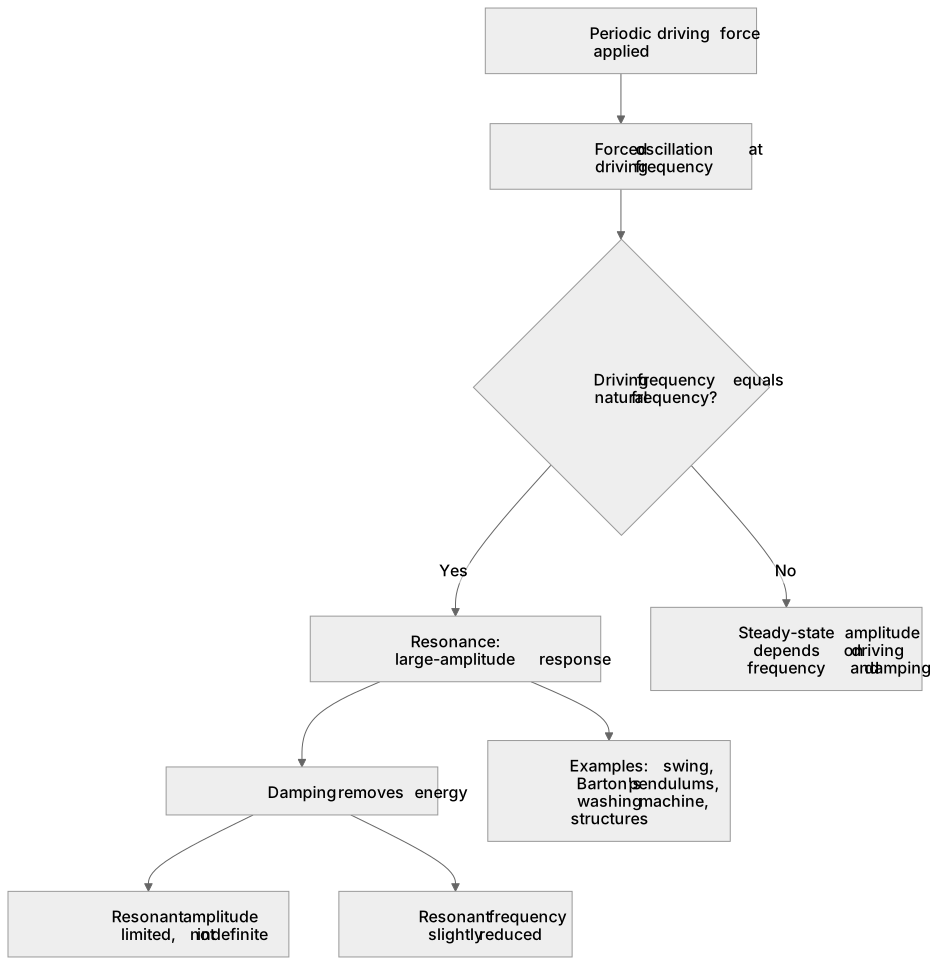
Key words
Say what each word means before you turn the card.
Forced oscillation
Try answering aloud or in your head before turning the card.
Resonance
Try answering aloud or in your head before turning the card.
Damping
Try answering aloud or in your head before turning the card.
See every definition
- Forced oscillation
- A periodic driving force is applied to a system, which then oscillates at the driving frequency.
- Resonance
- The large-amplitude response when the driving frequency is equal to the system's natural frequency.
- Damping
- Removes energy from the system, preventing the resonant amplitude from increasing indefinitely and slightly reducing the resonant frequency.
Label the diagram
Some boxes have lost their names. Pick the right name for each number.
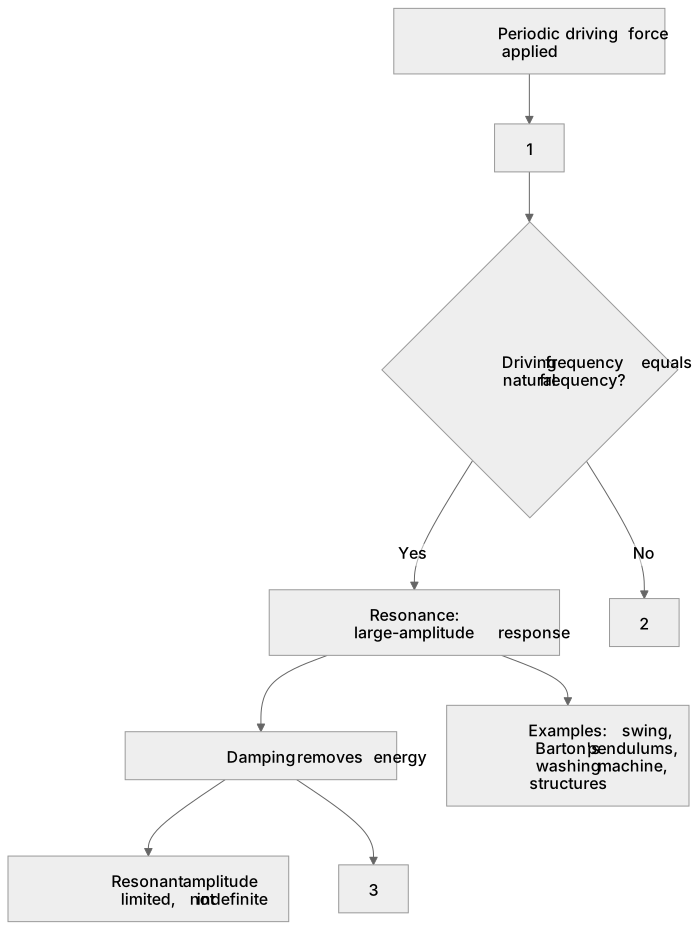
1Box 1
2Box 2
3Box 3
There is more to this lesson
The full lesson goes on to check your understanding and help you earn the marks. Create a free account to carry on, with your progress saved.
A week of Premium from your first lesson · Then the free plan continues · No card, no charge
Test your understanding of Damping: (e) practical examples of forced oscillations and resonance.
Active recall beats re-reading. Take an instant quiz now to test what you’ve learned and lock it into long-term memory.
A week of Premium from your first lesson · Then the free plan continues · No card, no charge