OCR · A-Level · Physics
Course version: H556 · Version from Sept 2015
(a) medical tracers; technetium–99m and fluorine–18
Full specification wording
Diagnostic methods in medicine: (a) medical tracers; technetium–99m and fluorine–18
A medical tracer is a radioactive substance introduced into the body so that its emitted radiation can be detected outside and used to image or monitor an organ.
Checked against the OCR H556 specification (opens in a new tab) on .
- Point 1 of 5
- 3 key terms
Study notes
From the checked teaching notes for this specification point.
The idea
A medical tracer is a radioactive substance introduced into the body so that its emitted radiation can be detected outside and used to image or monitor an organ. The tracer must be taken up by the target tissue, emit radiation that escapes the body, and have a suitable half-life: long enough to complete the investigation but short enough to limit the patient's dose. Technetium–99m is widely used because it emits gamma radiation, has a half-life of about 6 hours, and can be attached to many pharmaceuticals that target specific organs. Fluorine–18 is used in positron emission tomography because it emits positrons; when a positron meets an electron, two gamma photons are produced in opposite directions and detected in coincidence. Its half-life of about 110 minutes suits imaging of metabolic activity, for example in the brain or in tumours.
What earns the marks
- A medical tracer is a radioactive substance introduced into the body whose emitted radiation is detected externally to image or monitor an organ.
- Technetium–99m emits gamma radiation, has a half-life of about 6 hours, and can be attached to pharmaceuticals that target specific organs.
- Fluorine–18 emits positrons and is used in positron emission tomography, where annihilation produces two gamma photons detected in coincidence.
- A suitable tracer must be taken up by the target tissue and must emit radiation that can escape the body.
- The half-life must be long enough for the investigation but short enough to limit the radiation dose to the patient.
Common mistakes and how to put them right
Thinking the tracer must emit alpha or beta radiation that is detected outside the body.
Put it right: Gamma radiation is used because it penetrates tissue and can be detected externally.
Believing a longer half-life is always better.
Put it right: A half-life that is too long leaves the patient exposed for longer, so it must be matched to the investigation.
Confusing technetium–99m with fluorine–18.
Put it right: Technetium–99m is a gamma emitter used in single-photon imaging, while fluorine–18 is a positron emitter used in PET.
Assuming any radioactive substance can be a tracer.
Put it right: It must be chemically taken up by the target tissue and must not be toxic.
Exam tips
- Match each tracer to its emission and imaging method: technetium–99m to gamma imaging, fluorine–18 to positron emission tomography.
- Justify the half-life in terms of completing the investigation while limiting the patient's radiation dose.
- State that the tracer must be taken up by the target organ so that the image shows that organ.
Try the lesson
The start of the Diagnostic methods in medicine: (a) medical tracers; technetium–99m and fluorine–18 lesson, made from checked teaching notes for this specification point.
Listen
A medical tracer is a radioactive substance introduced into the body so that its emitted radiation can be detected outside and used to image or monitor an organ. The tracer must be taken up by the target tissue, emit radiation that escapes the body, and have a suitable half-life: long enough to complete the investigation but short enough to limit the patient's dose. Technetium–99m is widely used because it emits gamma radiation, has a half-life of about 6 hours, and can be attached to many pharmaceuticals that target specific organs. Fluorine–18 is used in positron emission tomography because it emits positrons; when a positron meets an electron, two gamma photons are produced in opposite directions and detected in coincidence. Its half-life of about 110 minutes suits imaging of metabolic activity, for example in the brain or in tumours. A strong answer earns marks for these points. A medical tracer is a radioactive substance introduced into the body whose emitted radiation is detected externally to image or monitor an organ. Technetium–99m emits gamma radiation, has a half-life of about 6 hours, and can be attached to pharmaceuticals that target specific organs. Fluorine–18 emits positrons and is used in positron emission tomography, where annihilation produces two gamma photons detected in coincidence. A suitable tracer must be taken up by the target tissue and must emit radiation that can escape the body. Exam tip: Match each tracer to its emission and imaging method: technetium–99m to gamma imaging, fluorine–18 to positron emission tomography.
See it
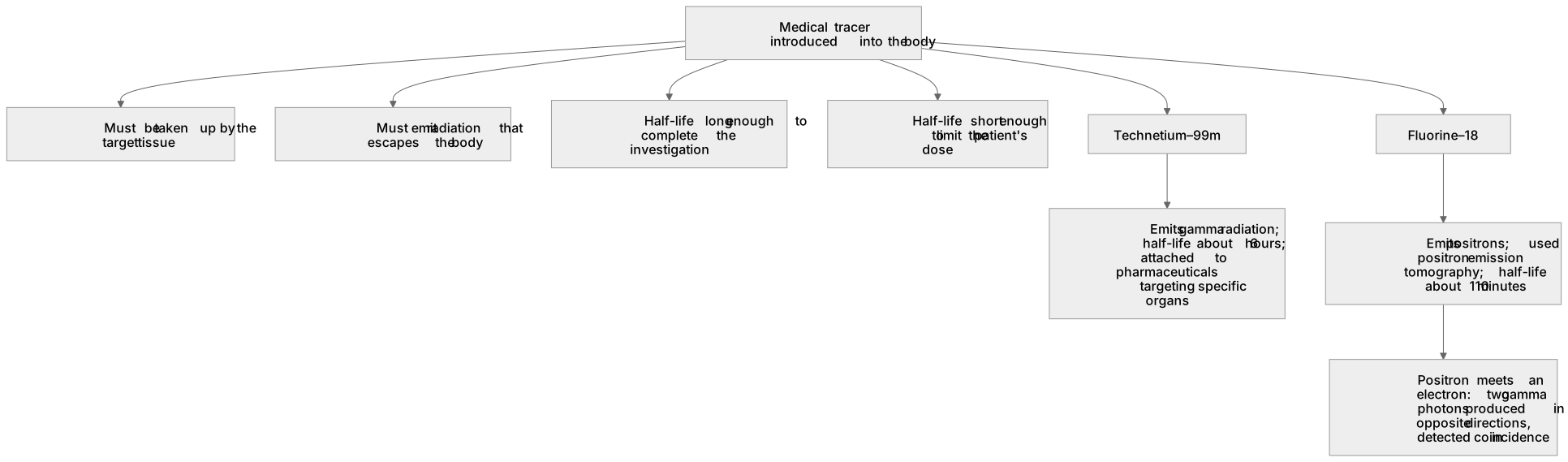
Key words
Say what each word means before you turn the card.
Medical tracer
Try answering aloud or in your head before turning the card.
Technetium–99m
Try answering aloud or in your head before turning the card.
Fluorine–18
Try answering aloud or in your head before turning the card.
See every definition
- Medical tracer
- A radioactive substance introduced into the body so that its emitted radiation can be detected outside and used to image or monitor an organ.
- Technetium–99m
- A tracer that emits gamma radiation, has a half-life of about 6 hours, and can be attached to many pharmaceuticals that target specific organs.
- Fluorine–18
- A tracer used in positron emission tomography because it emits positrons; when a positron meets an electron, two gamma photons are produced in opposite directions and detected in coincidence.
Label the diagram
Some boxes have lost their names. Pick the right name for each number.
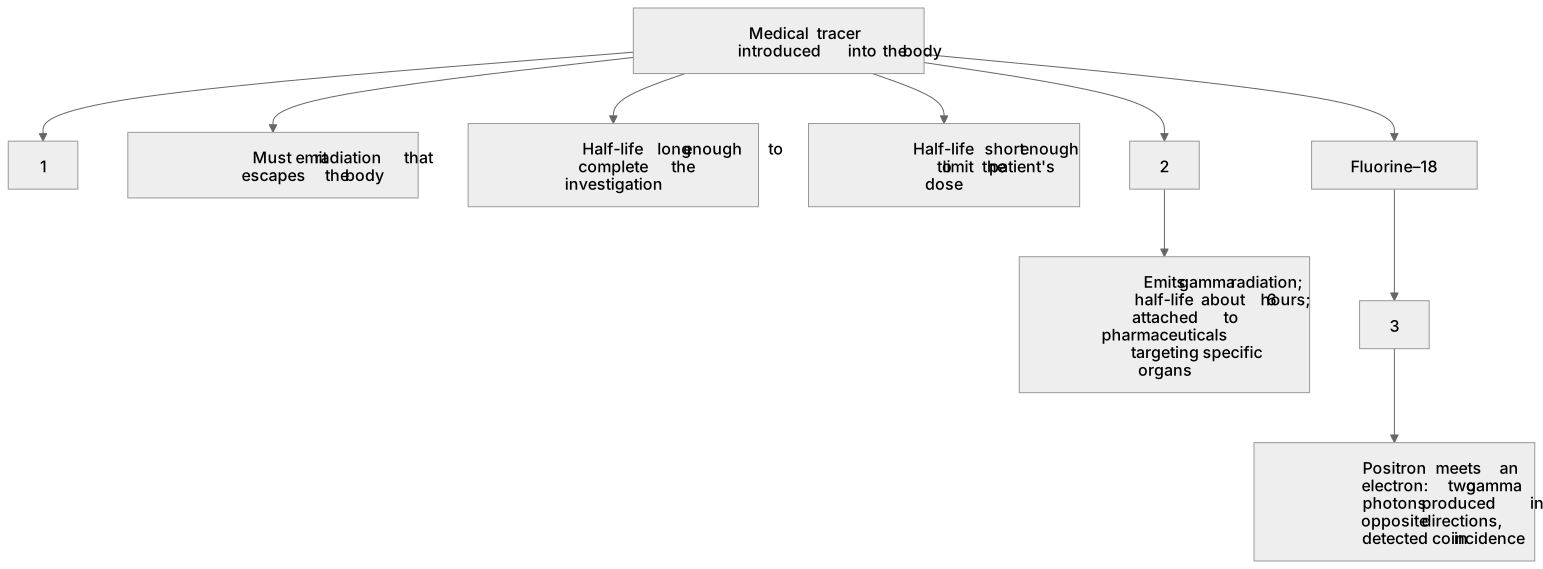
1Box 1
2Box 2
3Box 3
There is more to this lesson
The full lesson goes on to check your understanding and help you earn the marks. Create a free account to carry on, with your progress saved.
A week of Premium from your first lesson · Then the free plan continues · No card, no charge
Test your understanding of Diagnostic methods in medicine: (a) medical tracers; technetium–99m and fluorine–18
Active recall beats re-reading. Take an instant quiz now to test what you’ve learned and lock it into long-term memory.
A week of Premium from your first lesson · Then the free plan continues · No card, no charge