OCR · A-Level · Physics
Course version: H556 · Version from Sept 2015
Dynamics: (c) weight of an object; W = mg
Weight is the gravitational force acting on an object, calculated as W = mg, where m is mass in kilograms and g is gravitational field strength in newtons per kilogram (N kg⁻¹).
Checked against the OCR H556 specification (opens in a new tab) on .
- Point 3 of 10
Study notes
From the checked teaching notes for this specification point.
The idea
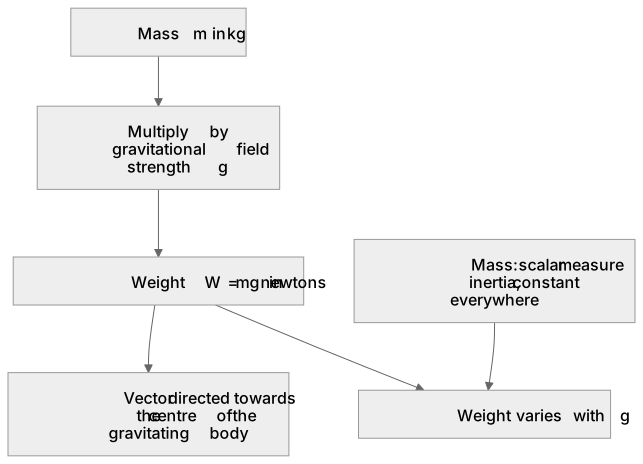
Weight is the gravitational force acting on an object, calculated as W = mg, where m is mass in kilograms and g is gravitational field strength in newtons per kilogram (N kg⁻¹). On Earth, g ≈ 9.81 N kg⁻¹, so a 2.0 kg mass has weight W = 2.0 × 9.81 = 19.62 N. Weight is a vector directed towards the centre of the gravitating body. Mass is a scalar measure of inertia, constant everywhere, while weight varies with g. Always convert grams to kilograms before substituting. The equation applies to a uniform gravitational field, which is a good approximation near a planet's surface.
What earns the marks
- Weight is the gravitational force on an object, given by W = mg.
- m is mass in kg; g is gravitational field strength in N kg⁻¹.
- Weight is a vector directed towards the centre of the gravitating body.
- Mass is a scalar and constant; weight varies with gravitational field strength.
- Typical value on Earth: g ≈ 9.81 N kg⁻¹, so W = mg gives weight in newtons.
- Correct unit conversion: 1 g = 1 × 10⁻³ kg before substitution.
Common mistakes and how to put them right
Confusing mass and weight.
Put it right by stating W = mg and using newtons for weight.
Using grams directly in W = mg.
Put it right by converting mass to kilograms first.
Treating g as 10 N kg⁻¹ when the question expects 9.81 N kg⁻¹.
Put it right by using the value given or the standard 9.81 N kg⁻¹ unless told otherwise.
Thinking weight is always the same everywhere.
Put it right by recognising g varies.
Exam tips
- Underline the mass value and its unit in the question; convert to kg immediately if it is in grams.
- Write the equation W = mg, substitute numbers with units, and give the answer in newtons.
- Check whether the question asks for weight or mass; the unit N indicates weight, kg indicates mass.
Try the lesson
The start of the Dynamics: (c) weight of an object; W = mg lesson, made from checked teaching notes for this specification point.
Listen
Weight is the gravitational force acting on an object, calculated as W = mg, where m is mass in kilograms and g is gravitational field strength in newtons per kilogram (N kg⁻¹). On Earth, g ≈ 9.81 N kg⁻¹, so a 2.0 kg mass has weight W = 2.0 × 9.81 = 19.62 N. Weight is a vector directed towards the centre of the gravitating body. Mass is a scalar measure of inertia, constant everywhere, while weight varies with g. Always convert grams to kilograms before substituting. The equation applies to a uniform gravitational field, which is a good approximation near a planet's surface. A strong answer earns marks for these points. Weight is the gravitational force on an object, given by W = mg. m is mass in kg; g is gravitational field strength in N kg⁻¹. Weight is a vector directed towards the centre of the gravitating body. Mass is a scalar and constant; weight varies with gravitational field strength. A common slip: Confusing mass and weight: mass is a scalar measure of inertia in kg, while weight is a force in N. Instead, stating W = mg and using newtons for weight. Exam tip: Underline the mass value and its unit in the question; convert to kg immediately if it is in grams.
See it
Label the diagram
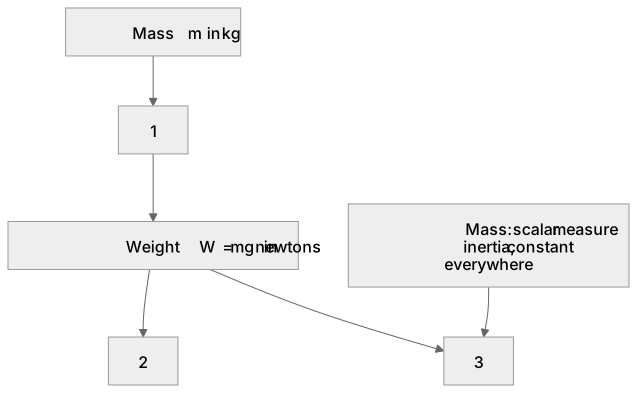
Some boxes have lost their names. Pick the right name for each number.
1Box 1
2Box 2
3Box 3
There is more to this lesson
The full lesson goes on to check your understanding and help you earn the marks. Create a free account to carry on, with your progress saved.
A week of Premium from your first lesson · Then the free plan continues · No card, no charge
Test your understanding of Dynamics: (c) weight of an object; W = mg
Active recall beats re-reading. Take an instant quiz now to test what you’ve learned and lock it into long-term memory.
A week of Premium from your first lesson · Then the free plan continues · No card, no charge