OCR · A-Level · Physics
Course version: H556 · Version from Sept 2015
(c) Faraday’s law of electromagnetic induction and Lenz’s law
Full specification wording
Electromagnetism: (c) Faraday’s law of electromagnetic induction and Lenz’s law
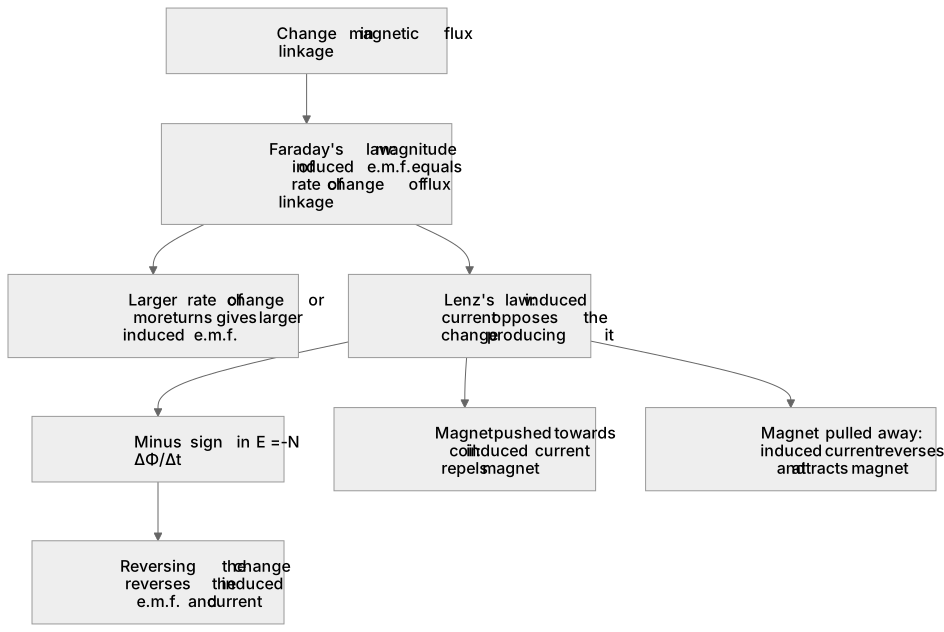
Faraday's law states that the magnitude of an induced e.m.f. equals the rate of change of magnetic flux linkage, so a faster change or a larger change in NΦ gives a larger e.m.f.
Checked against the OCR H556 specification (opens in a new tab) on .
- Point 3 of 8
- 3 key terms
Study notes
From the checked teaching notes for this specification point.
The idea
Faraday's law states that the magnitude of an induced e.m.f. equals the rate of change of magnetic flux linkage, so a faster change or a larger change in NΦ gives a larger e.m.f. Lenz's law states that the induced e.m.f. drives a current whose magnetic effect opposes the change producing it, which is why the minus sign appears in E = −N ΔΦ/Δt. For example, pushing a magnet towards a coil induces a current whose field repels the approaching magnet; pulling it away reverses the induced current so it attracts the receding magnet. Together the laws explain the direction and size of induced e.m.f. and current in generators, transformers and moving conductors.
What earns the marks
- Faraday's law: the magnitude of the induced e.m.f. is equal to the rate of change of magnetic flux linkage, |E| = N |ΔΦ/Δt|.
- Lenz's law: the induced e.m.f. and resulting current act in a direction that opposes the change in flux linkage producing them.
- The minus sign in E = −N ΔΦ/Δt expresses Lenz's law and indicates the opposing direction of the induced e.m.f.
- A larger rate of change of flux linkage, for example by faster motion or more turns, produces a larger induced e.m.f.
- Reversing the direction of the change in flux linkage reverses the direction of the induced e.m.f. and current.
Common mistakes and how to put them right
Stating that the induced e.m.f. equals the flux linkage rather than its rate of change.
Put it right: e.m.f. depends on how quickly flux linkage changes.
Ignoring the minus sign or treating it as an arithmetic detail.
Put it right: The sign represents Lenz's law and the opposing direction of the induced effect.
Claiming that Lenz's law opposes the flux itself rather than the change in flux.
Put it right: The induced current opposes the change producing it.
Exam tips
- Quote Faraday's law in words and as an equation before applying it to a numerical change in flux linkage.
- Use Lenz's law to justify the direction of an induced current by identifying what change is being opposed.
- When calculating, find the change in flux linkage and divide by the time interval, keeping the sign to show direction.
Try the lesson
The start of the Electromagnetism: (c) Faraday’s law of electromagnetic induction and Lenz’s law lesson, made from checked teaching notes for this specification point.
Listen
Faraday's law states that the magnitude of an induced e.m.f. equals the rate of change of magnetic flux linkage, so a faster change or a larger change in NΦ gives a larger e.m.f. Lenz's law states that the induced e.m.f. drives a current whose magnetic effect opposes the change producing it, which is why the minus sign appears in E = −N ΔΦ/Δt. For example, pushing a magnet towards a coil induces a current whose field repels the approaching magnet; pulling it away reverses the induced current so it attracts the receding magnet. Together the laws explain the direction and size of induced e.m.f. and current in generators, transformers and moving conductors. A strong answer earns marks for these points. Faraday's law: the magnitude of the induced e.m.f. is equal to the rate of change of magnetic flux linkage, |E| = N |ΔΦ/Δt|. Lenz's law: the induced e.m.f. and resulting current act in a direction that opposes the change in flux linkage producing them. The minus sign in E = −N ΔΦ/Δt expresses Lenz's law and indicates the opposing direction of the induced e.m.f. A larger rate of change of flux linkage, for example by faster motion or more turns, produces a larger induced e.m.f. A common slip: Stating that the induced e.m.f. equals the flux linkage rather than its rate of change. Instead, e.m.f. depends on how quickly flux linkage changes. Exam tip: Quote Faraday's law in words and as an equation before applying it to a numerical change in flux linkage.
See it
Key words
Say what each word means before you turn the card.
Faraday's law
Try answering aloud or in your head before turning the card.
Lenz's law
Try answering aloud or in your head before turning the card.
The minus sign in the induction equation
Try answering aloud or in your head before turning the card.
See every definition
- Faraday's law
- The magnitude of an induced e.m.f. is equal to the rate of change of magnetic flux linkage, so a faster change or a larger change in NΦ gives a larger e.m.f.
- Lenz's law
- The induced e.m.f. drives a current whose magnetic effect opposes the change producing it.
- The minus sign in the induction equation
- In E = −N ΔΦ/Δt it expresses Lenz's law and indicates the opposing direction of the induced e.m.f.
Label the diagram
Some boxes have lost their names. Pick the right name for each number.
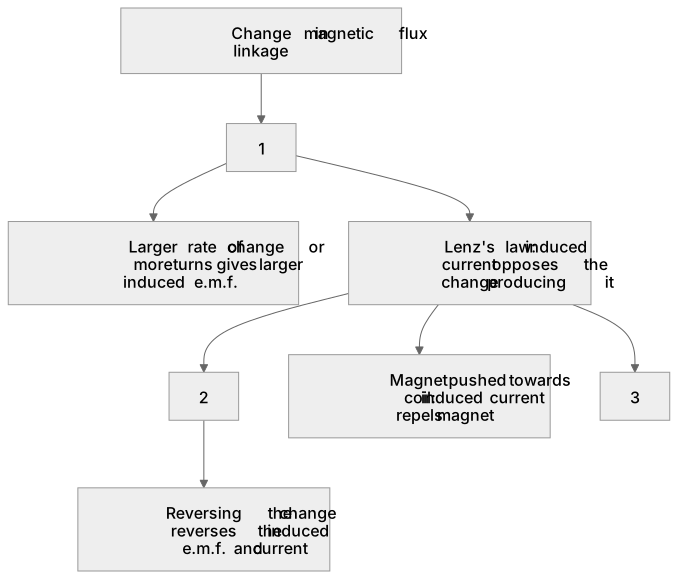
1Box 1
2Box 2
3Box 3
There is more to this lesson
The full lesson goes on to check your understanding and help you earn the marks. Create a free account to carry on, with your progress saved.
A week of Premium from your first lesson · Then the free plan continues · No card, no charge
Test your understanding of Electromagnetism: (c) Faraday’s law of electromagnetic induction and Lenz’s law
Active recall beats re-reading. Take an instant quiz now to test what you’ve learned and lock it into long-term memory.
A week of Premium from your first lesson · Then the free plan continues · No card, no charge