OCR · A-Level · Physics
Course version: H556 · Version from Sept 2015
(ii) techniques and procedures used to investigate magnetic flux using…
Full specification wording
Electromagnetism: (ii) techniques and procedures used to investigate magnetic flux using search coils
A search coil is a small flat coil of N turns and known area A connected to a sensitive meter or data logger.
Checked against the OCR H556 specification (opens in a new tab) on .
- Point 5 of 8
Study notes
From the checked teaching notes for this specification point.
The idea
A search coil is a small flat coil of N turns and known area A connected to a sensitive meter or data logger. Place it in a magnetic field so that its plane is perpendicular to the field; the flux linkage through it is NΦ = NBA. To investigate magnetic flux, rotate or withdraw the coil, or switch the field on and off, so that the flux linkage changes; the induced e.m.f. is proportional to the rate of change of flux linkage. A calibrated search coil in a known field lets you measure flux density B = Φ/A. Record the meter reading against time, note the peak, and compare coils of different N or A.
What earns the marks
- A search coil is a flat coil of N turns and known area A used to sample the magnetic flux in a region.
- With the coil plane perpendicular to the field, the flux linkage is NΦ = NBA.
- Changing the flux linkage, by rotating, withdrawing or switching the field, induces an e.m.f. proportional to the rate of change of flux linkage.
- A calibrated search coil in a known field allows flux density to be found from B = Φ/A.
- The induced e.m.f. can be displayed on a galvanometer, oscilloscope or data logger and its peak compared for different N or A.
Common mistakes and how to put them right
Thinking the search coil measures flux directly.
Put it right: It responds to the rate of change of flux linkage, so a steady field gives no reading.
Confusing flux Φ with flux linkage NΦ.
Put it right: The e.m.f. depends on the change in NΦ, not Φ alone.
Assuming the coil area or number of turns does not matter.
Put it right: Both scale the flux linkage and hence the induced e.m.f.
Forgetting to keep the coil plane perpendicular to the field when measuring flux density, which reduces the effective flux.
Exam tips
- State the orientation of the coil relative to the field before quoting NΦ = NBA.
- Link any observed meter deflection to a change in flux linkage, not to the field being present.
- When comparing results, keep either N or A constant so the effect of the other is clear.
Try the lesson
The start of the Electromagnetism: (ii) techniques and procedures used to investigate magnetic flux using search coils lesson, made from checked teaching notes for this specification point.
Listen
A search coil is a small flat coil of N turns and known area A connected to a sensitive meter or data logger. Place it in a magnetic field so that its plane is perpendicular to the field; the flux linkage through it is NΦ = NBA. To investigate magnetic flux, rotate or withdraw the coil, or switch the field on and off, so that the flux linkage changes; the induced e.m.f. is proportional to the rate of change of flux linkage. A calibrated search coil in a known field lets you measure flux density B = Φ/A. Record the meter reading against time, note the peak, and compare coils of different N or A. A strong answer earns marks for these points. A search coil is a flat coil of N turns and known area A used to sample the magnetic flux in a region. With the coil plane perpendicular to the field, the flux linkage is NΦ = NBA. Changing the flux linkage, by rotating, withdrawing or switching the field, induces an e.m.f. proportional to the rate of change of flux linkage. A calibrated search coil in a known field allows flux density to be found from B = Φ/A. Exam tip: State the orientation of the coil relative to the field before quoting NΦ = NBA.
See it
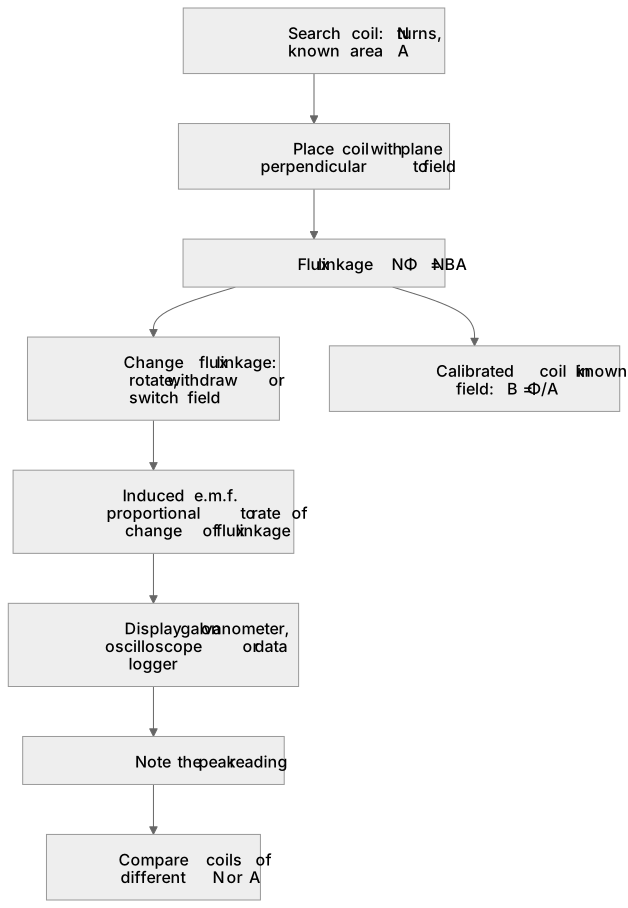
Label the diagram
Some boxes have lost their names. Pick the right name for each number.
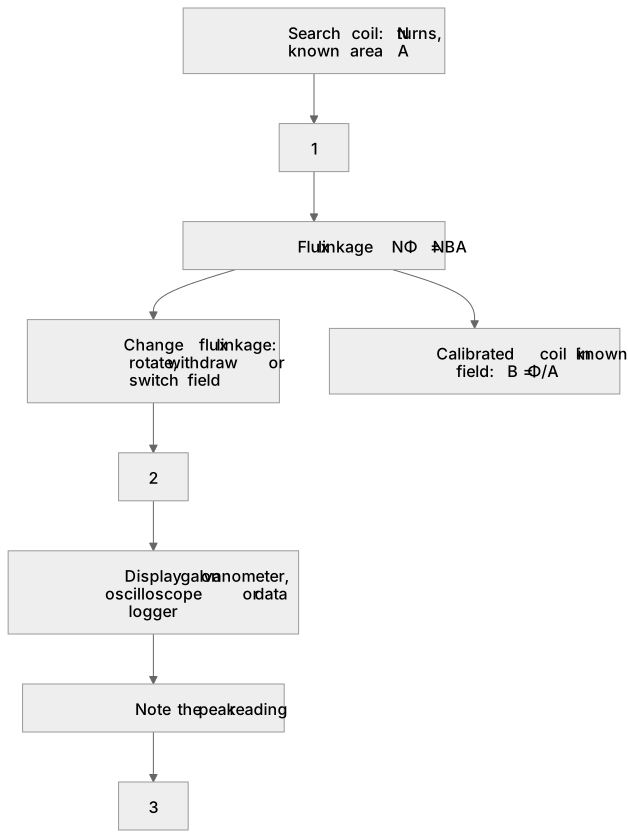
1Box 1
2Box 2
3Box 3
There is more to this lesson
The full lesson goes on to check your understanding and help you earn the marks. Create a free account to carry on, with your progress saved.
A week of Premium from your first lesson · Then the free plan continues · No card, no charge
Test your understanding of Electromagnetism: (ii) techniques and procedures used to investigate magnetic flux using search coils
Active recall beats re-reading. Take an instant quiz now to test what you’ve learned and lock it into long-term memory.
A week of Premium from your first lesson · Then the free plan continues · No card, no charge