OCR · A-Level · Physics
Course version: H556 · Version from Sept 2015
(a) p.d. – charge graph for a capacitor; energy stored is area under graph
Full specification wording
Energy: (a) p.d. – charge graph for a capacitor; energy stored is area under graph
For a capacitor, the p.d.
Checked against the OCR H556 specification (opens in a new tab) on .
- Point 1 of 3
- 4 key terms
Study notes
From the checked teaching notes for this specification point.
The idea
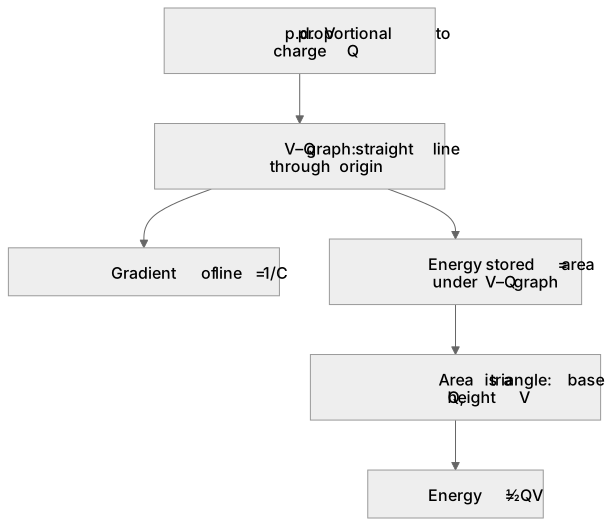
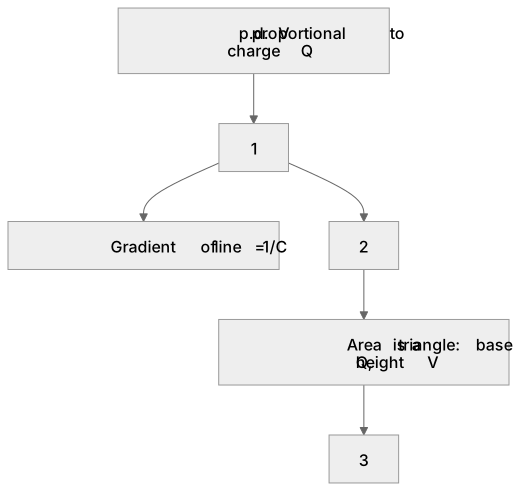
For a capacitor, the p.d. V across it is proportional to the charge Q stored, so a graph of V against Q is a straight line through the origin with gradient 1/C. The energy stored is the work done in transferring charge against the increasing p.d., which equals the area under the V–Q graph. Because the graph is a triangle of base Q and height V, the area is ½QV. This geometric interpretation links directly to the energy formulae and explains why the factor ½ appears. A concrete check: if Q = 4.0 × 10⁻³ C and V = 20 V, the area is ½ × 4.0 × 10⁻³ × 20 = 4.0 × 10⁻² J.
What earns the marks
- State that p.d. is directly proportional to charge for a capacitor, giving a straight-line V–Q graph through the origin.
- Explain that the energy stored equals the area under the p.d.–charge graph.
- Calculate energy from the triangular area as ½QV.
- Relate the gradient of the V–Q graph to 1/C.
Common mistakes and how to put them right
Treating the V–Q graph as a rectangle and using QV without the factor ½.
Put it right: The area is a triangle, so energy is ½QV.
Thinking the graph curves.
Put it right: For an ideal capacitor V is proportional to Q, so the graph is straight.
Confusing the area under a V–Q graph with the area under a V–I graph.
Put it right: They represent different quantities.
Exam tips
- Sketch the V–Q line and shade the triangular area to show where ½QV comes from.
- Use the gradient to find 1/C and hence C if the graph is given.
- Keep charge in coulombs and p.d. in volts so the area is in joules.
Try the lesson
The start of the Energy: (a) p.d. – charge graph for a capacitor; energy stored is area under graph lesson, made from checked teaching notes for this specification point.
Listen
For a capacitor, the p.d. V across it is proportional to the charge Q stored, so a graph of V against Q is a straight line through the origin with gradient 1/C. The energy stored is the work done in transferring charge against the increasing p.d., which equals the area under the V–Q graph. Because the graph is a triangle of base Q and height V, the area is ½QV. This geometric interpretation links directly to the energy formulae and explains why the factor ½ appears. A concrete check: if Q = 4.0 × 10⁻³ C and V = 20 V, the area is ½ × 4.0 × 10⁻³ × 20 = 4.0 × 10⁻² J. A strong answer earns marks for these points. State that p.d. is directly proportional to charge for a capacitor, giving a straight-line V–Q graph through the origin. Explain that the energy stored equals the area under the p.d.–charge graph. Calculate energy from the triangular area as ½QV. Relate the gradient of the V–Q graph to 1/C. Exam tip: Sketch the V–Q line and shade the triangular area to show where ½QV comes from.
See it
Key words
Say what each word means before you turn the card.
Proportionality of charge and p.d.
Try answering aloud or in your head before turning the card.
Graphical representation of energy
Try answering aloud or in your head before turning the card.
Area under a graph as work done
Try answering aloud or in your head before turning the card.
Capacitance from gradient
Try answering aloud or in your head before turning the card.
See every definition
- Proportionality of charge and p.d.
- For a capacitor, the p.d. V across it is proportional to the charge Q stored, so a graph of V against Q is a straight line through the origin.
- Graphical representation of energy
- The energy stored is the work done in transferring charge against the increasing p.d., which equals the area under the V–Q graph.
- Area under a graph as work done
- Because the graph is a triangle of base Q and height V, the area is ½QV, which links directly to the energy formulae and explains why the factor ½ appears.
- Capacitance from gradient
- A graph of V against Q is a straight line through the origin with gradient 1/C.
Label the diagram
Some boxes have lost their names. Pick the right name for each number.
1Box 1
2Box 2
3Box 3
There is more to this lesson
The full lesson goes on to check your understanding and help you earn the marks. Create a free account to carry on, with your progress saved.
A week of Premium from your first lesson · Then the free plan continues · No card, no charge
Test your understanding of Energy: (a) p.d. – charge graph for a capacitor; energy stored is area under graph
Active recall beats re-reading. Take an instant quiz now to test what you’ve learned and lock it into long-term memory.
A week of Premium from your first lesson · Then the free plan continues · No card, no charge