OCR · A-Level · Physics
Course version: H556 · Version from Sept 2015
(b) energy stored by capacitor; W = 1/2 QV, W = 1/2 CV² and W = 1/2 Q²/C
Full specification wording
Energy: (b) energy stored by capacitor; W = 1/2 QV, W = 1/2 CV² and W = 1/2 Q²/C
The energy stored by a capacitor can be written in three equivalent forms using Q = CV.
Checked against the OCR H556 specification (opens in a new tab) on .
- Point 2 of 3
- 4 key terms
Study notes
From the checked teaching notes for this specification point.
The idea
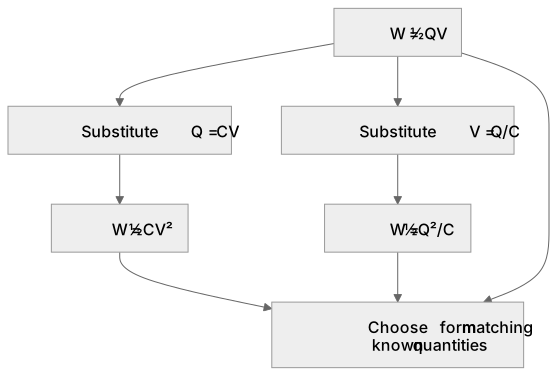
The energy stored by a capacitor can be written in three equivalent forms using Q = CV. Starting from W = ½QV, substituting Q = CV gives W = ½CV², and substituting V = Q/C gives W = ½Q²/C. Each form is useful depending on which quantities are known.
For example: A 2.0 × 10⁻⁶ F capacitor charged to 12 V stores W = ½ × 2.0 × 10⁻⁶ × 12² = 1.44 × 10⁻⁴ J. The factor ½ arises because the p.d. rises from zero to V as charge is transferred, so the average p.d. during charging is ½V. Choosing the right form avoids unnecessary intermediate calculations.
What earns the marks
- State the three equivalent expressions W = ½QV, W = ½CV² and W = ½Q²/C for energy stored by a capacitor.
- Derive the alternative forms from W = ½QV using Q = CV.
- Select the most convenient form based on the quantities given in a problem.
- Calculate energy stored correctly, keeping charge in coulombs, p.d. in volts and capacitance in farads.
Common mistakes and how to put them right
Omitting the factor ½ and using W = QV or W = CV².
Put it right: The correct expressions all include ½.
Mixing units, such as using capacitance in microfarads without converting to farads, which gives an energy a million times too large.
Substituting the wrong rearrangement, for example using V = Q/C when Q is unknown.
Put it right: Choose the form matching the given data.
Exam tips
- Write down the known quantities with units first, then choose the form of the energy equation that uses them directly.
- Convert microfarads to farads (× 10⁻⁶) and nanocoulombs to coulombs (× 10⁻⁹) before substituting.
- Check the answer is in joules and is reasonable for the size of capacitor and p.d. given.
Try the lesson
The start of the Energy: (b) energy stored by capacitor; W = 1/2 QV, W = 1/2 CV² and W = 1/2 Q²/C lesson, made from checked teaching notes for this specification point.
Listen
The energy stored by a capacitor can be written in three equivalent forms using Q = CV. Starting from W = ½QV, substituting Q = CV gives W = ½CV², and substituting V = Q/C gives W = ½Q²/C. Each form is useful depending on which quantities are known. For example, a 2.0 × 10⁻⁶ F capacitor charged to 12 V stores W = ½ × 2.0 × 10⁻⁶ × 12² = 1.44 × 10⁻⁴ J. The factor ½ arises because the p.d. rises from zero to V as charge is transferred, so the average p.d. during charging is ½V. Choosing the right form avoids unnecessary intermediate calculations. A strong answer earns marks for these points. State the three equivalent expressions W = ½QV, W = ½CV² and W = ½Q²/C for energy stored by a capacitor. Derive the alternative forms from W = ½QV using Q = CV. Select the most convenient form based on the quantities given in a problem. Calculate energy stored correctly, keeping charge in coulombs, p.d. in volts and capacitance in farads. Exam tip: Write down the known quantities with units first, then choose the form of the energy equation that uses them directly.
See it
Key words
Say what each word means before you turn the card.
Energy storage in a capacitor
Try answering aloud or in your head before turning the card.
Equivalent energy formulae
Try answering aloud or in your head before turning the card.
Use of Q = CV to transform expressions
Try answering aloud or in your head before turning the card.
Selection of appropriate equation
Try answering aloud or in your head before turning the card.
See every definition
- Energy storage in a capacitor
- The energy stored by a capacitor can be written in three equivalent forms using Q = CV.
- Equivalent energy formulae
- W = ½QV, W = ½CV² and W = ½Q²/C are the three equivalent expressions for energy stored by a capacitor.
- Use of Q = CV to transform expressions
- Substituting Q = CV into W = ½QV gives W = ½CV², and substituting V = Q/C gives W = ½Q²/C.
- Selection of appropriate equation
- Each form is useful depending on which quantities are known, and choosing the right form avoids unnecessary intermediate calculations.
Label the diagram
Some boxes have lost their names. Pick the right name for each number.
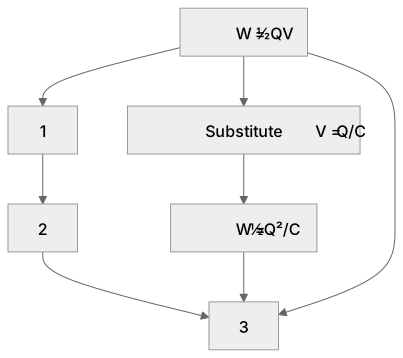
1Box 1
2Box 2
3Box 3
There is more to this lesson
The full lesson goes on to check your understanding and help you earn the marks. Create a free account to carry on, with your progress saved.
A week of Premium from your first lesson · Then the free plan continues · No card, no charge
Test your understanding of Energy: (b) energy stored by capacitor; W = 1/2 QV, W = 1/2 CV² and W = 1/2 Q²/C
Active recall beats re-reading. Take an instant quiz now to test what you’ve learned and lock it into long-term memory.
A week of Premium from your first lesson · Then the free plan continues · No card, no charge