OCR · A-Level · Physics
Course version: H556 · Version from Sept 2015
Equilibrium: (c) the principle of moments
The principle of moments states that for an object in rotational equilibrium, the sum of clockwise moments about any pivot equals the sum of anticlockwise moments.
Checked against the OCR H556 specification (opens in a new tab) on .
- Point 3 of 6
Study notes
From the checked teaching notes for this specification point.
The idea
The principle of moments states that for an object in rotational equilibrium, the sum of clockwise moments about any pivot equals the sum of anticlockwise moments. A moment is the product of a force and the perpendicular distance from the pivot to the force's line of action: moment = F × d, measured in newton metres (N m). For example, a 10 N force acting 0.50 m from a pivot produces a moment of 5.0 N m. When several forces act, calculate each moment separately, then equate the totals. This principle applies to any pivot point, provided the object is in equilibrium. It is used to solve problems involving seesaws, beams and balanced rulers, and is fundamental to understanding static equilibrium.
What earns the marks
- State that the principle of moments applies to an object in rotational equilibrium.
- Define moment as force multiplied by the perpendicular distance from the pivot to the line of action of the force.
- Use the correct unit for moment: newton metre (N m).
- Apply the principle by equating the sum of clockwise moments to the sum of anticlockwise moments about a chosen pivot.
- Calculate individual moments correctly using the perpendicular distance, not the distance along the force direction.
Common mistakes and how to put them right
Using the distance along the line of action instead of the perpendicular distance from the pivot.
Put it right: Use the perpendicular distance from the pivot to the line of action.
Forgetting to convert distances to metres before calculating moments.
Put it right: Convert all lengths to metres to keep units consistent (e.g., 50 cm = 0.50 m).
Assuming the principle of moments only applies when the pivot is at the centre of the object.
Put it right: The principle holds for any chosen pivot point when the object is in equilibrium.
Exam tips
- Always identify the pivot point clearly before calculating moments.
- Check that all distances are perpendicular to the force; if not, resolve the force or use the perpendicular component.
- Verify that the sum of clockwise moments equals the sum of anticlockwise moments as a final check.
Try the lesson
The start of the Equilibrium: (c) the principle of moments lesson, made from checked teaching notes for this specification point.
Listen
The principle of moments states that for an object in rotational equilibrium, the sum of clockwise moments about any pivot equals the sum of anticlockwise moments. A moment is the product of a force and the perpendicular distance from the pivot to the force's line of action: moment = F × d, measured in newton metres (N m). For example, a 10 N force acting 0.50 m from a pivot produces a moment of 5.0 N m. When several forces act, calculate each moment separately, then equate the totals. This principle applies to any pivot point, provided the object is in equilibrium. It is used to solve problems involving seesaws, beams and balanced rulers, and is fundamental to understanding static equilibrium. A strong answer earns marks for these points. State that the principle of moments applies to an object in rotational equilibrium. Define moment as force multiplied by the perpendicular distance from the pivot to the line of action of the force. Use the correct unit for moment: newton metre (N m). Apply the principle by equating the sum of clockwise moments to the sum of anticlockwise moments about a chosen pivot. A common slip: Using the distance along the line of action instead of the perpendicular distance from the pivot. Instead, use the perpendicular distance from the pivot to the line of action. Exam tip: Always identify the pivot point clearly before calculating moments.
See it
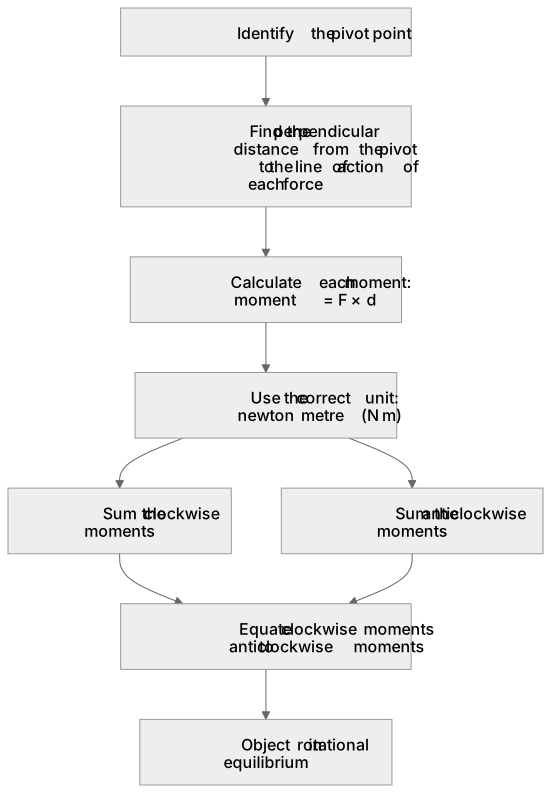
Label the diagram
Some boxes have lost their names. Pick the right name for each number.
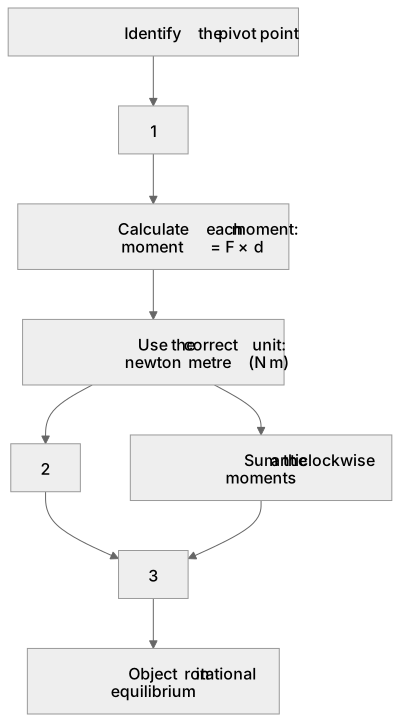
1Box 1
2Box 2
3Box 3
There is more to this lesson
The full lesson goes on to check your understanding and help you earn the marks. Create a free account to carry on, with your progress saved.
A week of Premium from your first lesson · Then the free plan continues · No card, no charge
Test your understanding of Equilibrium: (c) the principle of moments
Active recall beats re-reading. Take an instant quiz now to test what you’ve learned and lock it into long-term memory.
A week of Premium from your first lesson · Then the free plan continues · No card, no charge