OCR · A-Level · Physics
Course version: H556 · Version from Sept 2015
(d) centre of mass; centre of gravity; experimental determination of…
Full specification wording
Equilibrium: (d) centre of mass; centre of gravity; experimental determination of centre of gravity
The centre of mass of an object is the point where its entire mass may be considered to be concentrated.
Checked against the OCR H556 specification (opens in a new tab) on .
- Point 4 of 6
- 2 key terms
Study notes
From the checked teaching notes for this specification point.
The idea
The centre of mass of an object is the point where its entire mass may be considered to be concentrated. The centre of gravity is the point where the entire weight of the object acts. For a uniform gravitational field, these points coincide. For a symmetrical object of uniform density, the centre of mass lies at the geometric centre. For an irregular lamina, the centre of gravity can be found experimentally by suspending it freely from a pin and drawing a vertical line (using a plumb line) from the suspension point; repeating from a different point gives intersecting lines, and their intersection locates the centre of gravity. This method relies on the object hanging in equilibrium with its centre of gravity directly below the suspension point.
What earns the marks
- Define centre of mass as the point where the total mass of an object may be considered to be concentrated.
- Define centre of gravity as the point where the total weight of an object may be considered to act.
- State that for a uniform gravitational field, the centre of mass and centre of gravity coincide.
- Describe the experimental method: suspend the lamina freely from a pin, draw a vertical line using a plumb line, repeat from another point, and locate the intersection.
- Explain that the intersection of the lines gives the centre of gravity because the object hangs in equilibrium with its centre of gravity directly below the suspension point.
Common mistakes and how to put them right
Confusing centre of mass with centre of gravity.
Put it right: Centre of mass relates to mass distribution, centre of gravity relates to weight distribution; they coincide in a uniform gravitational field.
Thinking that the centre of gravity must lie within the material of the object.
Put it right: It can lie outside, e.g., for a ring or horseshoe.
Drawing only one line in the experimental determination.
Put it right: At least two lines from different suspension points are needed to find the intersection.
Exam tips
- Remember that the plumb line always hangs vertically, so the line drawn is vertical.
- Ensure the lamina can swing freely; any friction at the pivot may cause error.
- Use a sharp pencil and a fine plumb line to improve accuracy of the intersection point.
Try the lesson
The start of the Equilibrium: (d) centre of mass; centre of gravity; experimental determination of centre of gravity lesson, made from checked teaching notes for this specification point.
Listen
The centre of mass of an object is the point where its entire mass may be considered to be concentrated. The centre of gravity is the point where the entire weight of the object acts. For a uniform gravitational field, these points coincide. For a symmetrical object of uniform density, the centre of mass lies at the geometric centre. For an irregular lamina, the centre of gravity can be found experimentally by suspending it freely from a pin and drawing a vertical line (using a plumb line) from the suspension point; repeating from a different point gives intersecting lines, and their intersection locates the centre of gravity. This method relies on the object hanging in equilibrium with its centre of gravity directly below the suspension point. A strong answer earns marks for these points. Define centre of mass as the point where the total mass of an object may be considered to be concentrated. Define centre of gravity as the point where the total weight of an object may be considered to act. State that for a uniform gravitational field, the centre of mass and centre of gravity coincide. Describe the experimental method: suspend the lamina freely from a pin, draw a vertical line using a plumb line, repeat from another point, and locate the intersection. A common slip: Confusing centre of mass with centre of gravity. Instead, centre of mass relates to mass distribution, centre of gravity relates to weight distribution; they coincide in a uniform gravitational field. Exam tip: Remember that the plumb line always hangs vertically, so the line drawn is vertical.
See it
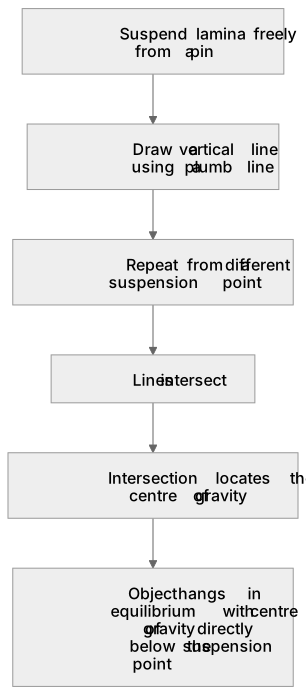
Put it in order
Put these steps in the order they happen.
- 1. Repeat from a different suspension point
- 2. Draw a vertical line using a plumb line
- 3. Suspend lamina freely from a pin
- 4. Object hangs in equilibrium with centre of gravity directly below the suspension point
- 5. Intersection locates the centre of gravity
- 6. Lines intersect
Key words
Say what each word means before you turn the card.
Centre of mass
Try answering aloud or in your head before turning the card.
Centre of gravity
Try answering aloud or in your head before turning the card.
See every definition
- Centre of mass
- The point where the entire mass of an object may be considered to be concentrated.
- Centre of gravity
- The point where the entire weight of the object acts.
Label the diagram
Some boxes have lost their names. Pick the right name for each number.
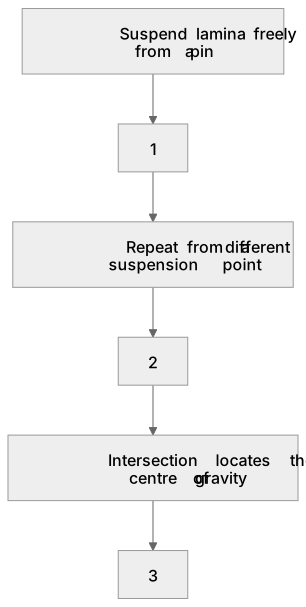
1Box 1
2Box 2
3Box 3
There is more to this lesson
The full lesson goes on to check your understanding and help you earn the marks. Create a free account to carry on, with your progress saved.
A week of Premium from your first lesson · Then the free plan continues · No card, no charge
Test your understanding of Equilibrium: (d) centre of mass; centre of gravity; experimental determination of centre of gravity
Active recall beats re-reading. Take an instant quiz now to test what you’ve learned and lock it into long-term memory.
A week of Premium from your first lesson · Then the free plan continues · No card, no charge