OCR · A-Level · Physics
Course version: H556 · Version from Sept 2015
(e) equilibrium of an object under the action of forces and torques
Full specification wording
Equilibrium: (e) equilibrium of an object under the action of forces and torques
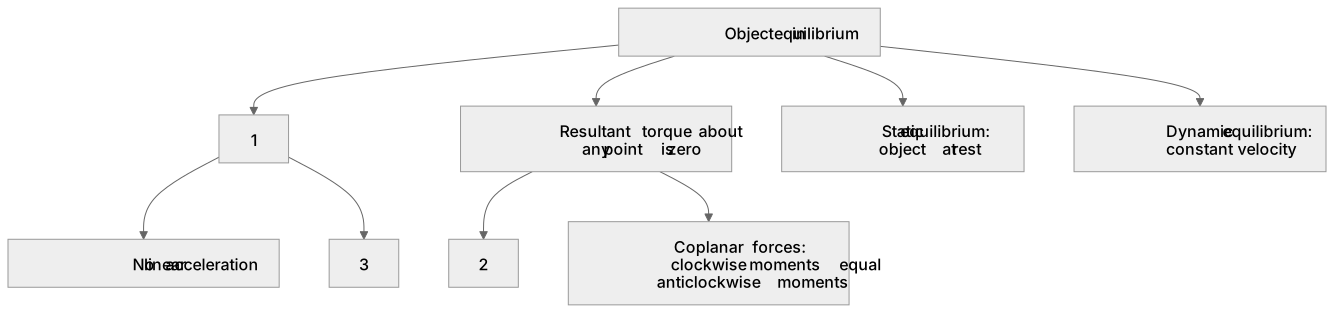
An object is in equilibrium when the resultant force acting on it is zero and the resultant torque (moment) about any point is zero.
Checked against the OCR H556 specification (opens in a new tab) on .
- Point 5 of 6
- 4 key terms
Study notes
From the checked teaching notes for this specification point.
The idea
An object is in equilibrium when the resultant force acting on it is zero and the resultant torque (moment) about any point is zero. This means the object has no linear acceleration and no angular acceleration. For coplanar forces, the conditions are: the vector sum of all forces is zero (ΣF = 0), and the sum of clockwise moments about any point equals the sum of anticlockwise moments (Στ = 0). For example, a beam balanced on two supports has upward forces from the supports equal to the total downward weight, and the moments about any support balance. These conditions apply to both static and dynamic equilibrium (constant velocity).
What earns the marks
- State that for equilibrium, the resultant force on the object must be zero.
- State that for equilibrium, the resultant torque (moment) about any point must be zero.
- Apply the condition ΣF = 0 in component form (e.g., sum of horizontal forces = 0, sum of vertical forces = 0).
- Apply the condition Στ = 0 by equating clockwise and anticlockwise moments about a chosen pivot.
- Recognise that equilibrium can be static (object at rest) or dynamic (object moving with constant velocity).
Common mistakes and how to put them right
Assuming that equilibrium only requires balanced forces and ignoring torques.
Put it right: Both resultant force and resultant torque must be zero.
Forgetting to consider all forces, including weight and reaction forces.
Put it right: Draw a free-body diagram to identify all forces and their points of application.
Choosing a pivot that simplifies the problem but then incorrectly omitting the moment of a force that acts through that pivot.
Put it right: Forces acting through the pivot have zero moment about that pivot, so they can be omitted from the moment equation.
Exam tips
- Draw a clear free-body diagram showing all forces and their directions.
- Choose a pivot point that eliminates unknown forces from the moment equation to simplify calculations.
- Check that both force and moment conditions are satisfied; one alone is not sufficient for equilibrium.
Try the lesson
The start of the Equilibrium: (e) equilibrium of an object under the action of forces and torques lesson, made from checked teaching notes for this specification point.
Listen
An object is in equilibrium when the resultant force acting on it is zero and the resultant torque (moment) about any point is zero. This means the object has no linear acceleration and no angular acceleration. For coplanar forces, the conditions are: the vector sum of all forces is zero (ΣF = 0), and the sum of clockwise moments about any point equals the sum of anticlockwise moments (Στ = 0). For example, a beam balanced on two supports has upward forces from the supports equal to the total downward weight, and the moments about any support balance. These conditions apply to both static and dynamic equilibrium (constant velocity). A strong answer earns marks for these points. State that for equilibrium, the resultant force on the object must be zero. State that for equilibrium, the resultant torque (moment) about any point must be zero. Apply the condition ΣF = 0 in component form (e.g., sum of horizontal forces = 0, sum of vertical forces = 0). Apply the condition Στ = 0 by equating clockwise and anticlockwise moments about a chosen pivot. A common slip: Assuming that equilibrium only requires balanced forces and ignoring torques. Instead, both resultant force and resultant torque must be zero. Exam tip: Draw a clear free-body diagram showing all forces and their directions.
See it

Key words
Say what each word means before you turn the card.
Equilibrium conditions
Try answering aloud or in your head before turning the card.
Resultant force
Try answering aloud or in your head before turning the card.
Resultant torque
Try answering aloud or in your head before turning the card.
Free-body diagrams
Try answering aloud or in your head before turning the card.
See every definition
- Equilibrium conditions
- The resultant force acting on the object is zero and the resultant torque about any point is zero, so there is no linear acceleration and no angular acceleration.
- Resultant force
- The vector sum of all forces acting on the object, which must be zero for equilibrium.
- Resultant torque
- The sum of the moments about any point, which must be zero for equilibrium, with clockwise moments equalling anticlockwise moments.
- Free-body diagrams
- A drawing used to identify all forces and their points of application, including weight and reaction forces.
Label the diagram
Some boxes have lost their names. Pick the right name for each number.
1Box 1
2Box 2
3Box 3
There is more to this lesson
The full lesson goes on to check your understanding and help you earn the marks. Create a free account to carry on, with your progress saved.
A week of Premium from your first lesson · Then the free plan continues · No card, no charge
Test your understanding of Equilibrium: (e) equilibrium of an object under the action of forces and torques
Active recall beats re-reading. Take an instant quiz now to test what you’ve learned and lock it into long-term memory.
A week of Premium from your first lesson · Then the free plan continues · No card, no charge