OCR · A-Level · Physics
Course version: H556 · Version from Sept 2015
(j) β⁺ decay in terms of a quark model; u → d + ⁰₊₁e + ν
Full specification wording
Fundamental particles: (j) β⁺ decay in terms of a quark model; u → d + ⁰₊₁e + ν
Beta-plus decay occurs in proton-rich nuclei when a proton converts into a neutron.
Checked against the OCR H556 specification (opens in a new tab) on .
- Point 10 of 12
Study notes
From the checked teaching notes for this specification point.
The idea
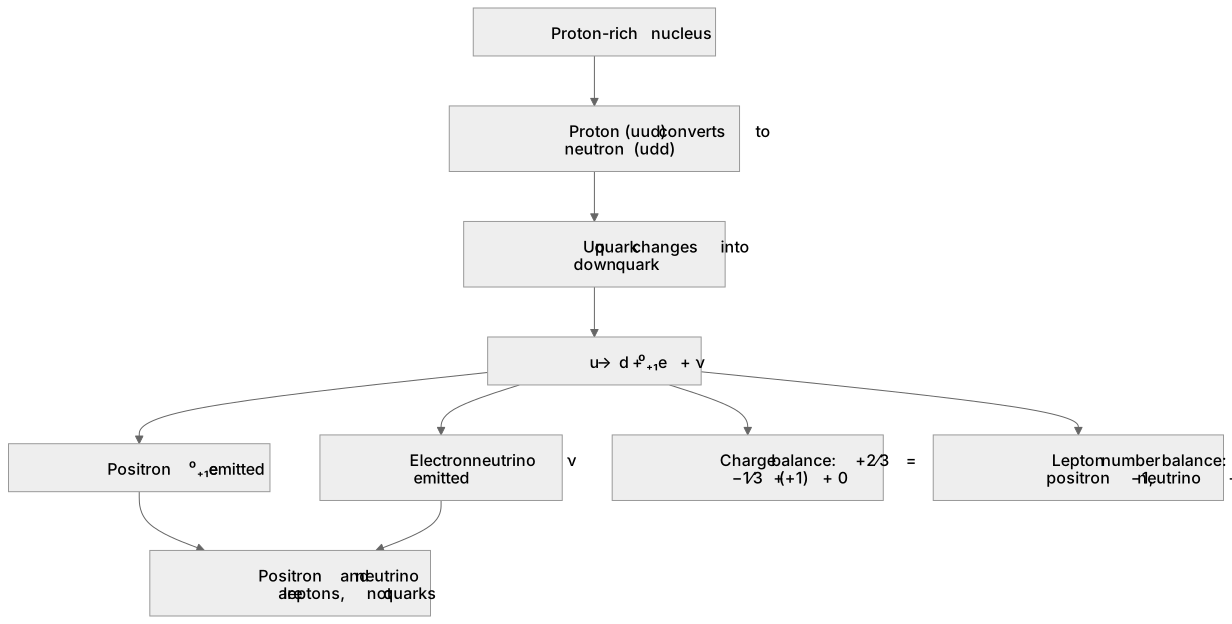
Beta-plus decay occurs in proton-rich nuclei when a proton converts into a neutron. In quark terms the proton is uud and the neutron is udd, so an up quark changes into a down quark. The transformation is u → d + ⁰₊₁e + ν, where ⁰₊₁e is the positron (the antiparticle of the electron) and ν is the electron neutrino. Charge balance is essential: the up quark has charge +2⁄3, while the down quark (−1⁄3), the positron (+1) and the neutrino (0) sum to +2⁄3. Lepton number balances because the positron has lepton number −1 and the neutrino has +1. The positron and neutrino are leptons emitted by the weak interaction, not quarks. A reliable method is to write the parent and daughter quark contents and confirm that exactly one quark flavour changes.
What earns the marks
- Identifies that in β⁺ decay an up quark transforms into a down quark, changing a proton into a neutron.
- States the transformation u → d + ⁰₊₁e + ν with the positron and electron neutrino as products.
- Confirms charge conservation: +2⁄3 = −1⁄3 + (+1) + 0.
- Recognises that the positron and neutrino are leptons, not quarks, and that the weak interaction mediates the change.
- Distinguishes β⁺ decay from β⁻ decay by the direction of quark flavour change and the emitted particles.
Common mistakes and how to put them right
Writing the neutrino as an antineutrino.
Put it right: The β⁺ product is the electron neutrino ν, which balances lepton number against the positron.
Using an electron instead of a positron.
Put it right: β⁺ decay emits a positron, the antiparticle of the electron.
Balancing charge incorrectly by treating the up quark as negative.
Put it right: The up quark charge is +2⁄3, not −2⁄3.
Exam tips
- Write the quark-level equation and check charge on both sides before choosing an option.
- Check lepton number as well as charge; the neutrino type must match the emitted lepton.
- Remember that β⁺ decay reduces the proton number by one and increases the neutron number by one.
Try the lesson
The start of the Fundamental particles: (j) β⁺ decay in terms of a quark model; u → d + ⁰₊₁e + ν lesson, made from checked teaching notes for this specification point.
Listen
Beta-plus decay occurs in proton-rich nuclei when a proton converts into a neutron. In quark terms the proton is uud and the neutron is udd, so an up quark changes into a down quark. The transformation is u → d + ⁰₊₁e + ν, where ⁰₊₁e is the positron (the antiparticle of the electron) and ν is the electron neutrino. Charge balance is essential: the up quark has charge +2⁄3, while the down quark (−1⁄3), the positron (+1) and the neutrino (0) sum to +2⁄3. Lepton number balances because the positron has lepton number −1 and the neutrino has +1. The positron and neutrino are leptons emitted by the weak interaction, not quarks. A reliable method is to write the parent and daughter quark contents and confirm that exactly one quark flavour changes. A strong answer earns marks for these points. Identifies that in β⁺ decay an up quark transforms into a down quark, changing a proton into a neutron. States the transformation u → d + ⁰₊₁e + ν with the positron and electron neutrino as products. Confirms charge conservation: +2⁄3 = −1⁄3 + (+1) + 0. Recognises that the positron and neutrino are leptons, not quarks, and that the weak interaction mediates the change. Exam tip: Write the quark-level equation and check charge on both sides before choosing an option.
See it
Label the diagram
Some boxes have lost their names. Pick the right name for each number.
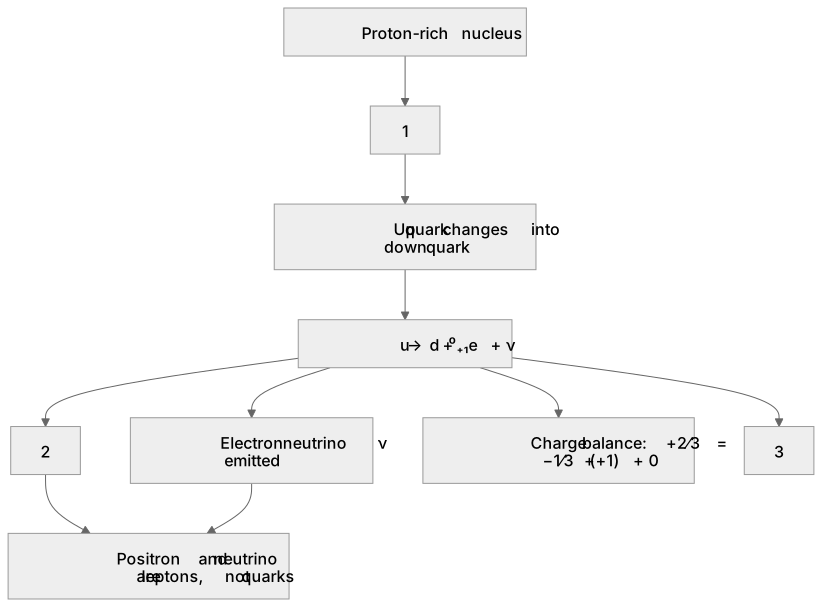
1Box 1
2Box 2
3Box 3
There is more to this lesson
The full lesson goes on to check your understanding and help you earn the marks. Create a free account to carry on, with your progress saved.
A week of Premium from your first lesson · Then the free plan continues · No card, no charge
Test your understanding of Fundamental particles: (j) β⁺ decay in terms of a quark model; u → d + ⁰₊₁e + ν
Active recall beats re-reading. Take an instant quiz now to test what you’ve learned and lock it into long-term memory.
A week of Premium from your first lesson · Then the free plan continues · No card, no charge