OCR · A-Level · Physics
Course version: H556 · Version from Sept 2015
(k) balancing of quark transformation equations in terms of charge
Full specification wording
Fundamental particles: (k) balancing of quark transformation equations in terms of charge
Quark transformation equations must balance in charge.
Checked against the OCR H556 specification (opens in a new tab) on .
- Point 11 of 12
- 3 key terms
Study notes
From the checked teaching notes for this specification point.
The idea
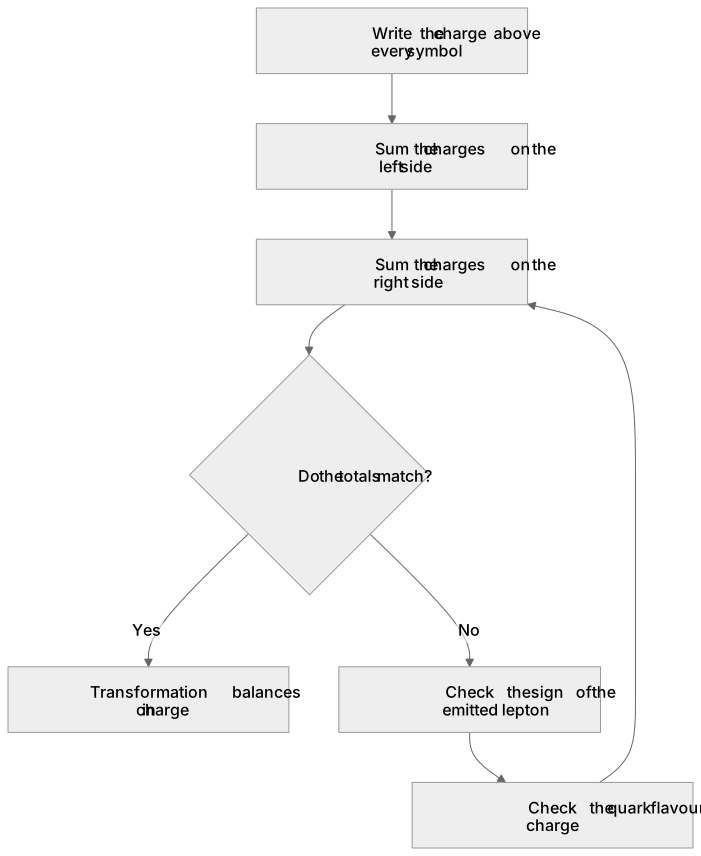
Quark transformation equations must balance in charge. Each quark has a fractional charge: up-type quarks have charge +2⁄3 and down-type quarks have charge −1⁄3, while antiquarks have the opposite sign. Leptons such as the electron have charge −1, the positron +1, and neutrinos zero. To balance an equation, add the charges on the left and set them equal to the sum on the right. For example, in d → u + ⁰₋₁e + ν̄ the left side is −1⁄3 and the right side is +2⁄3 + (−1) + 0 = −1⁄3. A systematic method is to write the charge above each symbol, sum each side, and adjust the lepton charges until they match. This check also helps identify whether a proposed transformation is physically possible.
What earns the marks
- States the fractional charges of up-type (+2⁄3) and down-type (−1⁄3) quarks and the opposite charges of their antiquarks.
- States the charges of the electron (−1), positron (+1) and neutrinos (0).
- Adds charges on each side of a quark transformation equation and shows that the totals are equal.
- Uses charge balance to test whether a proposed quark transformation is valid.
- Applies the method to both β⁻ and β⁺ transformations without confusing the sign of the emitted lepton.
Common mistakes and how to put them right
Forgetting that quark charges are fractional: treating an up quark as +1 and a down quark as −1 gives incorrect totals.
Ignoring the charge of the emitted lepton.
Put it right: The electron or positron contributes ±1 and must be included in the sum.
Reversing the sign of the antineutrino or neutrino.
Put it right: Neutrinos have zero charge, so their sign does not affect charge balance, but their particle type still matters for lepton number.
Exam tips
- Write the charge above every symbol before adding, so no term is missed.
- Check both charge and lepton number; charge balance alone does not guarantee a valid equation.
- If the totals do not match, look first at the sign of the emitted lepton and the quark flavour charge.
Try the lesson
The start of the Fundamental particles: (k) balancing of quark transformation equations in terms of charge lesson, made from checked teaching notes for this specification point.
Listen
Quark transformation equations must balance in charge. Each quark has a fractional charge: up-type quarks have charge +2⁄3 and down-type quarks have charge −1⁄3, while antiquarks have the opposite sign. Leptons such as the electron have charge −1, the positron +1, and neutrinos zero. To balance an equation, add the charges on the left and set them equal to the sum on the right. For example, in d → u + ⁰₋₁e + ν̄ the left side is −1⁄3 and the right side is +2⁄3 + (−1) + 0 = −1⁄3. A systematic method is to write the charge above each symbol, sum each side, and adjust the lepton charges until they match. This check also helps identify whether a proposed transformation is physically possible. A strong answer earns marks for these points. States the fractional charges of up-type (+2⁄3) and down-type (−1⁄3) quarks and the opposite charges of their antiquarks. States the charges of the electron (−1), positron (+1) and neutrinos (0). Adds charges on each side of a quark transformation equation and shows that the totals are equal. Uses charge balance to test whether a proposed quark transformation is valid. Exam tip: Write the charge above every symbol before adding, so no term is missed.
See it
Key words
Say what each word means before you turn the card.
Fractional quark charge
Try answering aloud or in your head before turning the card.
Lepton charge
Try answering aloud or in your head before turning the card.
Equation balancing as a validity test
Try answering aloud or in your head before turning the card.
See every definition
- Fractional quark charge
- Up-type quarks have charge +2⁄3 and down-type quarks have charge −1⁄3, while antiquarks have the opposite sign.
- Lepton charge
- The electron has charge −1, the positron +1, and neutrinos zero.
- Equation balancing as a validity test
- Adding the charges on each side of a quark transformation equation and showing the totals are equal, which also helps identify whether a proposed transformation is physically possible.
There is more to this lesson
The full lesson goes on to check your understanding and help you earn the marks. Create a free account to carry on, with your progress saved.
A week of Premium from your first lesson · Then the free plan continues · No card, no charge
Test your understanding of Fundamental particles: (k) balancing of quark transformation equations in terms of charge
Active recall beats re-reading. Take an instant quiz now to test what you’ve learned and lock it into long-term memory.
A week of Premium from your first lesson · Then the free plan continues · No card, no charge