OCR · A-Level · Physics
Course version: H556 · Version from Sept 2015
Fundamental particles: (l) decay of particles in terms of the quark model.
Particle decay can be described by showing how quark flavours change.
Checked against the OCR H556 specification (opens in a new tab) on .
- Point 12 of 12
Study notes
From the checked teaching notes for this specification point.
The idea
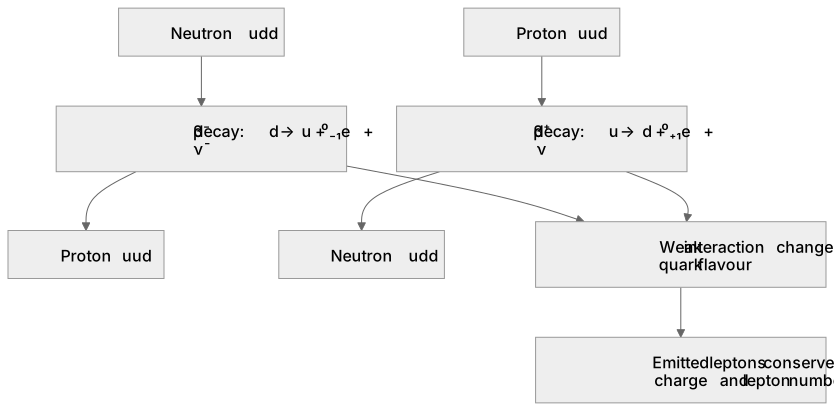
Particle decay can be described by showing how quark flavours change. In β⁻ decay a down quark becomes an up quark, so a neutron becomes a proton and an electron plus an electron antineutrino are emitted. In β⁺ decay an up quark becomes a down quark, so a proton becomes a neutron and a positron plus an electron neutrino are emitted. In each case the weak interaction changes quark flavour, and the emitted leptons conserve charge and lepton number. To describe a decay, write the quark content of the parent particle, show the flavour change, and list the products. For example, the neutron udd becomes the proton uud with the transformation d → u + ⁰₋₁e + ν̄. This approach explains why the nucleon's identity changes and why leptons appear even though they are not constituents of the nucleon.
What earns the marks
- Describes a neutron as udd and a proton as uud, and identifies the quark that changes in β⁻ decay.
- Describes a proton as uud and a neutron as udd, and identifies the quark that changes in β⁺ decay.
- Writes the quark-level transformation for β⁻ decay as d → u + ⁰₋₁e + ν̄.
- Writes the quark-level transformation for β⁺ decay as u → d + ⁰₊₁e + ν.
- Explains that the weak interaction changes quark flavour and that the emitted leptons conserve charge and lepton number.
Common mistakes and how to put them right
Thinking that the whole neutron turns into a proton without any quark change.
Put it right: The change is a single quark flavour transformation.
Believing that electrons or positrons are quarks.
Put it right: They are leptons produced in the decay and are not part of the nucleon.
Mixing up the neutrino types.
Put it right: β⁻ emits an electron antineutrino and β⁺ emits an electron neutrino.
Exam tips
- Write the quark content of the parent and daughter particles before writing the transformation.
- Check charge and lepton number on both sides of the equation.
- Use the direction of quark flavour change to decide whether the decay is β⁻ or β⁺.
Try the lesson
The start of the Fundamental particles: (l) decay of particles in terms of the quark model. lesson, made from checked teaching notes for this specification point.
Listen
Particle decay can be described by showing how quark flavours change. In β⁻ decay a down quark becomes an up quark, so a neutron becomes a proton and an electron plus an electron antineutrino are emitted. In β⁺ decay an up quark becomes a down quark, so a proton becomes a neutron and a positron plus an electron neutrino are emitted. In each case the weak interaction changes quark flavour, and the emitted leptons conserve charge and lepton number. To describe a decay, write the quark content of the parent particle, show the flavour change, and list the products. For example, the neutron udd becomes the proton uud with the transformation d → u + ⁰₋₁e + ν̄. This approach explains why the nucleon's identity changes and why leptons appear even though they are not constituents of the nucleon. A strong answer earns marks for these points. Describes a neutron as udd and a proton as uud, and identifies the quark that changes in β⁻ decay. Describes a proton as uud and a neutron as udd, and identifies the quark that changes in β⁺ decay. Writes the quark-level transformation for β⁻ decay as d → u + ⁰₋₁e + ν̄. Writes the quark-level transformation for β⁺ decay as u → d + ⁰₊₁e + ν. Exam tip: Write the quark content of the parent and daughter particles before writing the transformation.
See it
There is more to this lesson
The full lesson goes on to check your understanding and help you earn the marks. Create a free account to carry on, with your progress saved.
A week of Premium from your first lesson · Then the free plan continues · No card, no charge
Test your understanding of Fundamental particles: (l) decay of particles in terms of the quark model.
Active recall beats re-reading. Take an instant quiz now to test what you’ve learned and lock it into long-term memory.
A week of Premium from your first lesson · Then the free plan continues · No card, no charge