OCR · A-Level · Physics
Course version: H556 · Version from Sept 2015
(d) gravitational potential energy E mV r GMm g = =- at a distance r from…
Full specification wording
Gravitational potential and energy: (d) gravitational potential energy E mV r GMm g = =- at a distance r from a point mass M
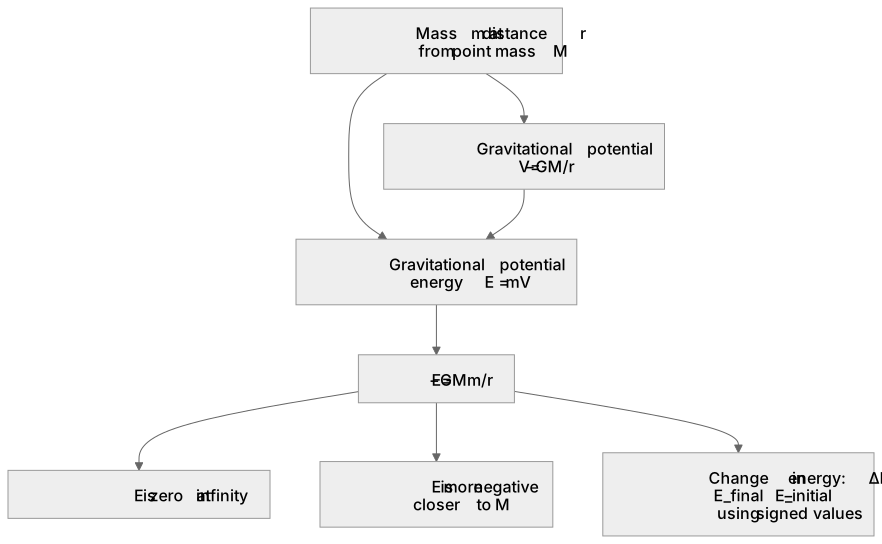
Gravitational potential energy of a mass m at distance r from a point mass M is E = mV = −GMm/r, where V = −GM/r is the gravitational potential at that point.
Checked against the OCR H556 specification (opens in a new tab) on .
- Point 4 of 5
- 3 key terms
Study notes
From the checked teaching notes for this specification point.
The idea
Gravitational potential energy of a mass m at distance r from a point mass M is E = mV = −GMm/r, where V = −GM/r is the gravitational potential at that point. The expression applies outside a spherical mass, with r measured from the centre. The negative sign means the potential energy is zero at infinity and decreases as the mass moves closer, so energy is released when a mass falls towards M. Because E is inversely proportional to r, doubling the separation from r to 2r changes E from −GMm/r to −GMm/2r, an increase of GMm/2r, which equals the energy needed to move the mass outward.
For example: A satellite of mass m in orbit at radius r has E = −GMm/r, and the energy required to move it to a higher orbit is the difference between the two values.
What earns the marks
- States E = mV = −GMm/r for a mass m at distance r from a point mass M.
- Explains that E is the product of the mass and the gravitational potential at that point.
- Interprets the negative sign: E is zero at infinity and more negative closer to M.
- Calculates changes in gravitational potential energy as ΔE = E_final − E_initial using signed values.
- Applies the expression outside a spherical mass, with r measured from the centre.
Common mistakes and how to put them right
Dropping the negative sign and writing E = GMm/r.
Put it right: Gravitational potential energy is negative relative to the zero at infinity.
Using r as the height above the surface rather than the distance from the centre.
Put it right: r is the centre-to-centre separation outside the sphere.
Adding magnitudes when finding a change in energy.
Put it right: Subtract signed values, E_final − E_initial, so the direction of energy transfer is clear.
Exam tips
- Write E = mV and substitute V = −GM/r explicitly to show where the negative sign comes from.
- For energy changes, calculate both energies with signs and subtract, rather than working with magnitudes.
- Check that the mass m is the object in the field, not the source mass M.
Try the lesson
The start of the Gravitational potential and energy: (d) gravitational potential energy E mV r GMm g = =- at a distance r from a point mass M lesson, made from checked teaching notes for this specification point.
Listen
Gravitational potential energy of a mass m at distance r from a point mass M is E = mV = −GMm/r, where V = −GM/r is the gravitational potential at that point. The expression applies outside a spherical mass, with r measured from the centre. The negative sign means the potential energy is zero at infinity and decreases as the mass moves closer, so energy is released when a mass falls towards M. Because E is inversely proportional to r, doubling the separation from r to 2r changes E from −GMm/r to −GMm/2r, an increase of GMm/2r, which equals the energy needed to move the mass outward. For example, a satellite of mass m in orbit at radius r has E = −GMm/r, and the energy required to move it to a higher orbit is the difference between the two values. A strong answer earns marks for these points. States E = mV = −GMm/r for a mass m at distance r from a point mass M. Explains that E is the product of the mass and the gravitational potential at that point. Interprets the negative sign: E is zero at infinity and more negative closer to M. Calculates changes in gravitational potential energy as ΔE = E_final − E_initial using signed values. A common slip: Dropping the negative sign and writing E = GMm/r. Instead, gravitational potential energy is negative relative to the zero at infinity. Exam tip: Write E = mV and substitute V = −GM/r explicitly to show where the negative sign comes from.
See it
Key words
Say what each word means before you turn the card.
Gravitational potential energy
Try answering aloud or in your head before turning the card.
Negative sign
Try answering aloud or in your head before turning the card.
Inverse-distance dependence
Try answering aloud or in your head before turning the card.
See every definition
- Gravitational potential energy
- The product of the mass and the gravitational potential at that point, given by E = mV = −GMm/r at a distance r from a point mass M.
- Negative sign
- It means the potential energy is zero at infinity and decreases as the mass moves closer, so energy is released when a mass falls towards M.
- Inverse-distance dependence
- Because E is inversely proportional to r, doubling the separation from r to 2r changes E from −GMm/r to −GMm/2r, an increase of GMm/2r.
Label the diagram
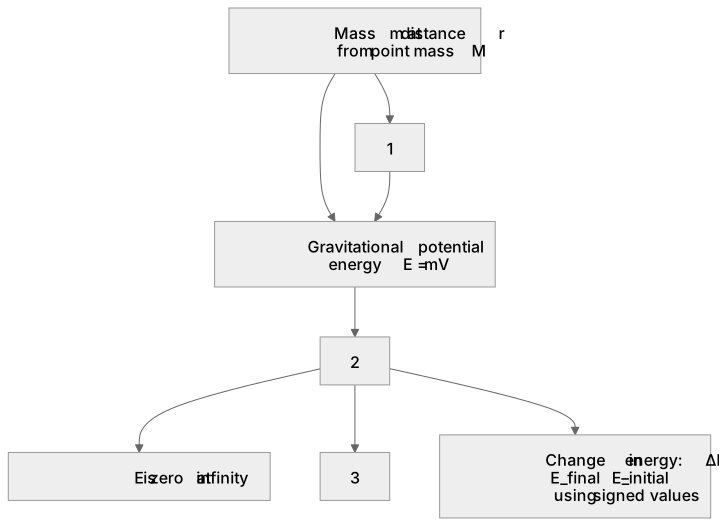
Some boxes have lost their names. Pick the right name for each number.
1Box 1
2Box 2
3Box 3
There is more to this lesson
The full lesson goes on to check your understanding and help you earn the marks. Create a free account to carry on, with your progress saved.
A week of Premium from your first lesson · Then the free plan continues · No card, no charge
Test your understanding of Gravitational potential and energy: (d) gravitational potential energy E mV r GMm g = =- at a distance r from a point mass M
Active recall beats re-reading. Take an instant quiz now to test what you’ve learned and lock it into long-term memory.
A week of Premium from your first lesson · Then the free plan continues · No card, no charge