OCR · A-Level · Physics
Course version: H556 · Version from Sept 2015
Gravitational potential and energy: (e) escape velocity.
Escape velocity is the minimum speed a projectile needs at the surface of a mass M to escape its gravitational field and reach infinity with zero kinetic energy.
Checked against the OCR H556 specification (opens in a new tab) on .
- Point 5 of 5
- 4 key terms
Study notes
From the checked teaching notes for this specification point.
The idea
Escape velocity is the minimum speed a projectile needs at the surface of a mass M to escape its gravitational field and reach infinity with zero kinetic energy. At the surface, radius R, the total energy is ½mv² − GMm/R. Setting this equal to zero at infinity gives ½mv² = GMm/R, so v = √(2GM/R). The mass m cancels, so escape velocity depends only on the mass and radius of the body, not on the projectile. For example, for a planet of mass 6.0 × 10²⁴ kg and radius 6.4 × 10⁶ m, v = √(2 × 6.67 × 10⁻¹¹ × 6.0 × 10²⁴ / 6.4 × 10⁶) ≈ 1.1 × 10⁴ m s⁻¹. Escape velocity is a scalar speed, and the direction of launch is ignored in this idealised treatment.
What earns the marks
- States that escape velocity is the minimum speed for a projectile to reach infinity with zero kinetic energy.
- Derives v = √(2GM/R) by equating total energy at the surface to zero at infinity.
- Explains that the projectile mass m cancels, so escape velocity is independent of the projectile.
- Calculates escape velocity using G = 6.67 × 10⁻¹¹ N m² kg⁻² and consistent SI units.
- Recognises that escape velocity depends on the mass and radius of the body being escaped from.
Common mistakes and how to put them right
Including the projectile mass m in the final expression.
Put it right: m cancels, leaving v = √(2GM/R).
Using the orbital speed formula v = √(GM/r) instead of the escape formula.
Put it right: Escape requires √2 times the circular orbital speed at the same radius.
Substituting the radius in kilometres without converting to metres.
Put it right: Convert all quantities to SI units before calculating.
Exam tips
- Start from the energy condition ½mv² − GMm/R = 0 and cancel m before substituting numbers.
- Convert radii from km to m and use G = 6.67 × 10⁻¹¹ N m² kg⁻² in SI units.
- Give the answer as a speed with the correct unit, and check the order of magnitude against typical values such as 1.1 × 10⁴ m s⁻¹ for Earth.
Try the lesson
The start of the Gravitational potential and energy: (e) escape velocity. lesson, made from checked teaching notes for this specification point.
Listen
Escape velocity is the minimum speed a projectile needs at the surface of a mass M to escape its gravitational field and reach infinity with zero kinetic energy. At the surface, radius R, the total energy is ½mv² − GMm/R. Setting this equal to zero at infinity gives ½mv² = GMm/R, so v = √(2GM/R). The mass m cancels, so escape velocity depends only on the mass and radius of the body, not on the projectile. For example, for a planet of mass 6.0 × 10²⁴ kg and radius 6.4 × 10⁶ m, v = √(2 × 6.67 × 10⁻¹¹ × 6.0 × 10²⁴ / 6.4 × 10⁶) ≈ 1.1 × 10⁴ m s⁻¹. Escape velocity is a scalar speed, and the direction of launch is ignored in this idealised treatment. A strong answer earns marks for these points. States that escape velocity is the minimum speed for a projectile to reach infinity with zero kinetic energy. Derives v = √(2GM/R) by equating total energy at the surface to zero at infinity. Explains that the projectile mass m cancels, so escape velocity is independent of the projectile. Calculates escape velocity using G = 6.67 × 10⁻¹¹ N m² kg⁻² and consistent SI units. A common slip: Including the projectile mass m in the final expression. Instead, m cancels, leaving v = √(2GM/R). Exam tip: Start from the energy condition ½mv² − GMm/R = 0 and cancel m before substituting numbers.
See it
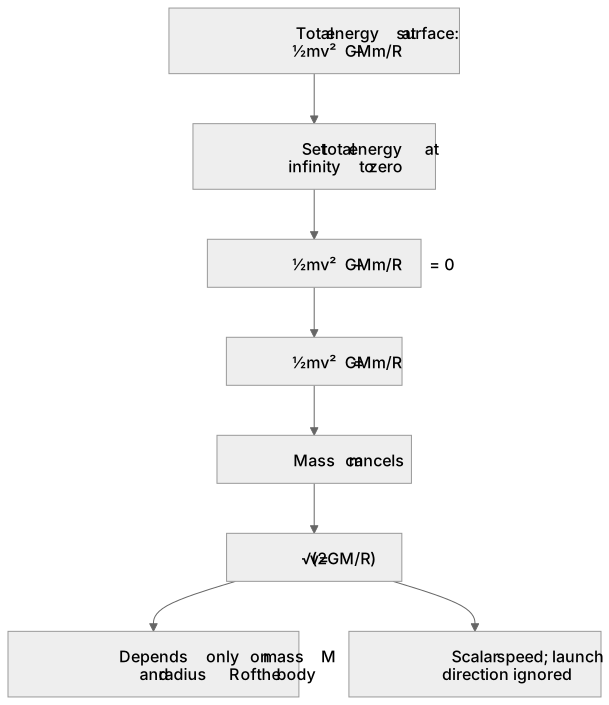
Key words
Say what each word means before you turn the card.
Escape velocity
Try answering aloud or in your head before turning the card.
Energy condition for escape
Try answering aloud or in your head before turning the card.
Independence from projectile mass
Try answering aloud or in your head before turning the card.
Escape velocity formula
Try answering aloud or in your head before turning the card.
See every definition
- Escape velocity
- The minimum speed a projectile needs at the surface of a mass M to escape its gravitational field and reach infinity with zero kinetic energy.
- Energy condition for escape
- At the surface, radius R, the total energy is ½mv² − GMm/R, and setting this equal to zero at infinity gives ½mv² = GMm/R.
- Independence from projectile mass
- The mass m cancels, so escape velocity depends only on the mass and radius of the body, not on the projectile.
- Escape velocity formula
- The expression v = √(2GM/R) obtained by equating total energy at the surface to zero at infinity.
Label the diagram
Some boxes have lost their names. Pick the right name for each number.
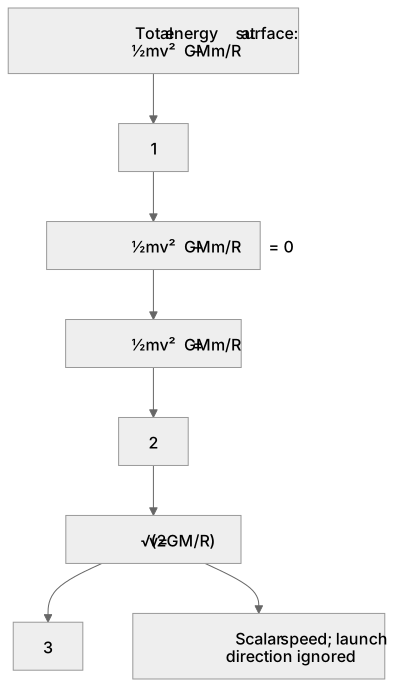
1Box 1
2Box 2
3Box 3
There is more to this lesson
The full lesson goes on to check your understanding and help you earn the marks. Create a free account to carry on, with your progress saved.
A week of Premium from your first lesson · Then the free plan continues · No card, no charge
Test your understanding of Gravitational potential and energy: (e) escape velocity.
Active recall beats re-reading. Take an instant quiz now to test what you’ve learned and lock it into long-term memory.
A week of Premium from your first lesson · Then the free plan continues · No card, no charge