OCR · A-Level · Physics
Course version: H556 · Version from Sept 2015
(a) amount of substance in moles; Avogadro constant N A equals 6.02 × 10…
Full specification wording
Ideal gases: (a) amount of substance in moles; Avogadro constant N A equals 6.02 × 10 23 mol –1
The amount of substance is measured in moles, symbol n.
Checked against the OCR H556 specification (opens in a new tab) on .
- Point 1 of 10
- 3 key terms
Study notes
From the checked teaching notes for this specification point.
The idea
The amount of substance is measured in moles, symbol n. One mole contains the Avogadro constant number of particles, N_A = 6.02 × 10²³ mol⁻¹. The number of particles N in a sample is therefore N = nN_A, and the number of moles is n = N/N_A. For example, 2.00 mol of helium contains 2.00 × 6.02 × 10²³ = 1.204 × 10²⁴ atoms. The unit mol⁻¹ shows that N_A is the number of particles per mole, so multiplying moles by N_A gives a pure number of particles. This links the macroscopic amount of gas to the microscopic particle count used in the ideal gas equation pV = nRT and in kinetic theory.
What earns the marks
- States that amount of substance is measured in moles, symbol n.
- Recalls the Avogadro constant as N_A = 6.02 × 10²³ mol⁻¹.
- Uses N = nN_A to convert between amount in moles and number of particles.
- Uses n = N/N_A to convert a particle count into moles.
- Interprets the unit mol⁻¹ as particles per mole.
Common mistakes and how to put them right
Writing the Avogadro constant without its unit or with the wrong unit.
Put it right: Write N_A = 6.02 × 10²³ mol⁻¹.
Confusing the Avogadro constant with the gas constant R.
Put it right: N_A counts particles per mole, while R appears in pV = nRT and has units J mol⁻¹ K⁻¹.
Multiplying by N_A when converting particles to moles.
Put it right: Divide the number of particles by N_A to find n.
Exam tips
- Check whether the question gives moles or a particle count, then choose N = nN_A or n = N/N_A accordingly.
- Keep the unit mol⁻¹ attached to N_A so you can see that the conversion cancels correctly.
- Give answers to a sensible number of significant figures, matching the data given.
Try the lesson
The start of the Ideal gases: (a) amount of substance in moles; Avogadro constant N A equals 6.02 × 10 23 mol –1 lesson, made from checked teaching notes for this specification point.
Listen
The amount of substance is measured in moles, symbol n. One mole contains the Avogadro constant number of particles, N_A = 6.02 × 10²³ mol⁻¹. The number of particles N in a sample is therefore N = nN_A, and the number of moles is n = N/N_A. For example, 2.00 mol of helium contains 2.00 × 6.02 × 10²³ = 1.204 × 10²⁴ atoms. The unit mol⁻¹ shows that N_A is the number of particles per mole, so multiplying moles by N_A gives a pure number of particles. This links the macroscopic amount of gas to the microscopic particle count used in the ideal gas equation pV = nRT and in kinetic theory. A strong answer earns marks for these points. States that amount of substance is measured in moles, symbol n. Recalls the Avogadro constant as N_A = 6.02 × 10²³ mol⁻¹. Uses N = nN_A to convert between amount in moles and number of particles. Uses n = N/N_A to convert a particle count into moles. A common slip: Writing the Avogadro constant without its unit or with the wrong unit. Instead, write N_A = 6.02 × 10²³ mol⁻¹. Exam tip: Check whether the question gives moles or a particle count, then choose N = nN_A or n = N/N_A accordingly.
See it
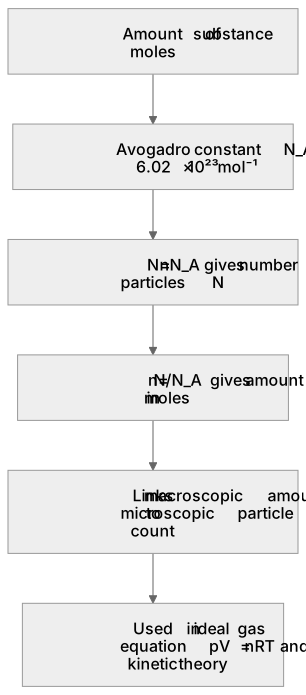
Put it in order
Put these steps in the order they happen.
- 1. N = nN_A gives number of particles N
- 2. Avogadro constant N_A = 6.02 × 10²³ mol⁻¹
- 3. Amount of substance n in moles
- 4. Used in ideal gas equation pV = nRT and kinetic theory
- 5. Links macroscopic amount to microscopic particle count
- 6. n = N/N_A gives amount in moles
Key words
Say what each word means before you turn the card.
Amount of substance
Try answering aloud or in your head before turning the card.
Avogadro constant
Try answering aloud or in your head before turning the card.
Conversion between moles and number of particles
Try answering aloud or in your head before turning the card.
See every definition
- Amount of substance
- A quantity measured in moles, symbol n.
- Avogadro constant
- N_A = 6.02 × 10²³ mol⁻¹, the number of particles per mole.
- Conversion between moles and number of particles
- The number of particles N in a sample is N = nN_A, and the number of moles is n = N/N_A.
Label the diagram
Some boxes have lost their names. Pick the right name for each number.
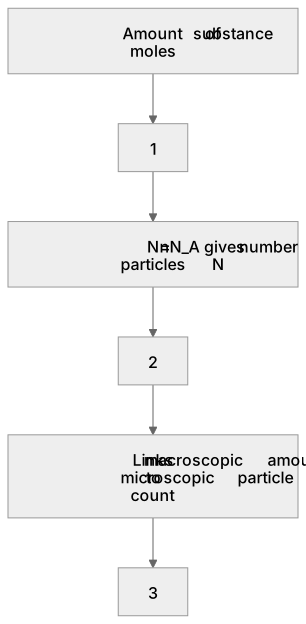
1Box 1
2Box 2
3Box 3
There is more to this lesson
The full lesson goes on to check your understanding and help you earn the marks. Create a free account to carry on, with your progress saved.
A week of Premium from your first lesson · Then the free plan continues · No card, no charge
Test your understanding of Ideal gases: (a) amount of substance in moles; Avogadro constant N A equals 6.02 × 10 23 mol –1
Active recall beats re-reading. Take an instant quiz now to test what you’ve learned and lock it into long-term memory.
A week of Premium from your first lesson · Then the free plan continues · No card, no charge