OCR · A-Level · Physics
Course version: H556 · Version from Sept 2015
Ideal gases: (b) model of kinetic theory of gases
The kinetic theory model treats a gas as a large number of identical point molecules in continuous random motion.
Checked against the OCR H556 specification (opens in a new tab) on .
- Point 2 of 10
- 3 key terms
Study notes
From the checked teaching notes for this specification point.
The idea
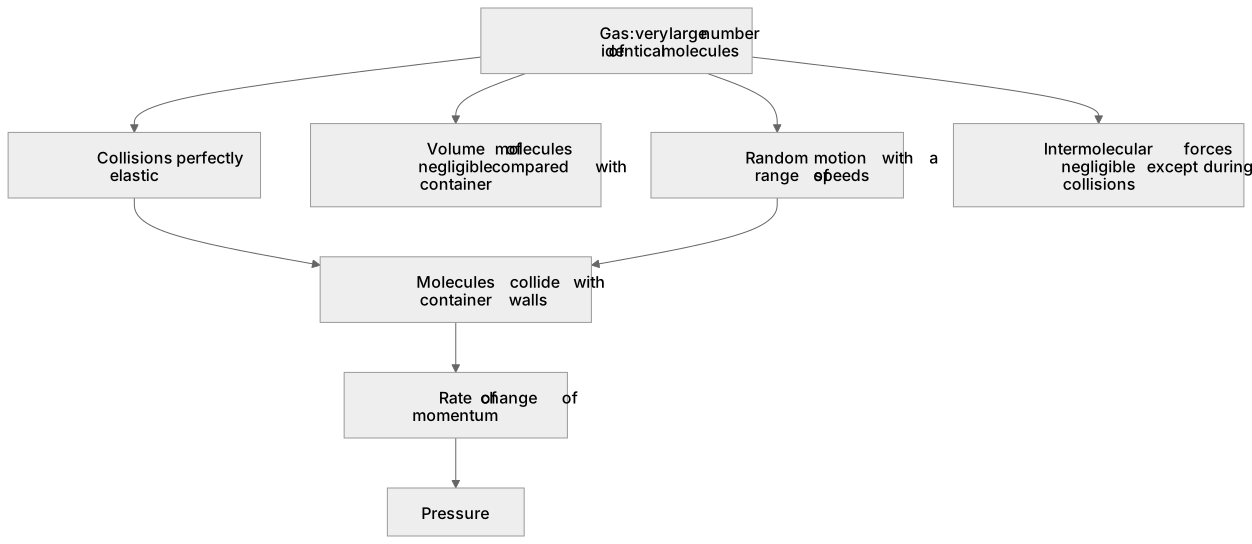
The kinetic theory model treats a gas as a large number of identical point molecules in continuous random motion. Their volume is negligible compared with the container, and collisions between molecules and with the walls are perfectly elastic. Between collisions no forces act, except during contact. Pressure arises from the rate of change of momentum when molecules collide with the walls. For example, doubling the absolute temperature of a fixed volume of gas increases the mean square speed of its molecules, so they strike the walls more often and harder, raising the pressure. This model explains the macroscopic gas laws in terms of molecular behaviour.
What earns the marks
- Gas consists of a very large number of identical molecules moving in random directions with a range of speeds.
- The volume of the molecules is negligible compared with the volume of the container.
- Collisions between molecules, and between molecules and the container walls, are perfectly elastic.
- Intermolecular forces are negligible except during collisions.
- Pressure is caused by the rate of change of momentum of molecules colliding with the walls.
Common mistakes and how to put them right
Thinking molecules all move at the same speed.
Put it right: The model uses a distribution of speeds and refers to mean square speed.
Believing intermolecular forces act continuously.
Put it right: The model assumes they are negligible except during collisions.
Confusing the model with a real gas.
Put it right: The ideal gas model ignores molecular volume and attractive forces, which real gases have.
Exam tips
- State assumptions precisely: 'volume of molecules negligible' not just 'molecules are small'.
- Link pressure to rate of change of momentum, not just to collisions.
- Use the phrase 'random motion' when describing molecular movement.
Try the lesson
The start of the Ideal gases: (b) model of kinetic theory of gases lesson, made from checked teaching notes for this specification point.
Listen
The kinetic theory model treats a gas as a large number of identical point molecules in continuous random motion. Their volume is negligible compared with the container, and collisions between molecules and with the walls are perfectly elastic. Between collisions no forces act, except during contact. Pressure arises from the rate of change of momentum when molecules collide with the walls. For example, doubling the absolute temperature of a fixed volume of gas increases the mean square speed of its molecules, so they strike the walls more often and harder, raising the pressure. This model explains the macroscopic gas laws in terms of molecular behaviour. A strong answer earns marks for these points. Gas consists of a very large number of identical molecules moving in random directions with a range of speeds. The volume of the molecules is negligible compared with the volume of the container. Collisions between molecules, and between molecules and the container walls, are perfectly elastic. Intermolecular forces are negligible except during collisions. Exam tip: State assumptions precisely: 'volume of molecules negligible' not just 'molecules are small'.
See it
Key words
Say what each word means before you turn the card.
Molecular model of gases
Try answering aloud or in your head before turning the card.
Assumptions of kinetic theory
Try answering aloud or in your head before turning the card.
Microscopic origin of pressure
Try answering aloud or in your head before turning the card.
See every definition
- Molecular model of gases
- A gas is treated as a very large number of identical point molecules in continuous random motion with a range of speeds.
- Assumptions of kinetic theory
- The volume of the molecules is negligible compared with the container, collisions are perfectly elastic, and intermolecular forces are negligible except during collisions.
- Microscopic origin of pressure
- Pressure is caused by the rate of change of momentum of molecules colliding with the walls.
Label the diagram
Some boxes have lost their names. Pick the right name for each number.
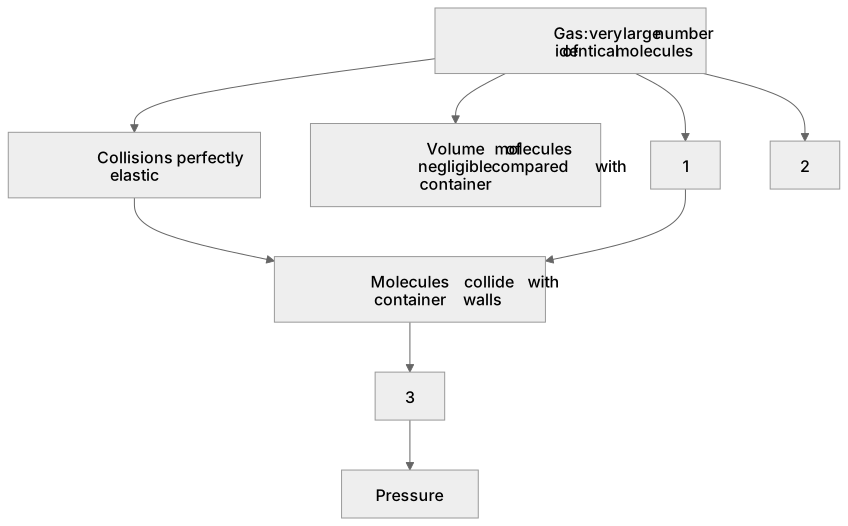
1Box 1
2Box 2
3Box 3
There is more to this lesson
The full lesson goes on to check your understanding and help you earn the marks. Create a free account to carry on, with your progress saved.
A week of Premium from your first lesson · Then the free plan continues · No card, no charge
Test your understanding of Ideal gases: (b) model of kinetic theory of gases
Active recall beats re-reading. Take an instant quiz now to test what you’ve learned and lock it into long-term memory.
A week of Premium from your first lesson · Then the free plan continues · No card, no charge