OCR · A-Level · Physics
Course version: H556 · Version from Sept 2015
(b) gravitational potential energy of an object in a uniform gravitational…
Full specification wording
Kinetic and potential energies: (b) gravitational potential energy of an object in a uniform gravitational field; E p = mgh
Gravitational potential energy (GPE) is the energy an object possesses due to its position in a gravitational field.
Checked against the OCR H556 specification (opens in a new tab) on .
- Point 2 of 3
- 4 key terms
Study notes
From the checked teaching notes for this specification point.
The idea
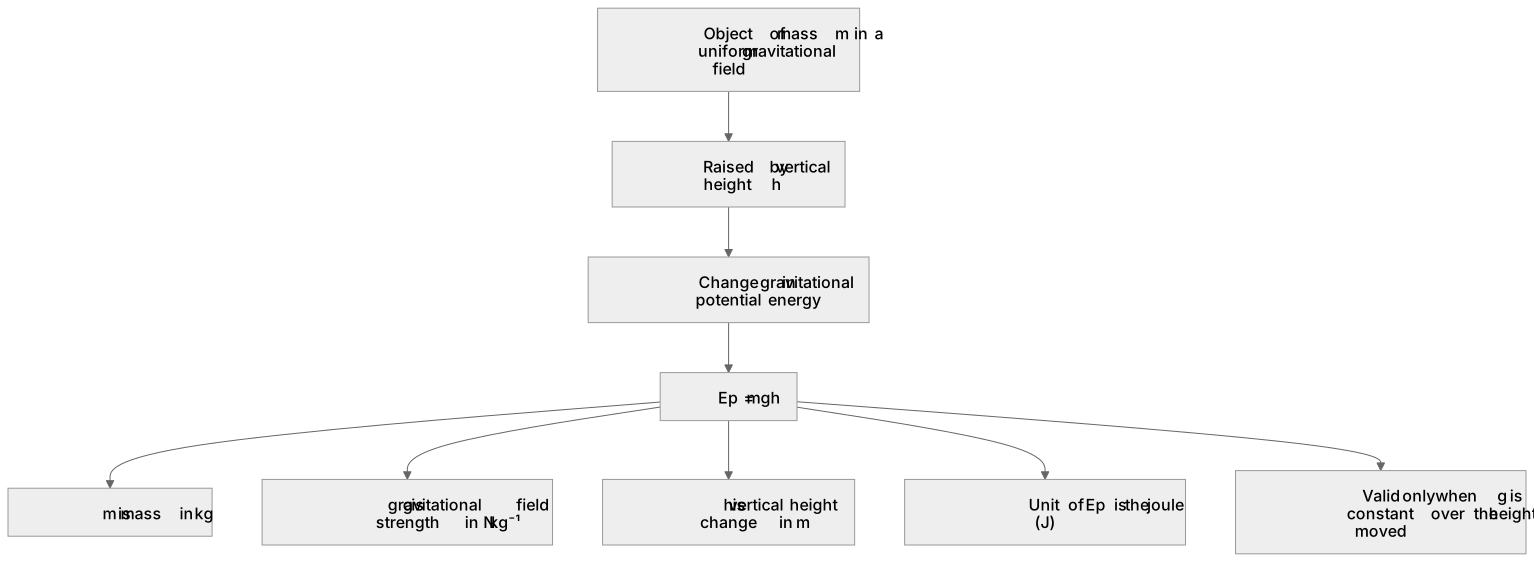
Gravitational potential energy (GPE) is the energy an object possesses due to its position in a gravitational field. In a uniform gravitational field, such as near the Earth's surface, the change in GPE when an object of mass m is raised by a height h is given by Ep = mgh, where g is the gravitational field strength (approximately 9.81 N kg⁻¹ on Earth). The equation assumes the field is uniform, meaning g is constant over the height moved. The unit of GPE is the joule (J).
For example: Lifting a 2 kg mass by 3 m gives Ep = 2 × 9.81 × 3 = 58.86 J. In MCQ questions, you may calculate GPE, compare changes, or identify the effect of changing mass, height, or gravitational field strength.
What earns the marks
- Gravitational potential energy is the energy stored in an object due to its position in a gravitational field.
- In a uniform gravitational field, the change in gravitational potential energy is calculated using Ep = mgh.
- m is mass in kg, g is gravitational field strength in N kg⁻¹, and h is vertical height change in m.
- The unit of gravitational potential energy is the joule (J).
- The equation applies when the gravitational field is uniform, i.e., g is constant over the change in height.
Common mistakes and how to put them right
Using the wrong value for g.
Put it right: Check the question for the value of g to use; if not given, use 9.81 N kg⁻¹.
Forgetting that h is the vertical height change, not the distance moved along a slope.
Put it right: Use the vertical component of displacement.
Mixing up mass and weight.
Put it right: Ensure you use mass in kg, not weight in N.
Assuming the equation applies in non-uniform fields.
Put it right: For large height changes, g varies and the equation is not accurate.
Exam tips
- In multiple-choice questions, check whether the height is vertical; if an object moves along a slope, you must use the vertical height, not the slope length.
- If the question gives g as 10 N kg⁻¹, use that value; otherwise use 9.81 N kg⁻¹.
- Remember that gravitational potential energy is relative to a chosen zero level; the equation gives the change in GPE.
Try the lesson
The start of the Kinetic and potential energies: (b) gravitational potential energy of an object in a uniform gravitational field; E p = mgh lesson, made from checked teaching notes for this specification point.
Listen
Gravitational potential energy (GPE) is the energy an object possesses due to its position in a gravitational field. In a uniform gravitational field, such as near the Earth's surface, the change in GPE when an object of mass m is raised by a height h is given by Ep = mgh, where g is the gravitational field strength (approximately 9.81 N kg⁻¹ on Earth). The equation assumes the field is uniform, meaning g is constant over the height moved. The unit of GPE is the joule (J). For example, lifting a 2 kg mass by 3 m gives Ep = 2 × 9.81 × 3 = 58.86 J. In MCQ questions, you may calculate GPE, compare changes, or identify the effect of changing mass, height, or gravitational field strength. A strong answer earns marks for these points. Gravitational potential energy is the energy stored in an object due to its position in a gravitational field. In a uniform gravitational field, the change in gravitational potential energy is calculated using Ep = mgh. m is mass in kg, g is gravitational field strength in N kg⁻¹, and h is vertical height change in m. The unit of gravitational potential energy is the joule (J). A common slip: Using the wrong value for g: for example, using 10 m s⁻² instead of 9.81 N kg⁻¹ when the question expects the standard value. Instead, check the question for the value of g to use; if not given, use 9.81 N kg⁻¹. Exam tip: In multiple-choice questions, check whether the height is vertical; if an object moves along a slope, you must use the vertical height, not the slope length.
See it
Key words
Say what each word means before you turn the card.
Gravitational potential energy
Try answering aloud or in your head before turning the card.
Uniform gravitational field
Try answering aloud or in your head before turning the card.
Gravitational field strength
Try answering aloud or in your head before turning the card.
Ep = mgh
Try answering aloud or in your head before turning the card.
See every definition
- Gravitational potential energy
- The energy an object possesses due to its position in a gravitational field, measured in the joule (J).
- Uniform gravitational field
- A field in which g is constant over the height moved, such as near the Earth's surface.
- Gravitational field strength
- The quantity g in the equation Ep = mgh, approximately 9.81 N kg⁻¹ on Earth.
- Ep = mgh
- The equation giving the change in gravitational potential energy when an object of mass m is raised by a height h in a uniform gravitational field.
Label the diagram
Some boxes have lost their names. Pick the right name for each number.
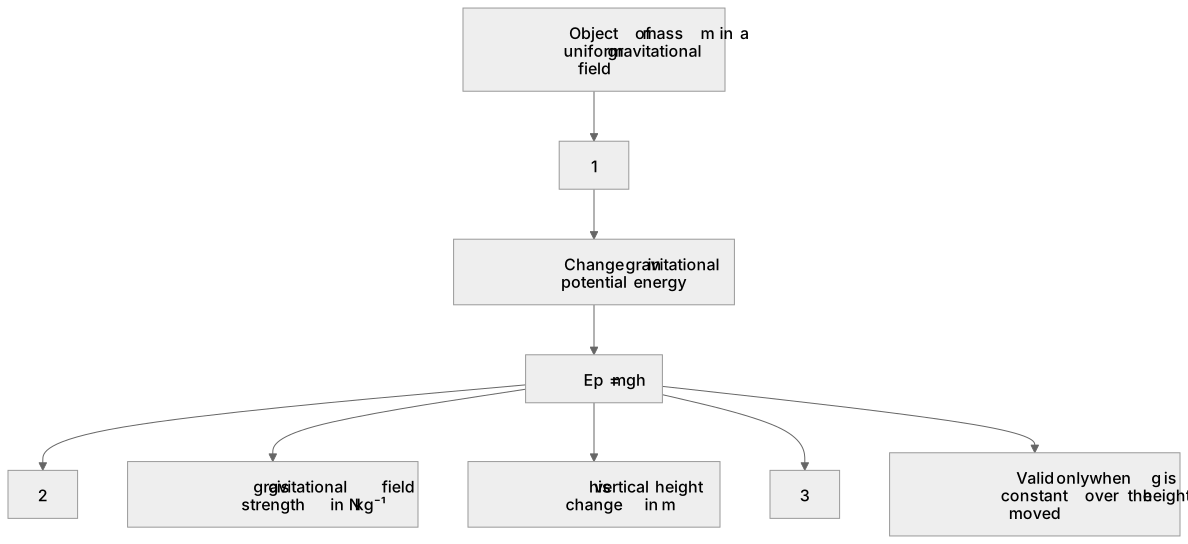
1Box 1
2Box 2
3Box 3
There is more to this lesson
The full lesson goes on to check your understanding and help you earn the marks. Create a free account to carry on, with your progress saved.
A week of Premium from your first lesson · Then the free plan continues · No card, no charge
Test your understanding of Kinetic and potential energies: (b) gravitational potential energy of an object in a uniform gravitational field; E p = mgh
Active recall beats re-reading. Take an instant quiz now to test what you’ve learned and lock it into long-term memory.
A week of Premium from your first lesson · Then the free plan continues · No card, no charge