OCR · A-Level · Physics
Course version: H556 · Version from Sept 2015
(c) the exchange between gravitational potential energy and kinetic energy.
Full specification wording
Kinetic and potential energies: (c) the exchange between gravitational potential energy and kinetic energy.
In a closed system where only gravity acts, gravitational potential energy (GPE) and kinetic energy (KE) can be exchanged.
Checked against the OCR H556 specification (opens in a new tab) on .
- Point 3 of 3
Study notes
From the checked teaching notes for this specification point.
The idea
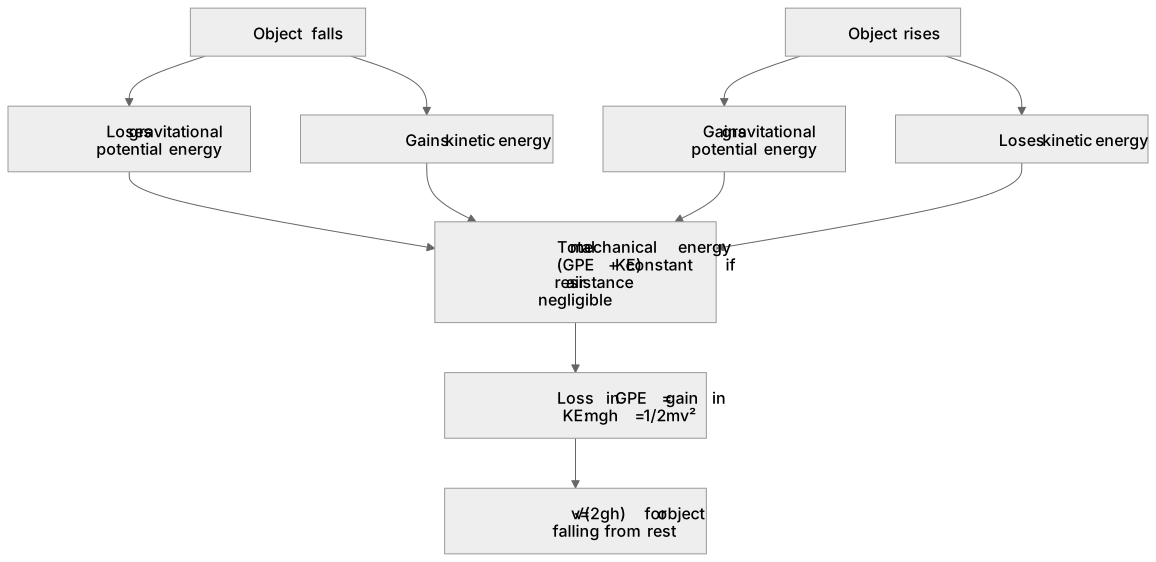
In a closed system where only gravity acts, gravitational potential energy (GPE) and kinetic energy (KE) can be exchanged. As an object falls, it loses GPE and gains KE; as it rises, it gains GPE and loses KE. If air resistance is negligible, the total mechanical energy (GPE + KE) remains constant. For example, a ball dropped from height h converts all its initial GPE (mgh) into KE just before impact, so 1/2 mv² = mgh, giving v = √(2gh). In MCQ questions, you may be asked to identify energy changes, calculate speeds using conservation of energy, or compare energies at different points.
What earns the marks
- Gravitational potential energy can be converted into kinetic energy and vice versa.
- In the absence of resistive forces, the total mechanical energy (sum of GPE and KE) is conserved.
- The exchange is described by equating the loss in GPE to the gain in KE: mgh = 1/2 mv².
- The speed of a falling object can be found from v = √(2gh) when starting from rest and ignoring air resistance.
- Energy conservation applies to systems where only conservative forces (like gravity) do work.
Common mistakes and how to put them right
Assuming energy is lost when it is only transferred between forms.
Put it right: In the absence of resistive forces, total mechanical energy is constant.
Forgetting that mass cancels when equating mgh and 1/2 mv², leading to v = √(2gh).
Put it right: Recognise that the final speed is independent of mass.
Including air resistance in calculations when the question states it is negligible.
Put it right: Only include resistive forces if explicitly mentioned.
Mixing up the direction of energy transfer.
Put it right: Identify whether the object is gaining or losing height.
Exam tips
- In multiple-choice questions, look for options that conserve total energy; eliminate any that suggest energy is created or destroyed.
- If a question involves a falling object, you can often use mgh = 1/2 mv² to find speed without knowing the mass.
- Check whether the system is isolated; if friction or air resistance is present, mechanical energy is not conserved.
Try the lesson
The start of the Kinetic and potential energies: (c) the exchange between gravitational potential energy and kinetic energy. lesson, made from checked teaching notes for this specification point.
Listen
In a closed system where only gravity acts, gravitational potential energy (GPE) and kinetic energy (KE) can be exchanged. As an object falls, it loses GPE and gains KE; as it rises, it gains GPE and loses KE. If air resistance is negligible, the total mechanical energy (GPE + KE) remains constant. For example, a ball dropped from height h converts all its initial GPE (mgh) into KE just before impact, so 1/2 mv² = mgh, giving v = √(2gh). In MCQ questions, you may be asked to identify energy changes, calculate speeds using conservation of energy, or compare energies at different points. A strong answer earns marks for these points. Gravitational potential energy can be converted into kinetic energy and vice versa. In the absence of resistive forces, the total mechanical energy (sum of GPE and KE) is conserved. The exchange is described by equating the loss in GPE to the gain in KE: mgh = 1/2 mv². The speed of a falling object can be found from v = √(2gh) when starting from rest and ignoring air resistance. A common slip: Assuming energy is lost when it is only transferred between forms. Instead, in the absence of resistive forces, total mechanical energy is constant. Exam tip: In multiple-choice questions, look for options that conserve total energy; eliminate any that suggest energy is created or destroyed.
See it
Label the diagram
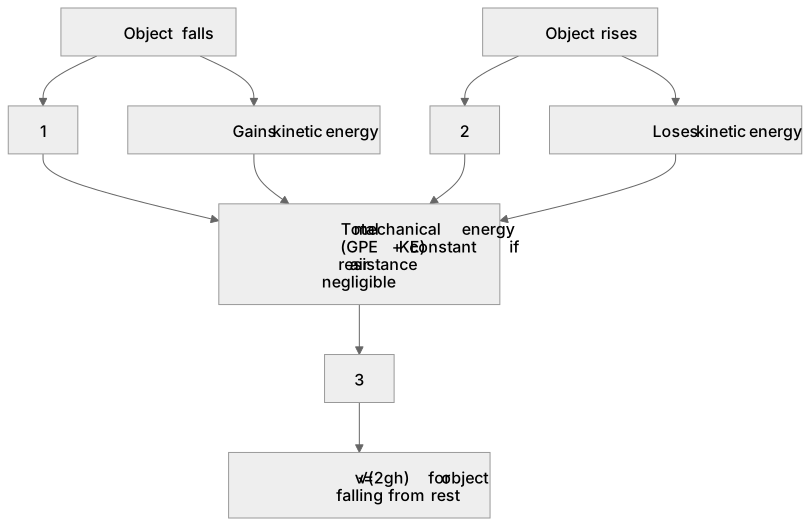
Some boxes have lost their names. Pick the right name for each number.
1Box 1
2Box 2
3Box 3
There is more to this lesson
The full lesson goes on to check your understanding and help you earn the marks. Create a free account to carry on, with your progress saved.
A week of Premium from your first lesson · Then the free plan continues · No card, no charge
Test your understanding of Kinetic and potential energies: (c) the exchange between gravitational potential energy and kinetic energy.
Active recall beats re-reading. Take an instant quiz now to test what you’ve learned and lock it into long-term memory.
A week of Premium from your first lesson · Then the free plan continues · No card, no charge