OCR · A-Level · Physics
Course version: H556 · Version from Sept 2015
(a) magnetic fields are due to moving charges or permanent magnets
Full specification wording
Magnetic fields: (a) magnetic fields are due to moving charges or permanent magnets
A magnetic field is a region where a magnetic force acts on magnetic materials or moving charges.
Checked against the OCR H556 specification (opens in a new tab) on .
- Point 1 of 7
- 4 key terms
Study notes
From the checked teaching notes for this specification point.
The idea
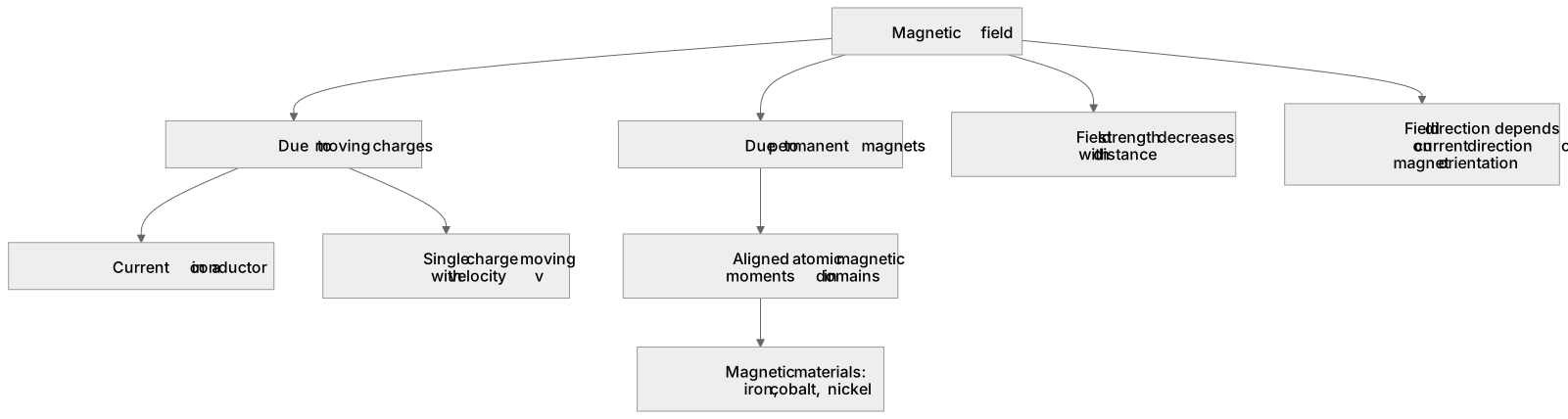
A magnetic field is a region where a magnetic force acts on magnetic materials or moving charges. This statement identifies two independent origins. First, moving charges: any current in a wire is a flow of charge, so a current-carrying conductor is surrounded by a magnetic field; a single charge moving through space also produces one. Second, permanent magnets: in iron, cobalt and nickel, atomic magnetic moments align to give a net field without any external current. The two origins are linked, because magnetism in materials arises from moving charges at atomic scale. A useful test is to ask whether a current or a magnetised material is present. Field strength falls with distance from the source, and the field direction depends on current direction or on the orientation of the magnet's poles.
What earns the marks
- Moving charges produce a magnetic field; a steady current is a flow of charge and so creates a field around the conductor.
- A single charge moving with velocity v produces a magnetic field; a stationary charge does not.
- Permanent magnets produce a magnetic field because atomic magnetic moments within domains are aligned.
- Magnetic materials include iron, cobalt and nickel; alignment of domains gives a net magnetic field.
- The field direction depends on the direction of conventional current or on the orientation of the magnet.
- Field strength decreases with distance from the current or magnet.
Common mistakes and how to put them right
Thinking a stationary charge produces a magnetic field.
Put it right: The charge must be moving, so a stationary charge has an electric field but no magnetic field.
Believing permanent magnets contain no moving charge.
Put it right: Magnetism in materials arises from atomic-scale moving charges whose moments are aligned.
Assuming the field around a current is uniform.
Put it right: It is strongest close to the conductor and weakens with distance.
Confusing magnetic poles with electric charges.
Put it right: Isolated magnetic poles have not been observed, whereas positive and negative charges can exist separately.
Exam tips
- Read the stem carefully to identify whether the source is a current, a moving charge or a permanent magnet before choosing an option.
- Eliminate options that describe a stationary charge producing a magnetic field, since that is impossible.
- Check the direction wording: conventional current direction is opposite to electron flow, so field direction follows conventional current.
- Where an option mentions field strength, ask whether it correctly states that the field weakens with distance.
Try the lesson
The start of the Magnetic fields: (a) magnetic fields are due to moving charges or permanent magnets lesson, made from checked teaching notes for this specification point.
Listen
A magnetic field is a region where a magnetic force acts on magnetic materials or moving charges. This statement identifies two independent origins. First, moving charges: any current in a wire is a flow of charge, so a current-carrying conductor is surrounded by a magnetic field; a single charge moving through space also produces one. Second, permanent magnets: in iron, cobalt and nickel, atomic magnetic moments align to give a net field without any external current. The two origins are linked, because magnetism in materials arises from moving charges at atomic scale. A useful test is to ask whether a current or a magnetised material is present. Field strength falls with distance from the source, and the field direction depends on current direction or on the orientation of the magnet's poles. A strong answer earns marks for these points. Moving charges produce a magnetic field; a steady current is a flow of charge and so creates a field around the conductor. A single charge moving with velocity v produces a magnetic field; a stationary charge does not. Permanent magnets produce a magnetic field because atomic magnetic moments within domains are aligned. Magnetic materials include iron, cobalt and nickel; alignment of domains gives a net magnetic field. Exam tip: Read the stem carefully to identify whether the source is a current, a moving charge or a permanent magnet before choosing an option.
See it
Key words
Say what each word means before you turn the card.
Moving charges
Try answering aloud or in your head before turning the card.
Permanent magnets
Try answering aloud or in your head before turning the card.
Field direction
Try answering aloud or in your head before turning the card.
Field strength
Try answering aloud or in your head before turning the card.
See every definition
- Moving charges
- A steady current is a flow of charge and so creates a field around the conductor, and a single charge moving with velocity v produces a magnetic field.
- Permanent magnets
- These produce a magnetic field because atomic magnetic moments within domains are aligned, giving a net magnetic field in materials such as iron, cobalt and nickel.
- Field direction
- This depends on the direction of conventional current or on the orientation of the magnet.
- Field strength
- This decreases with distance from the current or magnet.
Label the diagram
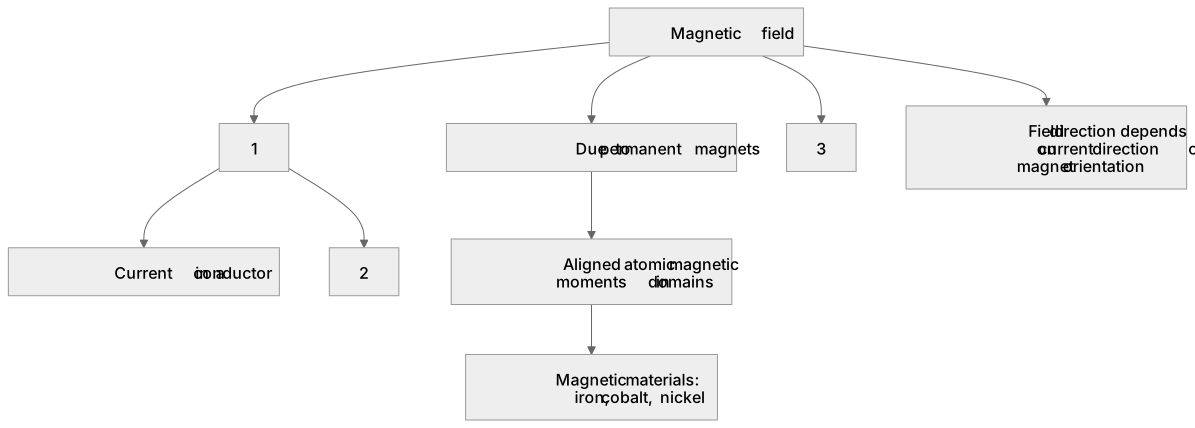
Some boxes have lost their names. Pick the right name for each number.
1Box 1
2Box 2
3Box 3
There is more to this lesson
The full lesson goes on to check your understanding and help you earn the marks. Create a free account to carry on, with your progress saved.
A week of Premium from your first lesson · Then the free plan continues · No card, no charge
Test your understanding of Magnetic fields: (a) magnetic fields are due to moving charges or permanent magnets
Active recall beats re-reading. Take an instant quiz now to test what you’ve learned and lock it into long-term memory.
A week of Premium from your first lesson · Then the free plan continues · No card, no charge