OCR · A-Level · Physics
Course version: H556 · Version from Sept 2015
Magnetic fields: (b) magnetic field lines to map magnetic fields
Magnetic field lines are a visual convention for mapping a magnetic field.
Checked against the OCR H556 specification (opens in a new tab) on .
- Point 2 of 7
- 3 key terms
Study notes
From the checked teaching notes for this specification point.
The idea
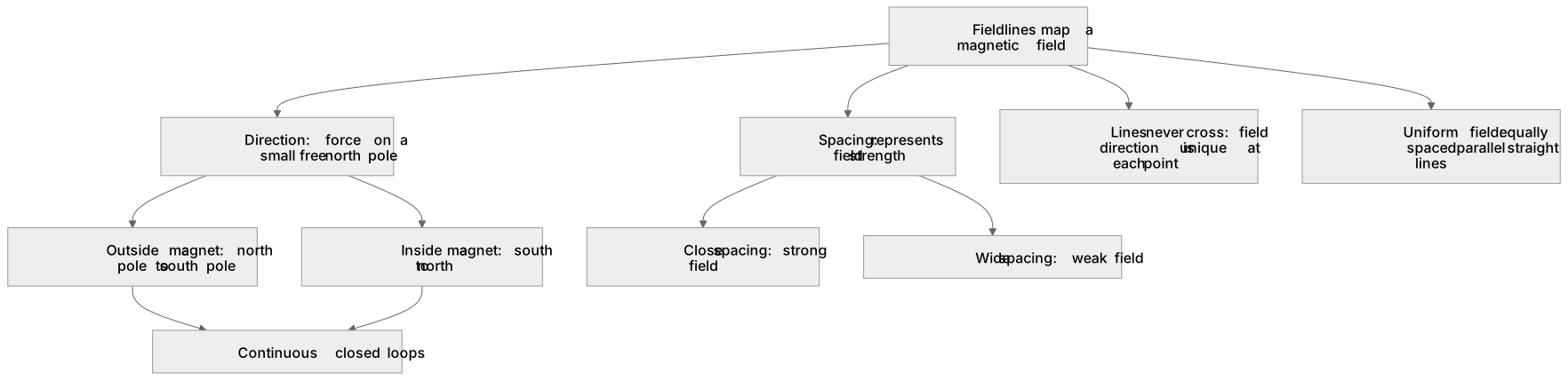
Magnetic field lines are a visual convention for mapping a magnetic field. The direction of the line at any point gives the direction of the force on a small free north pole placed there, so lines emerge from a north pole and enter a south pole outside a magnet. The spacing of the lines represents field strength: closely spaced lines mean a strong field, widely spaced lines a weak field. Lines never cross, because the field has only one direction at each point. A uniform field is drawn as equally spaced parallel straight lines, for example between the poles of a large horseshoe magnet. Field lines are continuous closed loops; inside a magnet they run from south to north, completing the loop.
What earns the marks
- Field lines show the direction of the force on a small free north pole at each point.
- Outside a magnet, field lines run from north pole to south pole; inside, they run from south to north.
- Line spacing indicates field strength: closer lines mean a stronger field.
- Field lines never cross, because the field direction at a point is unique.
- A uniform field is represented by equally spaced parallel straight lines.
- Field lines form continuous closed loops.
Common mistakes and how to put them right
Drawing field lines that cross.
Put it right: This would imply two field directions at one point, which is impossible.
Thinking field lines start and stop at poles.
Put it right: They are continuous closed loops, running south to north inside the magnet.
Treating widely spaced lines as a strong field.
Put it right: Wide spacing indicates a weak field, while close spacing indicates a strong field.
Assuming field lines show the path of a moving charge.
Put it right: They show field direction, not the trajectory of a particle.
Exam tips
- When asked to interpret a field diagram, check direction arrows first, then spacing, then whether lines cross.
- Use the rule that lines point away from north and towards south outside the magnet.
- For uniform-field questions, look for equally spaced parallel lines rather than curved ones.
- Remember that line density is a qualitative indicator of field strength, not a numerical value.
Try the lesson
The start of the Magnetic fields: (b) magnetic field lines to map magnetic fields lesson, made from checked teaching notes for this specification point.
Listen
Magnetic field lines are a visual convention for mapping a magnetic field. The direction of the line at any point gives the direction of the force on a small free north pole placed there, so lines emerge from a north pole and enter a south pole outside a magnet. The spacing of the lines represents field strength: closely spaced lines mean a strong field, widely spaced lines a weak field. Lines never cross, because the field has only one direction at each point. A uniform field is drawn as equally spaced parallel straight lines, for example between the poles of a large horseshoe magnet. Field lines are continuous closed loops; inside a magnet they run from south to north, completing the loop. A strong answer earns marks for these points. Field lines show the direction of the force on a small free north pole at each point. Outside a magnet, field lines run from north pole to south pole; inside, they run from south to north. Line spacing indicates field strength: closer lines mean a stronger field. Field lines never cross, because the field direction at a point is unique. Exam tip: When asked to interpret a field diagram, check direction arrows first, then spacing, then whether lines cross.
See it
Key words
Say what each word means before you turn the card.
Field line conventions
Try answering aloud or in your head before turning the card.
Direction of magnetic field
Try answering aloud or in your head before turning the card.
Field strength from line spacing
Try answering aloud or in your head before turning the card.
See every definition
- Field line conventions
- A visual convention for mapping a magnetic field, in which lines emerge from a north pole and enter a south pole outside a magnet.
- Direction of magnetic field
- The direction of the force on a small free north pole placed at that point.
- Field strength from line spacing
- Closely spaced lines mean a strong field, while widely spaced lines mean a weak field.
Label the diagram
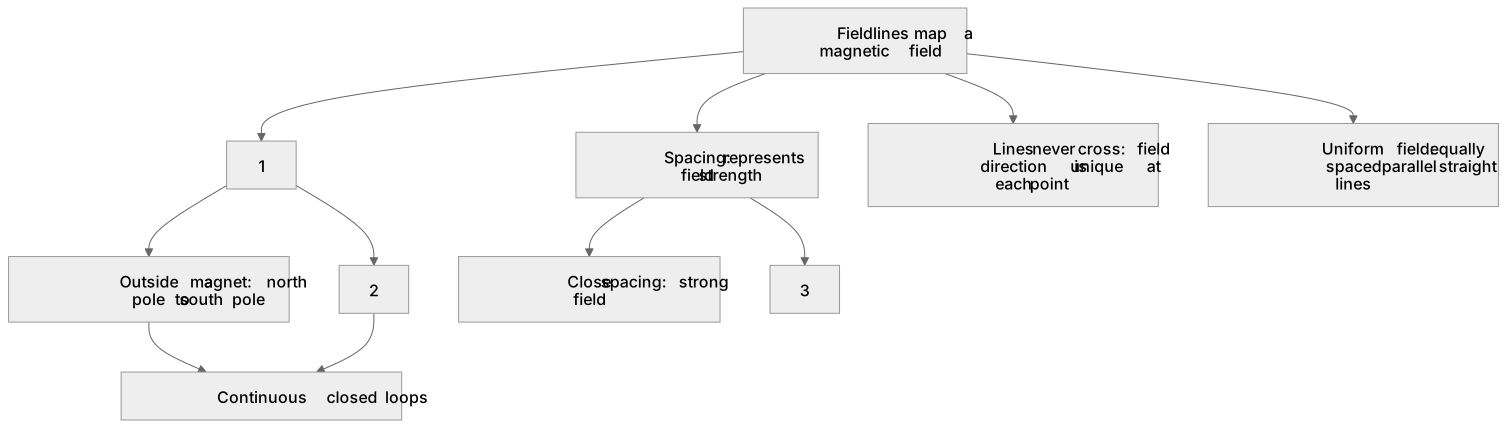
Some boxes have lost their names. Pick the right name for each number.
1Box 1
2Box 2
3Box 3
There is more to this lesson
The full lesson goes on to check your understanding and help you earn the marks. Create a free account to carry on, with your progress saved.
A week of Premium from your first lesson · Then the free plan continues · No card, no charge
Test your understanding of Magnetic fields: (b) magnetic field lines to map magnetic fields
Active recall beats re-reading. Take an instant quiz now to test what you’ve learned and lock it into long-term memory.
A week of Premium from your first lesson · Then the free plan continues · No card, no charge