OCR · A-Level · Physics
Course version: H556 · Version from Sept 2015
Mean drift velocity: (a) mean drift velocity of charge carriers
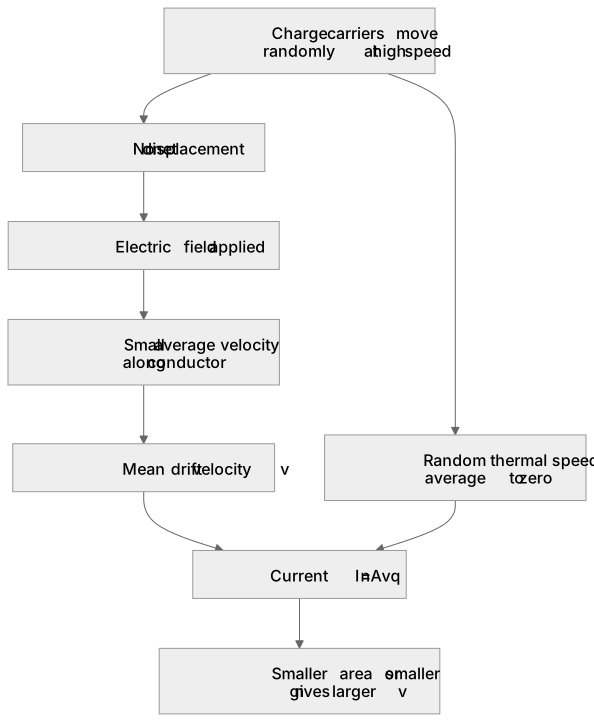
In a conductor, charge carriers move randomly with high speeds but with no net displacement until an electric field is applied.
Checked against the OCR H556 specification (opens in a new tab) on .
- Point 1 of 3
- 4 key terms
Study notes
From the checked teaching notes for this specification point.
The idea
In a conductor, charge carriers move randomly with high speeds but with no net displacement until an electric field is applied. The field gives each carrier a small average velocity along the conductor, called the mean drift velocity v. The current is I = nAvq, where n is the number density of charge carriers, A is the cross-sectional area, v is the mean drift velocity and q is the charge on each carrier. For copper, n is about 8.5 × 10²⁸ m⁻³, so a current of 1 A in a wire of cross-sectional area 1 × 10⁻⁶ m² gives v = I ÷ (nAq) ≈ 7 × 10⁻⁵ m s⁻¹, a fraction of a millimetre per second. The random thermal speeds are much larger, around 10⁵ m s⁻¹, but average to zero.
What earns the marks
- Mean drift velocity is the average velocity of charge carriers along a conductor due to an applied electric field.
- The relationship is I = nAvq, where n is the number density of charge carriers, A is the cross-sectional area, v is the mean drift velocity and q is the charge on each carrier.
- Carriers also have much larger random thermal speeds, but these average to zero and do not contribute to the current.
- For a given current, a smaller cross-sectional area or a smaller number density gives a larger mean drift velocity.
- Typical values of mean drift velocity in metals are of the order of 10⁻⁵ to 10⁻⁴ m s⁻¹, far smaller than the random thermal speeds.
Common mistakes and how to put them right
Confusing mean drift velocity with the speed at which the electrical signal travels.
Put it right: The signal propagates much faster than the carriers drift.
Using the cross-sectional area in cm² without converting to m².
Put it right: The equation requires SI units, so convert 1 cm² to 1 × 10⁻⁴ m².
Forgetting that n is the number density of charge carriers per cubic metre, not the total number of carriers in the wire.
Exam tips
- Rearrange I = nAvq for the quantity required before substituting values, and check that all units are SI.
- Remember that for electrons q = 1.60 × 10⁻¹⁹ C, and use the magnitude when calculating v.
- If a question gives the number of carriers per unit volume, use it directly as n; if it gives the total number, divide by the volume of the conductor.
Try the lesson
The start of the Mean drift velocity: (a) mean drift velocity of charge carriers lesson, made from checked teaching notes for this specification point.
Listen
In a conductor, charge carriers move randomly with high speeds but with no net displacement until an electric field is applied. The field gives each carrier a small average velocity along the conductor, called the mean drift velocity v. The current is I = nAvq, where n is the number density of charge carriers, A is the cross-sectional area, v is the mean drift velocity and q is the charge on each carrier. For copper, n is about 8.5 × 10²⁸ m⁻³, so a current of 1 A in a wire of cross-sectional area 1 × 10⁻⁶ m² gives v = I ÷ (nAq) ≈ 7 × 10⁻⁵ m s⁻¹, a fraction of a millimetre per second. The random thermal speeds are much larger, around 10⁵ m s⁻¹, but average to zero. A strong answer earns marks for these points. Mean drift velocity is the average velocity of charge carriers along a conductor due to an applied electric field. The relationship is I = nAvq, where n is the number density of charge carriers, A is the cross-sectional area, v is the mean drift velocity and q is the charge on each carrier. Carriers also have much larger random thermal speeds, but these average to zero and do not contribute to the current. For a given current, a smaller cross-sectional area or a smaller number density gives a larger mean drift velocity. Exam tip: Rearrange I = nAvq for the quantity required before substituting values, and check that all units are SI.
See it
Key words
Say what each word means before you turn the card.
Mean drift velocity
Try answering aloud or in your head before turning the card.
Number density of charge carriers
Try answering aloud or in your head before turning the card.
Relationship between current and drift velocity
Try answering aloud or in your head before turning the card.
Random thermal motion versus drift motion
Try answering aloud or in your head before turning the card.
See every definition
- Mean drift velocity
- The average velocity of charge carriers along a conductor due to an applied electric field.
- Number density of charge carriers
- The number of charge carriers per cubic metre, denoted n in the equation I = nAvq.
- Relationship between current and drift velocity
- The current is I = nAvq, where n is the number density of charge carriers, A is the cross-sectional area, v is the mean drift velocity and q is the charge on each carrier.
- Random thermal motion versus drift motion
- Carriers have much larger random thermal speeds, but these average to zero and do not contribute to the current, whereas the field gives each carrier a small average velocity along the conductor.
Label the diagram
Some boxes have lost their names. Pick the right name for each number.
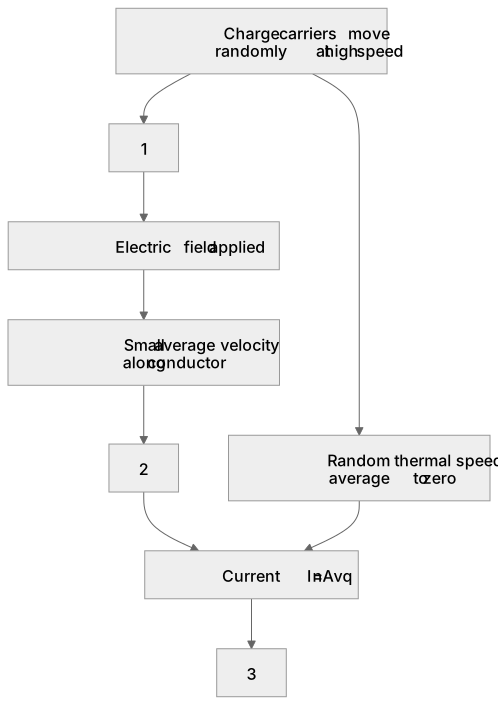
1Box 1
2Box 2
3Box 3
There is more to this lesson
The full lesson goes on to check your understanding and help you earn the marks. Create a free account to carry on, with your progress saved.
A week of Premium from your first lesson · Then the free plan continues · No card, no charge
Test your understanding of Mean drift velocity: (a) mean drift velocity of charge carriers
Active recall beats re-reading. Take an instant quiz now to test what you’ve learned and lock it into long-term memory.
A week of Premium from your first lesson · Then the free plan continues · No card, no charge