OCR · A-Level · Physics
Course version: H556 · Version from Sept 2015
(a) systematic errors (including zero errors) and random errors in…
Full specification wording
Measurements and uncertainties: (a) systematic errors (including zero errors) and random errors in measurements
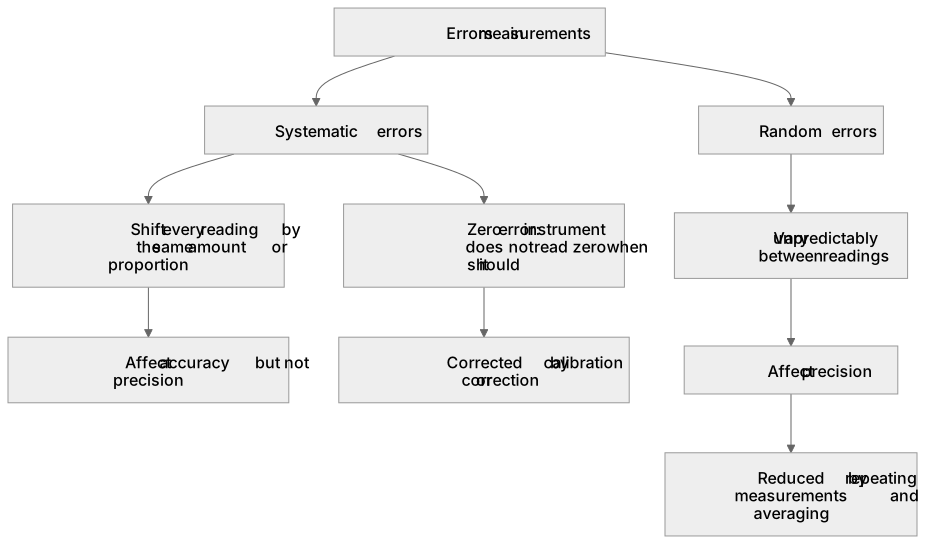
Systematic errors shift every reading by the same amount or in the same proportion, so they affect accuracy but not precision.
Checked against the OCR H556 specification (opens in a new tab) on .
- Point 1 of 4
- 4 key terms
Study notes
From the checked teaching notes for this specification point.
The idea
Systematic errors shift every reading by the same amount or in the same proportion, so they affect accuracy but not precision. A zero error is a systematic error where an instrument does not read zero when it should; for example, a top-pan balance reading 0.02 g with nothing on it. Random errors vary unpredictably between readings, often due to fluctuations or reading uncertainty, and affect precision. Repeating measurements and averaging reduces random errors, while systematic errors require calibration or correction. When analysing data, look for a consistent offset (systematic) or scatter around a mean (random).
What earns the marks
- Systematic errors cause all readings to be shifted by a consistent amount or proportion.
- Zero errors are systematic errors where the instrument does not read zero correctly.
- Random errors cause unpredictable variation between repeated readings.
- Averaging repeated readings reduces the effect of random errors.
- Systematic errors cannot be reduced by averaging; they require calibration or correction.
Common mistakes and how to put them right
Thinking that repeating measurements removes a systematic error.
Put it right: Repetition only reduces random error, while systematic error needs calibration or correction.
Confusing zero error with random error.
Put it right: A zero error is a fixed offset and is systematic.
Believing that systematic errors affect precision.
Put it right: They mainly affect accuracy, while random errors affect precision.
Assuming all errors are random.
Put it right: Check for a consistent offset that indicates a systematic error.
Exam tips
- Identify whether an error shifts all readings in the same direction (systematic) or scatters them (random).
- For a zero error, state the correction: subtract the zero reading from all measurements.
- Use repeated readings and a mean to reduce random error, and quote the uncertainty.
- When describing an improvement, match it to the type of error: calibration for systematic, averaging for random.
Try the lesson
The start of the Measurements and uncertainties: (a) systematic errors (including zero errors) and random errors in measurements lesson, made from checked teaching notes for this specification point.
Listen
Systematic errors shift every reading by the same amount or in the same proportion, so they affect accuracy but not precision. A zero error is a systematic error where an instrument does not read zero when it should; for example, a top-pan balance reading 0.02 g with nothing on it. Random errors vary unpredictably between readings, often due to fluctuations or reading uncertainty, and affect precision. Repeating measurements and averaging reduces random errors, while systematic errors require calibration or correction. When analysing data, look for a consistent offset (systematic) or scatter around a mean (random). A strong answer earns marks for these points. Systematic errors cause all readings to be shifted by a consistent amount or proportion. Zero errors are systematic errors where the instrument does not read zero correctly. Random errors cause unpredictable variation between repeated readings. Averaging repeated readings reduces the effect of random errors. Exam tip: Identify whether an error shifts all readings in the same direction (systematic) or scatters them (random).
See it
Key words
Say what each word means before you turn the card.
Systematic errors
Try answering aloud or in your head before turning the card.
Zero errors
Try answering aloud or in your head before turning the card.
Random errors
Try answering aloud or in your head before turning the card.
Averaging
Try answering aloud or in your head before turning the card.
See every definition
- Systematic errors
- Errors that shift every reading by the same amount or in the same proportion, affecting accuracy but not precision.
- Zero errors
- A systematic error where an instrument does not read zero when it should, such as a top-pan balance reading 0.02 g with nothing on it.
- Random errors
- Errors that vary unpredictably between readings, often due to fluctuations or reading uncertainty, and affect precision.
- Averaging
- Repeating measurements and averaging reduces random errors, but cannot reduce systematic errors, which require calibration or correction.
Label the diagram
Some boxes have lost their names. Pick the right name for each number.
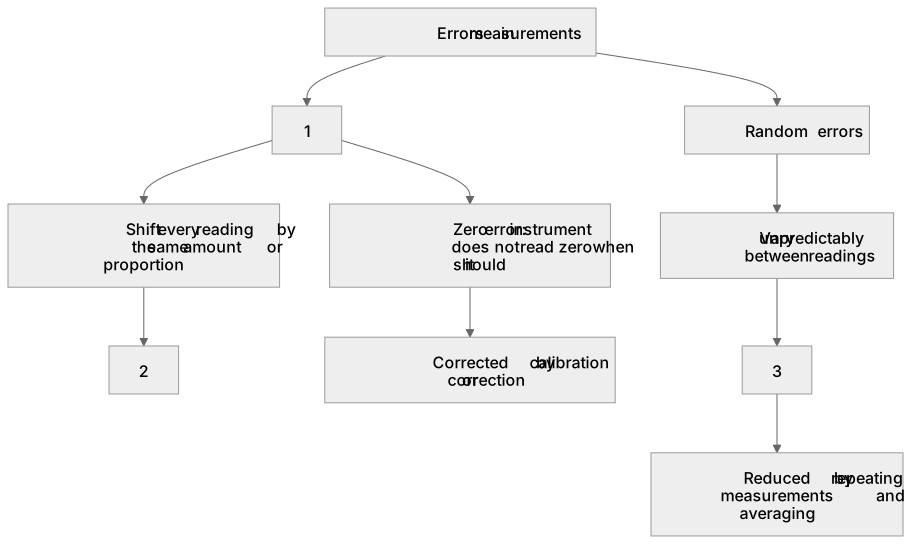
1Box 1
2Box 2
3Box 3
There is more to this lesson
The full lesson goes on to check your understanding and help you earn the marks. Create a free account to carry on, with your progress saved.
A week of Premium from your first lesson · Then the free plan continues · No card, no charge
Test your understanding of Measurements and uncertainties: (a) systematic errors (including zero errors) and random errors in measurements
Active recall beats re-reading. Take an instant quiz now to test what you’ve learned and lock it into long-term memory.
A week of Premium from your first lesson · Then the free plan continues · No card, no charge