OCR · A-Level · Physics
Course version: H556 · Version from Sept 2015
Measurements and uncertainties: (b) precision and accuracy
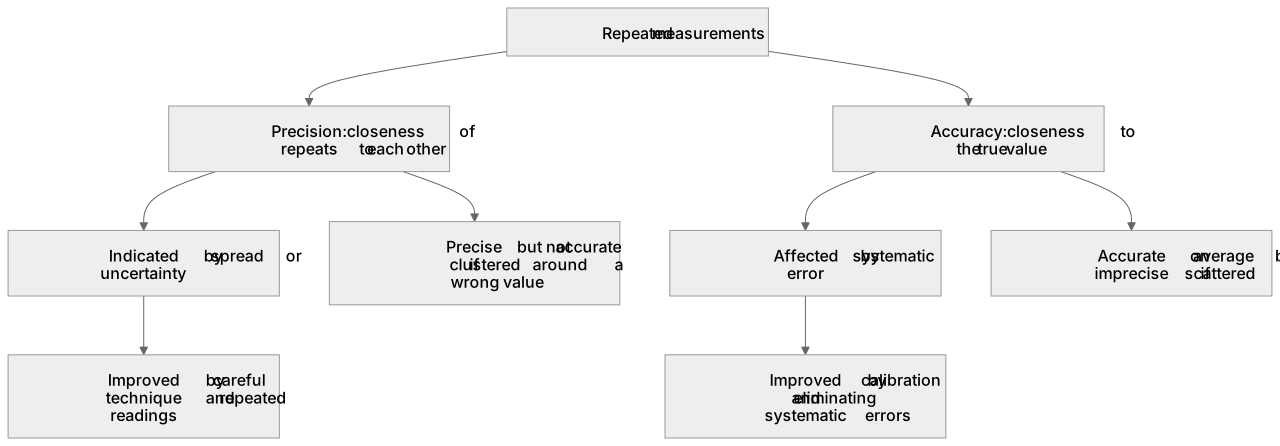
Precision describes how close repeated measurements are to each other, often indicated by the spread or uncertainty.
Checked against the OCR H556 specification (opens in a new tab) on .
- Point 2 of 4
- 2 key terms
Study notes
From the checked teaching notes for this specification point.
The idea
Precision describes how close repeated measurements are to each other, often indicated by the spread or uncertainty. Accuracy describes how close a measurement is to the true value. A set of readings can be precise but not accurate if they cluster around a wrong value, for example due to a systematic error. Conversely, readings can be accurate on average but imprecise if they are scattered. In experimental work, precision is improved by careful technique and repeated readings, while accuracy is improved by calibration and eliminating systematic errors. When evaluating data, comment on both the spread (precision) and the closeness to the true value (accuracy).
What earns the marks
- Precision is the closeness of repeated measurements to each other.
- Accuracy is the closeness of a measurement to the true value.
- Precise readings can be inaccurate if there is a systematic error.
- Accurate readings can be imprecise if there is large random scatter.
- Precision is often quantified by the spread or uncertainty of repeated readings.
Common mistakes and how to put them right
Using 'accurate' and 'precise' interchangeably.
Put it right: They describe different things: closeness to true value versus closeness of repeats.
Assuming precise data must be accurate.
Put it right: A systematic error can make precise data inaccurate.
Thinking that accuracy can be improved by taking more readings.
Put it right: Accuracy requires calibration or correction of systematic errors.
Confusing precision with the number of decimal places.
Put it right: Precision relates to the spread of repeated measurements, not just the format.
Exam tips
- When asked to compare, state whether the data are precise, accurate, both or neither, and justify with reference to spread and true value.
- Use the terms correctly: precision for repeatability, accuracy for closeness to true value.
- If a graph shows a straight line with a non-zero intercept, comment on accuracy and suggest a systematic error.
- Quote uncertainties to support statements about precision.
Try the lesson
The start of the Measurements and uncertainties: (b) precision and accuracy lesson, made from checked teaching notes for this specification point.
Listen
Precision describes how close repeated measurements are to each other, often indicated by the spread or uncertainty. Accuracy describes how close a measurement is to the true value. A set of readings can be precise but not accurate if they cluster around a wrong value, for example due to a systematic error. Conversely, readings can be accurate on average but imprecise if they are scattered. In experimental work, precision is improved by careful technique and repeated readings, while accuracy is improved by calibration and eliminating systematic errors. When evaluating data, comment on both the spread (precision) and the closeness to the true value (accuracy). A strong answer earns marks for these points. Precision is the closeness of repeated measurements to each other. Accuracy is the closeness of a measurement to the true value. Precise readings can be inaccurate if there is a systematic error. Accurate readings can be imprecise if there is large random scatter. Exam tip: When asked to compare, state whether the data are precise, accurate, both or neither, and justify with reference to spread and true value.
See it
Key words
Say what each word means before you turn the card.
Precision
Try answering aloud or in your head before turning the card.
Accuracy
Try answering aloud or in your head before turning the card.
See every definition
- Precision
- Describes how close repeated measurements are to each other, often indicated by the spread or uncertainty.
- Accuracy
- Describes how close a measurement is to the true value.
Label the diagram
Some boxes have lost their names. Pick the right name for each number.
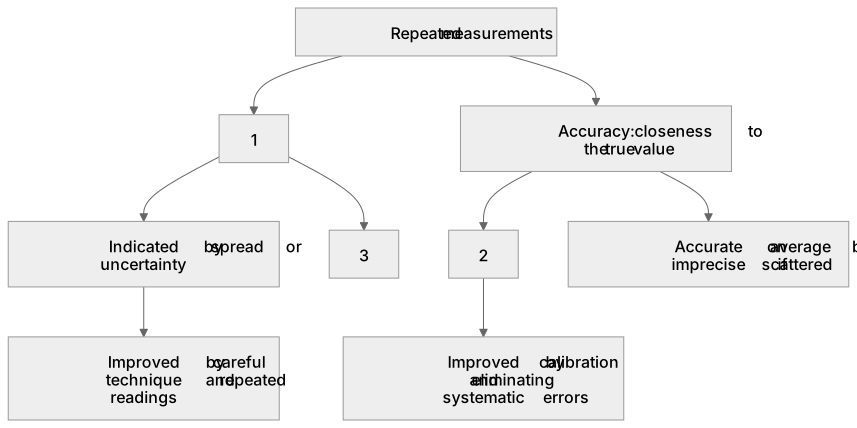
1Box 1
2Box 2
3Box 3
There is more to this lesson
The full lesson goes on to check your understanding and help you earn the marks. Create a free account to carry on, with your progress saved.
A week of Premium from your first lesson · Then the free plan continues · No card, no charge
Test your understanding of Measurements and uncertainties: (b) precision and accuracy
Active recall beats re-reading. Take an instant quiz now to test what you’ve learned and lock it into long-term memory.
A week of Premium from your first lesson · Then the free plan continues · No card, no charge