OCR · A-Level · Physics
Course version: H556 · Version from Sept 2015
(a) force–extension (or compression) graph; work done is area under graph
Full specification wording
Mechanical properties of matter: (a) force–extension (or compression) graph; work done is area under graph
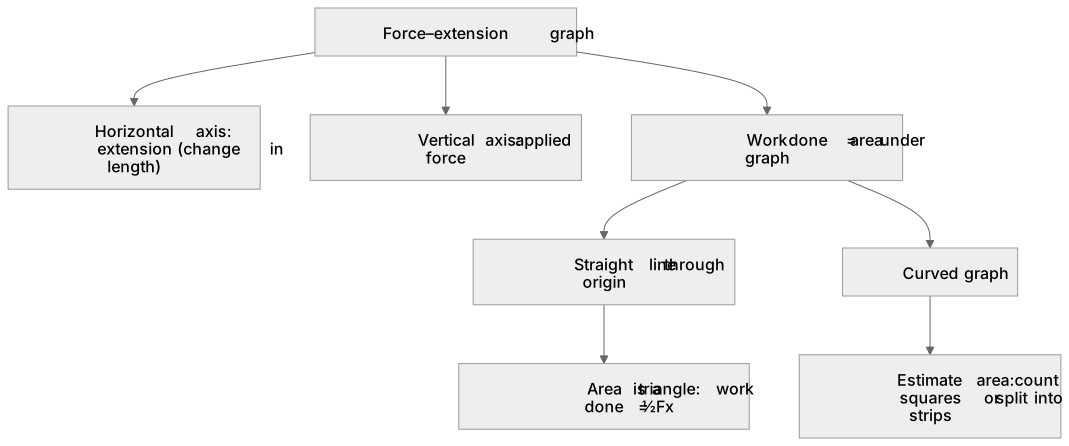
A force–extension graph plots the applied force on the vertical axis against the extension (or compression) on the horizontal axis.
Checked against the OCR H556 specification (opens in a new tab) on .
- Point 1 of 7
- 3 key terms
Study notes
From the checked teaching notes for this specification point.
The idea
A force–extension graph plots the applied force on the vertical axis against the extension (or compression) on the horizontal axis. For a material obeying Hooke's law the line is straight through the origin, so force is proportional to extension. The work done in stretching or compressing the material equals the area under the graph, because work is the product of force and the displacement it produces. For a straight line from the origin to a point (x, F), that area is a triangle: work done = ½ × base × height = ½Fx. If the graph curves, you cannot use ½Fx; you must estimate the area, for example by counting squares or splitting it into strips. Extension is the change in length, not the total length, and the same reasoning applies to compression.
What earns the marks
- Work done in stretching or compressing equals the area under the force–extension (or force–compression) graph.
- For a straight-line graph through the origin, the area is a triangle, giving work done = ½Fx.
- Extension means the change in length from the natural length, not the total length of the sample.
- A curved graph requires area estimation, such as counting squares or dividing the region into strips.
Common mistakes and how to put them right
Using the total length instead of the extension when reading the horizontal axis.
Put it right: Plot or read the change in length from the natural length.
Assuming ½Fx always applies.
Put it right: It holds only for a straight-line graph through the origin, and a curved graph needs area estimation.
Treating the gradient as the work done.
Put it right: The gradient gives the stiffness (force per unit extension) while the area gives the work done.
Exam tips
- Check whether the graph is a straight line through the origin before choosing the triangle-area method.
- State clearly that work done is represented by the area under the graph, then show the area calculation.
- If the graph is curved, describe a valid area-estimation method rather than forcing ½Fx.
Try the lesson
The start of the Mechanical properties of matter: (a) force–extension (or compression) graph; work done is area under graph lesson, made from checked teaching notes for this specification point.
Listen
A force–extension graph plots the applied force on the vertical axis against the extension (or compression) on the horizontal axis. For a material obeying Hooke's law the line is straight through the origin, so force is proportional to extension. The work done in stretching or compressing the material equals the area under the graph, because work is the product of force and the displacement it produces. For a straight line from the origin to a point (x, F), that area is a triangle: work done = ½ × base × height = ½Fx. If the graph curves, you cannot use ½Fx; you must estimate the area, for example by counting squares or splitting it into strips. Extension is the change in length, not the total length, and the same reasoning applies to compression. A strong answer earns marks for these points. Work done in stretching or compressing equals the area under the force–extension (or force–compression) graph. For a straight-line graph through the origin, the area is a triangle, giving work done = ½Fx. Extension means the change in length from the natural length, not the total length of the sample. A curved graph requires area estimation, such as counting squares or dividing the region into strips. A common slip: Using the total length instead of the extension when reading the horizontal axis. Instead, plot or read the change in length from the natural length. Exam tip: Check whether the graph is a straight line through the origin before choosing the triangle-area method.
See it
Key words
Say what each word means before you turn the card.
Force–extension relationships
Try answering aloud or in your head before turning the card.
Work done and energy transfer
Try answering aloud or in your head before turning the card.
Hooke's law behaviour
Try answering aloud or in your head before turning the card.
See every definition
- Force–extension relationships
- A graph plotting the applied force on the vertical axis against the extension (or compression) on the horizontal axis.
- Work done and energy transfer
- The work done in stretching or compressing the material equals the area under the graph, because work is the product of force and the displacement it produces.
- Hooke's law behaviour
- For a material obeying Hooke's law the line is straight through the origin, so force is proportional to extension.
Label the diagram
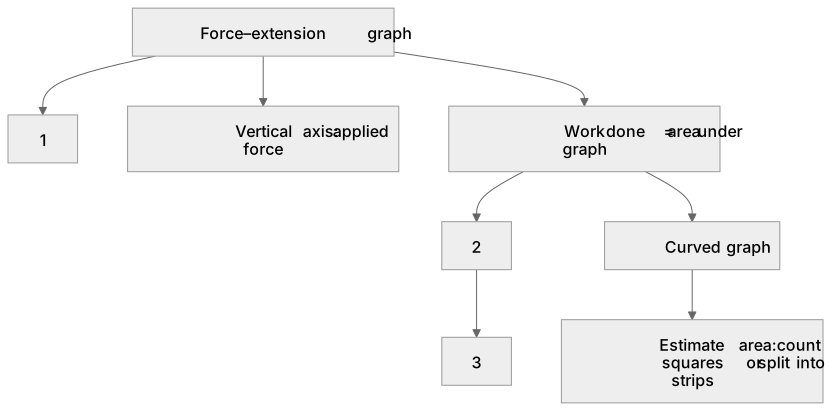
Some boxes have lost their names. Pick the right name for each number.
1Box 1
2Box 2
3Box 3
There is more to this lesson
The full lesson goes on to check your understanding and help you earn the marks. Create a free account to carry on, with your progress saved.
A week of Premium from your first lesson · Then the free plan continues · No card, no charge
Test your understanding of Mechanical properties of matter: (a) force–extension (or compression) graph; work done is area under graph
Active recall beats re-reading. Take an instant quiz now to test what you’ve learned and lock it into long-term memory.
A week of Premium from your first lesson · Then the free plan continues · No card, no charge