OCR · A-Level · Physics
Course version: H556 · Version from Sept 2015
(b) elastic potential energy; E = 1/2 Fx; E = 1/2 kx²
Full specification wording
Mechanical properties of matter: (b) elastic potential energy; E = 1/2 Fx; E = 1/2 kx²
Elastic potential energy is the energy stored in a material when it is stretched or compressed elastically, and it is recovered when the deforming force is removed.
Checked against the OCR H556 specification (opens in a new tab) on .
- Point 2 of 7
- 4 key terms
Study notes
From the checked teaching notes for this specification point.
The idea
Elastic potential energy is the energy stored in a material when it is stretched or compressed elastically, and it is recovered when the deforming force is removed. For a material obeying Hooke's law, the stored energy equals the work done, which is the area under the force–extension graph: E = ½Fx, where F is the final force and x is the extension. Since F = kx, substituting gives E = ½kx², where k is the force constant in N m⁻¹. Both expressions apply only while the limit of proportionality is not exceeded.
For example: A spring of force constant 200 N m⁻¹ stretched by 0.10 m stores E = ½ × 200 × (0.10)² = 1.0 J.
What earns the marks
- Elastic potential energy is the energy stored when a material is elastically stretched or compressed.
- E = ½Fx applies to a straight-line force–extension graph through the origin, where F is the final force and x the extension.
- E = ½kx² follows from substituting F = kx, with k the force constant in N m⁻¹.
- The expressions apply only up to the limit of proportionality; beyond it the stored energy is not given by these equations.
Common mistakes and how to put them right
Using the full force throughout the extension.
Put it right: The average force is ½F, which is why the factor ½ appears.
Forgetting to square the extension in E = ½kx².
Put it right: Square x before multiplying.
Applying the equations beyond the limit of proportionality.
Put it right: They hold only for straight-line Hooke's law behaviour.
Exam tips
- Write down the equation, substitute values with units, then evaluate to avoid order-of-operation errors.
- Check that the extension is in metres before squaring it in E = ½kx².
- If the material has been stretched beyond the limit of proportionality, state that these equations no longer apply.
Try the lesson
The start of the Mechanical properties of matter: (b) elastic potential energy; E = 1/2 Fx; E = 1/2 kx² lesson, made from checked teaching notes for this specification point.
Listen
Elastic potential energy is the energy stored in a material when it is stretched or compressed elastically, and it is recovered when the deforming force is removed. For a material obeying Hooke's law, the stored energy equals the work done, which is the area under the force–extension graph: E = ½Fx, where F is the final force and x is the extension. Since F = kx, substituting gives E = ½kx², where k is the force constant in N m⁻¹. Both expressions apply only while the limit of proportionality is not exceeded. For example, a spring of force constant 200 N m⁻¹ stretched by 0.10 m stores E = ½ × 200 × (0.10)² = 1.0 J. A strong answer earns marks for these points. Elastic potential energy is the energy stored when a material is elastically stretched or compressed. E = ½Fx applies to a straight-line force–extension graph through the origin, where F is the final force and x the extension. E = ½kx² follows from substituting F = kx, with k the force constant in N m⁻¹. The expressions apply only up to the limit of proportionality; beyond it the stored energy is not given by these equations. A common slip: Using the full force throughout the extension. Instead, the average force is ½F, which is why the factor ½ appears. Exam tip: Write down the equation, substitute values with units, then evaluate to avoid order-of-operation errors.
See it
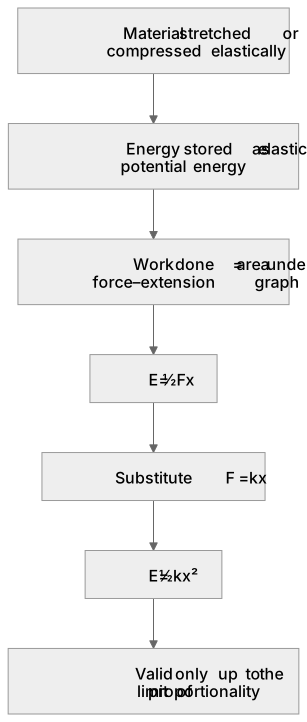
Put it in order
Put these steps in the order they happen.
- 1. Valid only up to the limit of proportionality
- 2. E = ½kx²
- 3. Work done = area under force–extension graph
- 4. Substitute F = kx
- 5. Material stretched or compressed elastically
- 6. Energy stored as elastic potential energy
- 7. E = ½Fx
Key words
Say what each word means before you turn the card.
Elastic potential energy
Try answering aloud or in your head before turning the card.
Hooke's law
Try answering aloud or in your head before turning the card.
Force constant
Try answering aloud or in your head before turning the card.
Limit of proportionality
Try answering aloud or in your head before turning the card.
See every definition
- Elastic potential energy
- The energy stored in a material when it is stretched or compressed elastically, recovered when the deforming force is removed.
- Hooke's law
- Behaviour in which the force–extension graph is a straight line through the origin, so that F = kx.
- Force constant
- The constant k in F = kx, measured in N m⁻¹.
- Limit of proportionality
- The point up to which the expressions for stored energy apply; beyond it the stored energy is not given by these equations.
Label the diagram
Some boxes have lost their names. Pick the right name for each number.
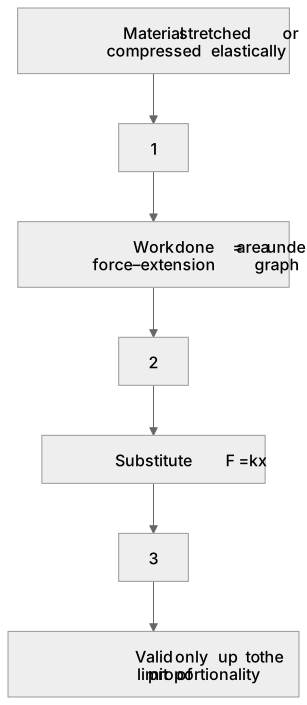
1Box 1
2Box 2
3Box 3
There is more to this lesson
The full lesson goes on to check your understanding and help you earn the marks. Create a free account to carry on, with your progress saved.
A week of Premium from your first lesson · Then the free plan continues · No card, no charge
Test your understanding of Mechanical properties of matter: (b) elastic potential energy; E = 1/2 Fx; E = 1/2 kx²
Active recall beats re-reading. Take an instant quiz now to test what you’ve learned and lock it into long-term memory.
A week of Premium from your first lesson · Then the free plan continues · No card, no charge