OCR · A-Level · Physics
Course version: H556 · Version from Sept 2015
(i) Young modulus = tensile stress / tensile strain, E = σ/ε
Full specification wording
Mechanical properties of matter: (i) Young modulus = tensile stress / tensile strain, E = σ/ε
The Young modulus E quantifies stiffness: how much a material stretches elastically per unit of applied stress.
Checked against the OCR H556 specification (opens in a new tab) on .
- Point 4 of 7
- 4 key terms
Study notes
From the checked teaching notes for this specification point.
The idea
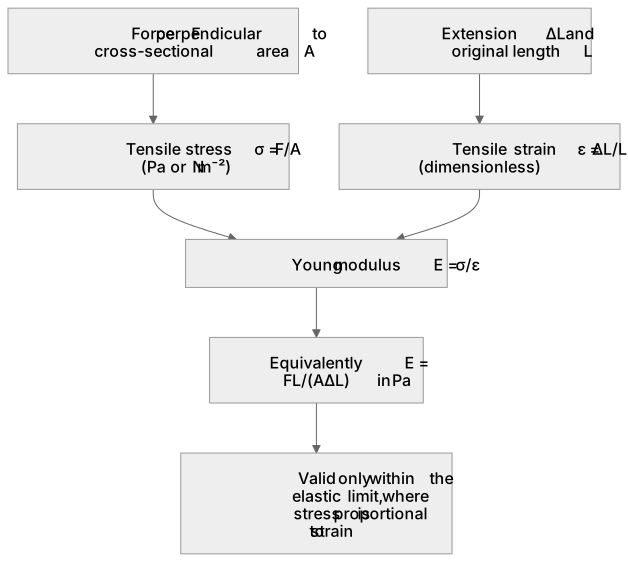
The Young modulus E quantifies stiffness: how much a material stretches elastically per unit of applied stress. Tensile stress σ is the force F applied perpendicular to a specimen's cross-sectional area A, so σ = F/A, measured in pascals (Pa), where 1 Pa = 1 N m⁻². Tensile strain ε is the fractional extension: ε = ΔL/L, where ΔL is the extension and L the original length; strain is dimensionless, though it may be quoted as a percentage. Combining these gives E = σ/ε = (F/A)/(ΔL/L) = FL/(AΔL), in Pa. For example, a wire of area 1.0 × 10⁻⁶ m², original length 2.00 m, extending 1.0 mm under 50 N: σ = 5.0 × 10⁷ Pa, ε = 5.0 × 10⁻⁴, so E = 1.0 × 10¹¹ Pa. E applies only within the elastic limit, where stress is proportional to strain.
What earns the marks
- Defines tensile stress as force per unit cross-sectional area, σ = F/A, with units Pa or N m⁻².
- Defines tensile strain as extension divided by original length, ε = ΔL/L, and recognises it as dimensionless.
- States and applies E = σ/ε, equivalently E = FL/(AΔL), within the elastic limit.
- Uses consistent SI units and converts mm to m, mm² to m² and GPa to Pa correctly before substituting.
Common mistakes and how to put them right
Using the final length instead of the original length in the strain denominator.
Put it right: Divide extension by the original length L.
Forgetting to convert area from mm² to m² by multiplying by 10⁻⁶.
Put it right: Express A in m² before computing stress.
Treating strain as having units of metres.
Put it right: Recognise strain is a ratio of two lengths and is dimensionless.
Applying E = σ/ε beyond the elastic limit.
Put it right: Use the equation only where the material obeys Hooke's law.
Exam tips
- Write the defining equation, then substitute values with units shown, so method marks are visible even if arithmetic slips.
- Check unit conversions first: 1 mm² = 1 × 10⁻⁶ m² and 1 GPa = 1 × 10⁹ Pa.
- Sanity-check the magnitude: metals typically have E of order 10¹⁰–10¹¹ Pa, so an answer of 10⁵ Pa signals an error.
Try the lesson
The start of the Mechanical properties of matter: (i) Young modulus = tensile stress / tensile strain, E = σ/ε lesson, made from checked teaching notes for this specification point.
Listen
The Young modulus E quantifies stiffness: how much a material stretches elastically per unit of applied stress. Tensile stress σ is the force F applied perpendicular to a specimen's cross-sectional area A, so σ = F/A, measured in pascals (Pa), where 1 Pa = 1 N m⁻². Tensile strain ε is the fractional extension: ε = ΔL/L, where ΔL is the extension and L the original length; strain is dimensionless, though it may be quoted as a percentage. Combining these gives E = σ/ε = (F/A)/(ΔL/L) = FL/(AΔL), in Pa. For example, a wire of area 1.0 × 10⁻⁶ m², original length 2.00 m, extending 1.0 mm under 50 N: σ = 5.0 × 10⁷ Pa, ε = 5.0 × 10⁻⁴, so E = 1.0 × 10¹¹ Pa. E applies only within the elastic limit, where stress is proportional to strain. A strong answer earns marks for these points. Defines tensile stress as force per unit cross-sectional area, σ = F/A, with units Pa or N m⁻². Defines tensile strain as extension divided by original length, ε = ΔL/L, and recognises it as dimensionless. States and applies E = σ/ε, equivalently E = FL/(AΔL), within the elastic limit. Uses consistent SI units and converts mm to m, mm² to m² and GPa to Pa correctly before substituting. A common slip: Using the final length instead of the original length in the strain denominator. Instead, divide extension by the original length L. Exam tip: Write the defining equation, then substitute values with units shown, so method marks are visible even if arithmetic slips.
See it
Key words
Say what each word means before you turn the card.
Tensile stress
Try answering aloud or in your head before turning the card.
Tensile strain
Try answering aloud or in your head before turning the card.
Young modulus
Try answering aloud or in your head before turning the card.
Elastic limit
Try answering aloud or in your head before turning the card.
See every definition
- Tensile stress
- The force F applied perpendicular to a specimen's cross-sectional area A, so σ = F/A, measured in pascals (Pa), where 1 Pa = 1 N m⁻².
- Tensile strain
- The fractional extension ε = ΔL/L, where ΔL is the extension and L the original length; it is dimensionless, though it may be quoted as a percentage.
- Young modulus
- E = σ/ε, equivalently FL/(AΔL), in Pa; it applies only within the elastic limit, where stress is proportional to strain.
- Elastic limit
- The limit within which E applies, where stress is proportional to strain.
Label the diagram
Some boxes have lost their names. Pick the right name for each number.
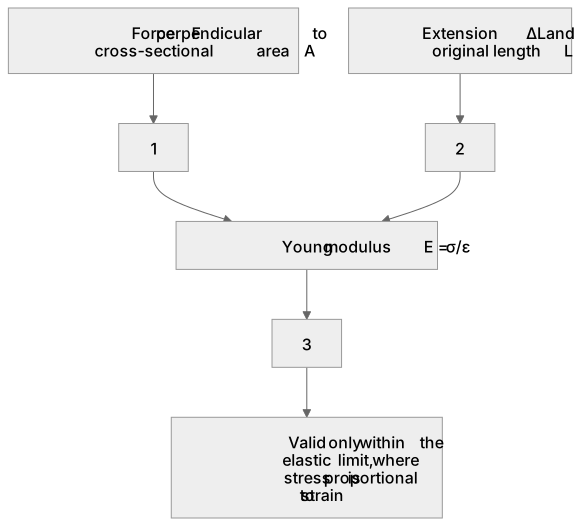
1Box 1
2Box 2
3Box 3
There is more to this lesson
The full lesson goes on to check your understanding and help you earn the marks. Create a free account to carry on, with your progress saved.
A week of Premium from your first lesson · Then the free plan continues · No card, no charge
Test your understanding of Mechanical properties of matter: (i) Young modulus = tensile stress / tensile strain, E = σ/ε
Active recall beats re-reading. Take an instant quiz now to test what you’ve learned and lock it into long-term memory.
A week of Premium from your first lesson · Then the free plan continues · No card, no charge