OCR · A-Level · Physics
Course version: H556 · Version from Sept 2015
(ii) techniques and procedures used to determine the Young modulus for a…
Full specification wording
Mechanical properties of matter: (ii) techniques and procedures used to determine the Young modulus for a metal
A practical determination of the Young modulus for a metal wire uses a long, thin specimen clamped at one end and loaded at the other over a pulley.
Checked against the OCR H556 specification (opens in a new tab) on .
- Point 5 of 7
- 3 key terms
Study notes
From the checked teaching notes for this specification point.
The idea
A practical determination of the Young modulus for a metal wire uses a long, thin specimen clamped at one end and loaded at the other over a pulley. A metre rule or scale measures the original length L between fixed marks, and a micrometer measures the wire diameter d at several places and orientations; the mean diameter gives cross-sectional area A = πd²/4. A mass hanger adds known weights, so force F = mg using g = 9.81 m s⁻². Extension ΔL is measured with a vernier scale or travelling microscope, often against a fiducial mark, after tapping the wire to remove kinks. Plotting F against ΔL gives a straight line through the origin within the elastic limit; its gradient k = F/ΔL, so E = kL/A. Alternatively, E = FL/(AΔL) from a single consistent set of readings.
What earns the marks
- Measures original length L between fixed reference marks with a metre rule, avoiding parallax.
- Measures wire diameter with a micrometer at several positions and orientations, then averages to find A = πd²/4.
- Applies known loads and records extension ΔL using a vernier scale or travelling microscope, tapping the wire to remove kinks.
- Plots a graph of force F against extension ΔL and uses the gradient k with E = kL/A, or substitutes into E = FL/(AΔL).
- Identifies safety and reliability measures such as a safety cushion or G-clamp, eye protection, and keeping stress within the elastic limit.
Common mistakes and how to put them right
Measuring diameter once only.
Put it right: Take repeat readings at different places and orientations and average them.
Using the total length of wire including the clamped portion.
Put it right: Measure only the length between the fixed marks that actually extends.
Ignoring the weight of the hanger or adding masses without converting to force.
Put it right: Compute F = mg for each load.
Plotting extension against force and then using the gradient directly as E.
Put it right: Use the gradient k = F/ΔL in E = kL/A.
Exam tips
- Describe the procedure in a logical sequence: set up, measure L, measure d, load, measure ΔL, analyse.
- State how you reduce uncertainty: repeat diameter readings, use a long wire, use a travelling microscope, tap the wire.
- Show the graph method clearly, labelling axes F and ΔL and explaining that the gradient equals k.
Try the lesson
The start of the Mechanical properties of matter: (ii) techniques and procedures used to determine the Young modulus for a metal lesson, made from checked teaching notes for this specification point.
Listen
A practical determination of the Young modulus for a metal wire uses a long, thin specimen clamped at one end and loaded at the other over a pulley. A metre rule or scale measures the original length L between fixed marks, and a micrometer measures the wire diameter d at several places and orientations; the mean diameter gives cross-sectional area A = πd²/4. A mass hanger adds known weights, so force F = mg using g = 9.81 m s⁻². Extension ΔL is measured with a vernier scale or travelling microscope, often against a fiducial mark, after tapping the wire to remove kinks. Plotting F against ΔL gives a straight line through the origin within the elastic limit; its gradient k = F/ΔL, so E = kL/A. Alternatively, E = FL/(AΔL) from a single consistent set of readings. A strong answer earns marks for these points. Measures original length L between fixed reference marks with a metre rule, avoiding parallax. Measures wire diameter with a micrometer at several positions and orientations, then averages to find A = πd²/4. Applies known loads and records extension ΔL using a vernier scale or travelling microscope, tapping the wire to remove kinks. Plots a graph of force F against extension ΔL and uses the gradient k with E = kL/A, or substitutes into E = FL/(AΔL). A common slip: Measuring diameter once only. Instead, take repeat readings at different places and orientations and average them. Exam tip: Describe the procedure in a logical sequence: set up, measure L, measure d, load, measure ΔL, analyse.
See it
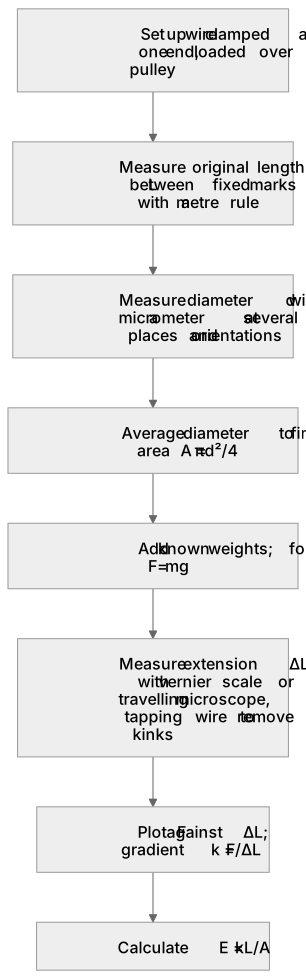
Put it in order
Put these steps in the order they happen.
- 1. Add known weights; force F = mg
- 2. Calculate E = kL/A
- 3. Measure extension ΔL with vernier scale or travelling microscope, tapping wire to remove kinks
- 4. Set up wire clamped at one end, loaded over a pulley
- 5. Measure original length L between fixed marks with a metre rule
- 6. Plot F against ΔL; gradient k = F/ΔL
- 7. Measure diameter d with a micrometer at several places and orientations
- 8. Average diameter to find area A = πd²/4
Key words
Say what each word means before you turn the card.
Uncertainty reduction and repeat readings
Try answering aloud or in your head before turning the card.
Graphical analysis of Hooke's law data
Try answering aloud or in your head before turning the card.
Stress, strain and the Young modulus
Try answering aloud or in your head before turning the card.
See every definition
- Uncertainty reduction and repeat readings
- The mean diameter from readings at several places and orientations gives the cross-sectional area, and the wire is tapped to remove kinks.
- Graphical analysis of Hooke's law data
- Plotting force against extension gives a straight line through the origin within the elastic limit, and its gradient k is used with E = kL/A.
- Stress, strain and the Young modulus
- The Young modulus is found from E = kL/A using the gradient, or from E = FL/(AΔL) from a single consistent set of readings.
Label the diagram
Some boxes have lost their names. Pick the right name for each number.
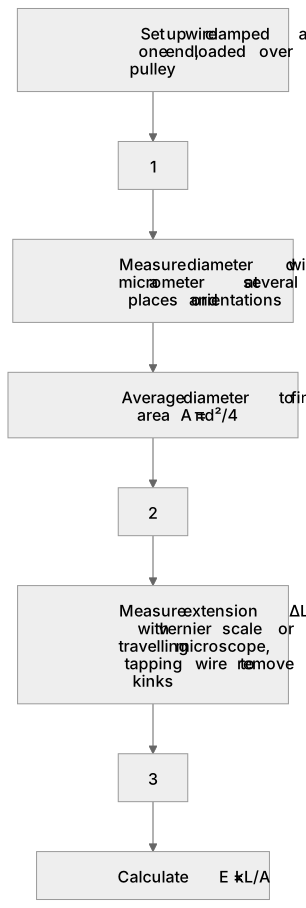
1Box 1
2Box 2
3Box 3
There is more to this lesson
The full lesson goes on to check your understanding and help you earn the marks. Create a free account to carry on, with your progress saved.
A week of Premium from your first lesson · Then the free plan continues · No card, no charge
Test your understanding of Mechanical properties of matter: (ii) techniques and procedures used to determine the Young modulus for a metal
Active recall beats re-reading. Take an instant quiz now to test what you’ve learned and lock it into long-term memory.
A week of Premium from your first lesson · Then the free plan continues · No card, no charge