OCR · A-Level · Physics
Course version: H556 · Version from Sept 2015
Newton’s laws of motion: (a) Newton’s three laws of motion
Newton's three laws describe how forces change motion.
Checked against the OCR H556 specification (opens in a new tab) on .
- Point 1 of 5
- 3 key terms
Study notes
From the checked teaching notes for this specification point.
The idea
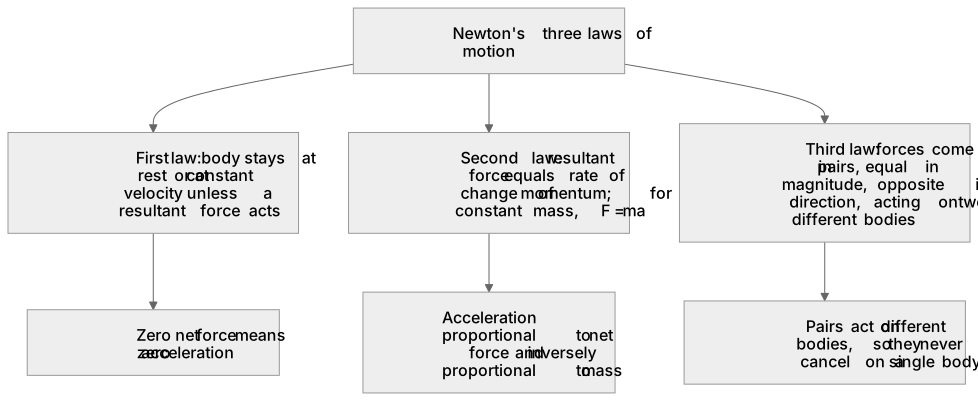
Newton's three laws describe how forces change motion. The first law: a body remains at rest or moves with constant velocity unless acted on by a resultant force, so zero net force means zero acceleration. The second law: the resultant force equals the rate of change of momentum, which for constant mass reduces to F = ma, so acceleration is proportional to net force and inversely proportional to mass. The third law: if body A exerts a force on body B, then B exerts an equal-magnitude force on A in the opposite direction, acting on a different body.
For example: A rocket pushes exhaust gases backwards while the gases push the rocket forwards.
What earns the marks
- First law: a body stays at rest or at constant velocity unless a resultant force acts on it.
- Second law: resultant force equals rate of change of momentum; for constant mass, F = ma.
- Third law: forces come in pairs, equal in magnitude, opposite in direction, acting on two different bodies.
- Newton's third-law pairs act on different objects, so they never cancel on a single body.
- Applying F = ma requires the resultant force, not any single applied force.
Common mistakes and how to put them right
Thinking a moving object always needs a forward force.
Put it right: Constant velocity needs zero resultant force.
Treating Newton's third-law pairs as balanced forces on one body.
Put it right: The two forces act on different bodies.
Using any single force in F = ma instead of the resultant force.
Put it right: Resolve all forces first, then divide the resultant by mass.
Exam tips
- Underline the word resultant in the question before choosing an answer.
- Check whether the question describes one body or two interacting bodies.
- For constant-velocity situations, immediately set resultant force to zero.
Try the lesson
The start of the Newton’s laws of motion: (a) Newton’s three laws of motion lesson, made from checked teaching notes for this specification point.
Listen
Newton's three laws describe how forces change motion. The first law: a body remains at rest or moves with constant velocity unless acted on by a resultant force, so zero net force means zero acceleration. The second law: the resultant force equals the rate of change of momentum, which for constant mass reduces to F = ma, so acceleration is proportional to net force and inversely proportional to mass. The third law: if body A exerts a force on body B, then B exerts an equal-magnitude force on A in the opposite direction, acting on a different body. For example, a rocket pushes exhaust gases backwards while the gases push the rocket forwards. A strong answer earns marks for these points. First law: a body stays at rest or at constant velocity unless a resultant force acts on it. Second law: resultant force equals rate of change of momentum; for constant mass, F = ma. Third law: forces come in pairs, equal in magnitude, opposite in direction, acting on two different bodies. Newton's third-law pairs act on different objects, so they never cancel on a single body. A common slip: Thinking a moving object always needs a forward force. Instead, constant velocity needs zero resultant force. Exam tip: Underline the word resultant in the question before choosing an answer.
See it
Key words
Say what each word means before you turn the card.
Resultant force and motion
Try answering aloud or in your head before turning the card.
Rate of change of momentum
Try answering aloud or in your head before turning the card.
Action–reaction pairs
Try answering aloud or in your head before turning the card.
See every definition
- Resultant force and motion
- A body remains at rest or moves with constant velocity unless acted on by a resultant force, so zero net force means zero acceleration.
- Rate of change of momentum
- The resultant force equals this quantity, which for constant mass reduces to F = ma.
- Action–reaction pairs
- If body A exerts a force on body B, then B exerts an equal-magnitude force on A in the opposite direction, acting on a different body.
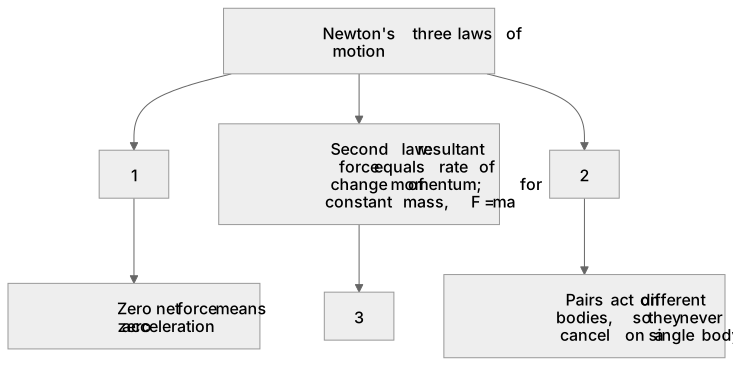
Label the diagram
Some boxes have lost their names. Pick the right name for each number.
1Box 1
2Box 2
3Box 3
There is more to this lesson
The full lesson goes on to check your understanding and help you earn the marks. Create a free account to carry on, with your progress saved.
A week of Premium from your first lesson · Then the free plan continues · No card, no charge
Test your understanding of Newton’s laws of motion: (a) Newton’s three laws of motion
Active recall beats re-reading. Take an instant quiz now to test what you’ve learned and lock it into long-term memory.
A week of Premium from your first lesson · Then the free plan continues · No card, no charge