OCR · A-Level · Physics
Course version: H556 · Version from Sept 2015
(b) linear momentum; p = mv ; vector nature of momentum
Full specification wording
Newton’s laws of motion: (b) linear momentum; p = mv ; vector nature of momentum
Linear momentum p is defined as the product of mass and velocity: p = mv.
Checked against the OCR H556 specification (opens in a new tab) on .
- Point 2 of 5
Study notes
From the checked teaching notes for this specification point.
The idea
Linear momentum p is defined as the product of mass and velocity: p = mv. Its SI unit is kg m s⁻¹, equivalently N s. Momentum is a vector, so it has both magnitude and direction; the direction of p is the direction of the velocity. When solving problems, choose a positive direction first, then assign signs to velocities and momenta. For example, a 2.0 kg ball moving at 3.0 m s⁻¹ to the right has momentum 6.0 kg m s⁻¹ to the right; if it moves left at the same speed, its momentum is −6.0 kg m s⁻¹. Total momentum of a system is found by vector addition of individual momenta.
What earns the marks
- Momentum is defined as p = mv, the product of mass and velocity.
- The SI unit of momentum is kg m s⁻¹, which is equivalent to N s.
- Momentum is a vector quantity with the same direction as the velocity.
- Signs must be assigned consistently when adding momenta in one dimension.
- Total momentum of a system is the vector sum of the individual momenta.
Common mistakes and how to put them right
Treating momentum as a scalar and ignoring direction.
Put it right: Assign a positive direction and use signs.
Using speed instead of velocity in p = mv.
Put it right: Velocity includes direction, so use the signed value.
Forgetting that momentum depends on mass as well as velocity.
Put it right: Calculate p = mv with both quantities.
Exam tips
- Always state your chosen positive direction before substituting values.
- Check units: kg m s⁻¹ and N s are both acceptable for momentum.
- When two objects move in opposite directions, give one a negative velocity.
Try the lesson
The start of the Newton’s laws of motion: (b) linear momentum; p = mv ; vector nature of momentum lesson, made from checked teaching notes for this specification point.
Listen
Linear momentum p is defined as the product of mass and velocity: p = mv. Its SI unit is kg m s⁻¹, equivalently N s. Momentum is a vector, so it has both magnitude and direction; the direction of p is the direction of the velocity. When solving problems, choose a positive direction first, then assign signs to velocities and momenta. For example, a 2.0 kg ball moving at 3.0 m s⁻¹ to the right has momentum 6.0 kg m s⁻¹ to the right; if it moves left at the same speed, its momentum is −6.0 kg m s⁻¹. Total momentum of a system is found by vector addition of individual momenta. A strong answer earns marks for these points. Momentum is defined as p = mv, the product of mass and velocity. The SI unit of momentum is kg m s⁻¹, which is equivalent to N s. Momentum is a vector quantity with the same direction as the velocity. Signs must be assigned consistently when adding momenta in one dimension. A common slip: Treating momentum as a scalar and ignoring direction. Instead, assign a positive direction and use signs. Exam tip: Always state your chosen positive direction before substituting values.
See it
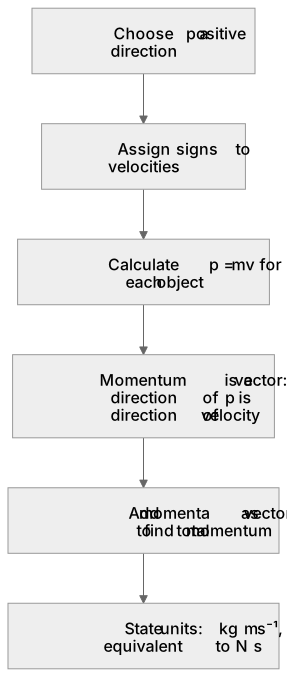
Put it in order
Put these steps in the order they happen.
- 1. Calculate p = mv for each object
- 2. Assign signs to velocities
- 3. Choose a positive direction
- 4. State units: kg m s⁻¹, equivalent to N s
- 5. Add momenta as vectors to find total momentum
- 6. Momentum is a vector: direction of p is direction of velocity
Label the diagram
Some boxes have lost their names. Pick the right name for each number.
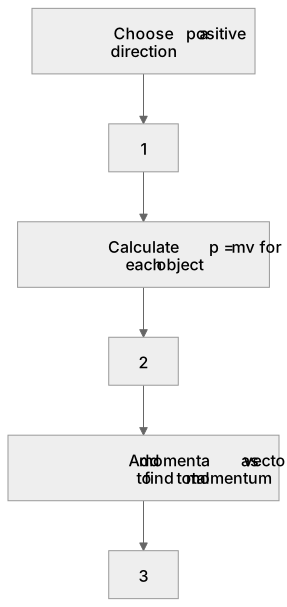
1Box 1
2Box 2
3Box 3
There is more to this lesson
The full lesson goes on to check your understanding and help you earn the marks. Create a free account to carry on, with your progress saved.
A week of Premium from your first lesson · Then the free plan continues · No card, no charge
Test your understanding of Newton’s laws of motion: (b) linear momentum; p = mv ; vector nature of momentum
Active recall beats re-reading. Take an instant quiz now to test what you’ve learned and lock it into long-term memory.
A week of Premium from your first lesson · Then the free plan continues · No card, no charge