OCR · A-Level · Physics
Course version: H556 · Version from Sept 2015
(c) X-ray attenuation mechanisms; simple scatter, photoelectric effect,…
Full specification wording
Nuclear fission and fusion: (c) X-ray attenuation mechanisms; simple scatter, photoelectric effect, Compton effect and pair production
As an X-ray beam passes through matter, photons are removed by several mechanisms whose relative importance depends on photon energy and the atomic number Z of the absorber.
Checked against the OCR H556 specification (opens in a new tab) on .
- Point 14 of 18
- 4 key terms
Study notes
From the checked teaching notes for this specification point.
The idea
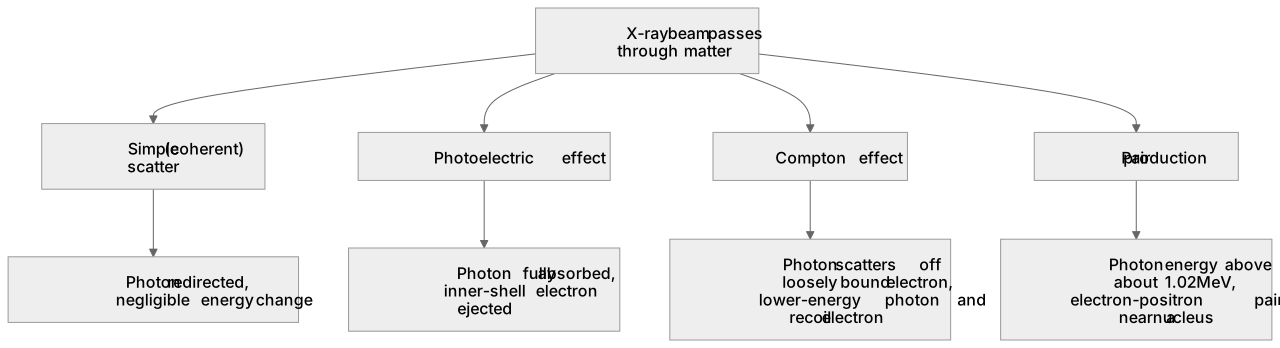
As an X-ray beam passes through matter, photons are removed by several mechanisms whose relative importance depends on photon energy and the atomic number Z of the absorber. Simple (coherent) scatter redirects a photon with negligible energy change. In the photoelectric effect a photon is fully absorbed and ejects a tightly bound inner-shell electron; the probability rises strongly with Z and falls rapidly as photon energy increases. In the Compton effect a photon scatters off a loosely bound or free electron, transferring some energy and producing a recoil electron and a lower-energy scattered photon. Pair production occurs only when photon energy exceeds about 1.02 MeV, creating an electron–positron pair near a nucleus.
What earns the marks
- Simple (coherent) scatter: photon is redirected with essentially no energy loss, contributing little to attenuation.
- Photoelectric effect: photon is completely absorbed and ejects a bound inner-shell electron; probability increases with atomic number Z and decreases as photon energy rises.
- Compton effect: photon scatters off a loosely bound electron, transferring energy; the scattered photon has lower energy and a recoil electron is produced.
- Pair production: requires photon energy greater than about 1.02 MeV (twice the electron rest energy) and occurs in the field of a nucleus, producing an electron–positron pair.
- The dominant attenuation mechanism depends on photon energy and absorber atomic number, which is why contrast media use high-Z elements such as iodine or barium.
- Attenuation reduces beam intensity exponentially with absorber thickness, governed by the attenuation coefficient.
Common mistakes and how to put them right
Treating simple scatter as a major attenuation mechanism.
Put it right: It changes direction but removes little energy, so it contributes little to attenuation.
Stating that the photoelectric effect dominates at high photon energies.
Put it right: Its probability falls rapidly as photon energy increases and rises with Z.
Confusing Compton scattering with the photoelectric effect.
Put it right: Compton involves a loosely bound electron and partial energy transfer, photoelectric involves full absorption and a bound electron.
Believing pair production can occur at any photon energy.
Put it right: It requires photon energy above about 1.02 MeV.
Exam tips
- For each mechanism, state what happens to the photon (absorbed, scattered, converted) and what particle is ejected.
- Link the dominance of each mechanism to photon energy and atomic number Z, using contrast media as a concrete example.
- Quote the pair production threshold as approximately 1.02 MeV and explain it as twice the electron rest energy.
- Use precise vocabulary: coherent scatter, photoelectric absorption, Compton scattering, pair production, recoil electron, positron.
Try the lesson
The start of the Nuclear fission and fusion: (c) X-ray attenuation mechanisms; simple scatter, photoelectric effect, Compton effect and pair production lesson, made from checked teaching notes for this specification point.
Listen
As an X-ray beam passes through matter, photons are removed by several mechanisms whose relative importance depends on photon energy and the atomic number Z of the absorber. Simple (coherent) scatter redirects a photon with negligible energy change. In the photoelectric effect a photon is fully absorbed and ejects a tightly bound inner-shell electron; the probability rises strongly with Z and falls rapidly as photon energy increases. In the Compton effect a photon scatters off a loosely bound or free electron, transferring some energy and producing a recoil electron and a lower-energy scattered photon. Pair production occurs only when photon energy exceeds about 1.02 MeV, creating an electron–positron pair near a nucleus. A strong answer earns marks for these points. Simple (coherent) scatter: photon is redirected with essentially no energy loss, contributing little to attenuation. Photoelectric effect: photon is completely absorbed and ejects a bound inner-shell electron; probability increases with atomic number Z and decreases as photon energy rises. Compton effect: photon scatters off a loosely bound electron, transferring energy; the scattered photon has lower energy and a recoil electron is produced. Pair production: requires photon energy greater than about 1.02 MeV (twice the electron rest energy) and occurs in the field of a nucleus, producing an electron–positron pair. A common slip: Treating simple scatter as a major attenuation mechanism. Instead, it changes direction but removes little energy, so it contributes little to attenuation. Exam tip: For each mechanism, state what happens to the photon (absorbed, scattered, converted) and what particle is ejected.
See it
Key words
Say what each word means before you turn the card.
Simple (coherent) scatter
Try answering aloud or in your head before turning the card.
Photoelectric effect
Try answering aloud or in your head before turning the card.
Compton effect
Try answering aloud or in your head before turning the card.
Pair production
Try answering aloud or in your head before turning the card.
See every definition
- Simple (coherent) scatter
- A photon is redirected with negligible energy change, contributing little to attenuation.
- Photoelectric effect
- A photon is fully absorbed and ejects a tightly bound inner-shell electron, with probability rising strongly with Z and falling rapidly as photon energy increases.
- Compton effect
- A photon scatters off a loosely bound or free electron, transferring some energy and producing a recoil electron and a lower-energy scattered photon.
- Pair production
- Occurs only when photon energy exceeds about 1.02 MeV, creating an electron–positron pair near a nucleus.
Label the diagram
Some boxes have lost their names. Pick the right name for each number.
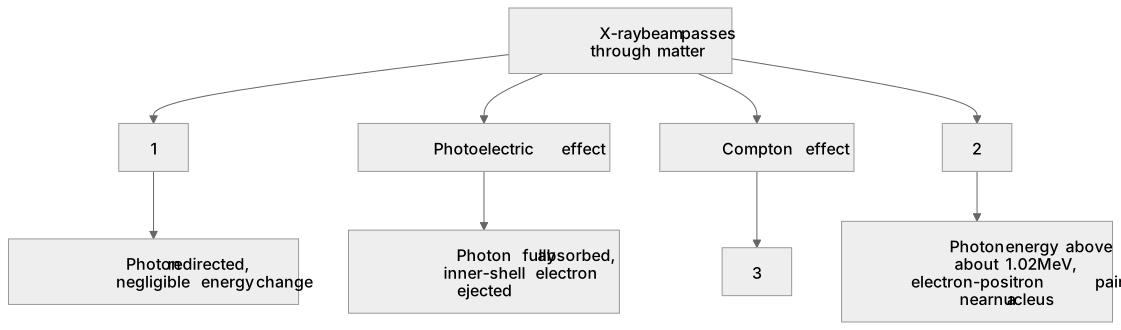
1Box 1
2Box 2
3Box 3
There is more to this lesson
The full lesson goes on to check your understanding and help you earn the marks. Create a free account to carry on, with your progress saved.
A week of Premium from your first lesson · Then the free plan continues · No card, no charge
Test your understanding of Nuclear fission and fusion: (c) X-ray attenuation mechanisms; simple scatter, photoelectric effect, Compton effect and pair production
Active recall beats re-reading. Take an instant quiz now to test what you’ve learned and lock it into long-term memory.
A week of Premium from your first lesson · Then the free plan continues · No card, no charge