OCR · A-Level · Physics
Course version: H556 · Version from Sept 2015
(d) attenuation of X-rays; I I e x 0 = n - , where n is the attenuation
Full specification wording
Nuclear fission and fusion: (d) attenuation of X-rays; I I e x 0 = n - , where n is the attenuation
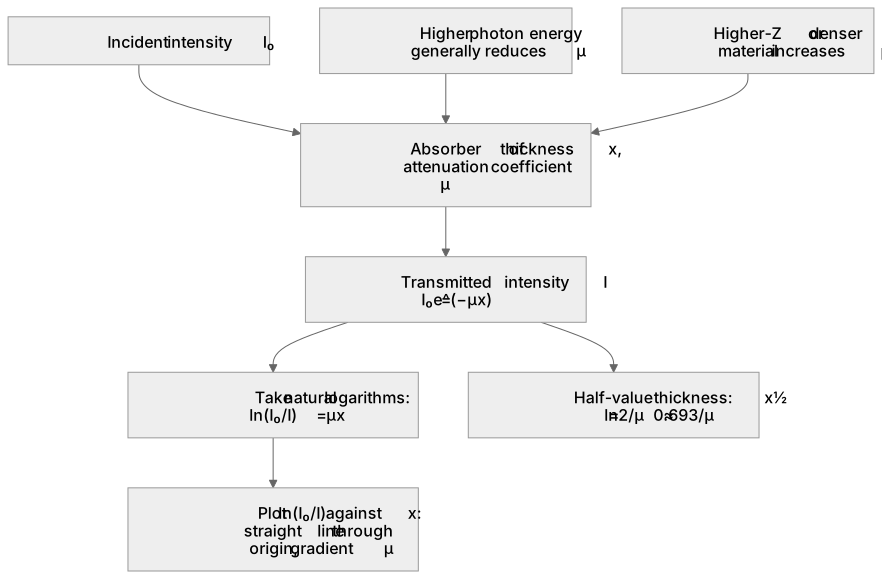
The attenuation of a collimated X-ray beam follows I = I₀e^(−μx), where I₀ is the incident intensity, I is the transmitted intensity, x is the absorber thickness and μ is the attenuation…
Checked against the OCR H556 specification (opens in a new tab) on .
- Point 15 of 18
- 3 key terms
Study notes
From the checked teaching notes for this specification point.
The idea
The attenuation of a collimated X-ray beam follows I = I₀e^(−μx), where I₀ is the incident intensity, I is the transmitted intensity, x is the absorber thickness and μ is the attenuation (absorption) coefficient. The coefficient depends on photon energy and the material's atomic number and density. Taking natural logarithms gives ln(I₀/I) = μx, so a graph of ln(I₀/I) against x is a straight line through the origin with gradient μ. The half-value thickness x½, where I = I₀/2, satisfies x½ = ln2/μ ≈ 0.693/μ. Increasing photon energy generally reduces μ, while higher-Z or denser materials increase it.
What earns the marks
- The attenuation equation is I = I₀e^(−μx), where I₀ is incident intensity, I is transmitted intensity, x is thickness and μ is the attenuation coefficient.
- μ depends on the photon energy and on the atomic number and density of the absorber.
- Taking natural logarithms gives ln(I₀/I) = μx, so a plot of ln(I₀/I) against x is linear with gradient μ.
- Half-value thickness x½ satisfies x½ = ln2/μ, the thickness that reduces intensity to half its initial value.
- Higher photon energy generally decreases μ, while higher-Z or denser absorbers increase μ.
- The equation assumes a narrow, collimated, monoenergetic beam and a uniform absorber.
Common mistakes and how to put them right
Using log base 10 instead of natural logarithms.
Put it right: The exponential uses e, so take ln, and the gradient of ln(I₀/I) against x equals μ.
Mixing up I and I₀ in the ratio.
Put it right: I₀ is the incident intensity and I is the transmitted intensity, so I₀/I is greater than 1.
Forgetting that μ depends on photon energy.
Put it right: μ is not a fixed constant for a material but varies with the X-ray photon energy.
Confusing half-value thickness with attenuation coefficient.
Put it right: x½ = ln2/μ, so they are inversely related, not equal.
Exam tips
- Rearrange to ln(I₀/I) = μx before plotting, and identify the gradient as μ with units m⁻¹.
- Quote x½ = ln2/μ and show the substitution clearly when calculating half-value thickness.
- Check units: x in metres gives μ in m⁻¹; convert mm or cm to m before substituting.
- State the assumptions of the equation (narrow collimated monoenergetic beam, uniform absorber) when explaining limitations.
Try the lesson
The start of the Nuclear fission and fusion: (d) attenuation of X-rays; I I e x 0 = n - , where n is the attenuation lesson, made from checked teaching notes for this specification point.
Listen
The attenuation of a collimated X-ray beam follows I = I₀e^(−μx), where I₀ is the incident intensity, I is the transmitted intensity, x is the absorber thickness and μ is the attenuation (absorption) coefficient. The coefficient depends on photon energy and the material's atomic number and density. Taking natural logarithms gives ln(I₀/I) = μx, so a graph of ln(I₀/I) against x is a straight line through the origin with gradient μ. The half-value thickness x½, where I = I₀/2, satisfies x½ = ln2/μ ≈ 0.693/μ. Increasing photon energy generally reduces μ, while higher-Z or denser materials increase it. A strong answer earns marks for these points. The attenuation equation is I = I₀e^(−μx), where I₀ is incident intensity, I is transmitted intensity, x is thickness and μ is the attenuation coefficient. μ depends on the photon energy and on the atomic number and density of the absorber. Taking natural logarithms gives ln(I₀/I) = μx, so a plot of ln(I₀/I) against x is linear with gradient μ. Half-value thickness x½ satisfies x½ = ln2/μ, the thickness that reduces intensity to half its initial value. A common slip: Using log base 10 instead of natural logarithms. Instead, the exponential uses e, so take ln, and the gradient of ln(I₀/I) against x equals μ. Exam tip: Rearrange to ln(I₀/I) = μx before plotting, and identify the gradient as μ with units m⁻¹.
See it
Key words
Say what each word means before you turn the card.
Exponential attenuation of X-rays
Try answering aloud or in your head before turning the card.
Linearisation using natural logarithms
Try answering aloud or in your head before turning the card.
Half-value thickness
Try answering aloud or in your head before turning the card.
See every definition
- Exponential attenuation of X-rays
- The attenuation of a collimated X-ray beam follows I = I₀e^(−μx), where I₀ is the incident intensity, I is the transmitted intensity, x is the absorber thickness and μ is the attenuation coefficient.
- Linearisation using natural logarithms
- Taking natural logarithms gives ln(I₀/I) = μx, so a plot of ln(I₀/I) against x is linear with gradient μ.
- Half-value thickness
- The half-value thickness x½ satisfies x½ = ln2/μ, the thickness that reduces intensity to half its initial value.
Label the diagram
Some boxes have lost their names. Pick the right name for each number.
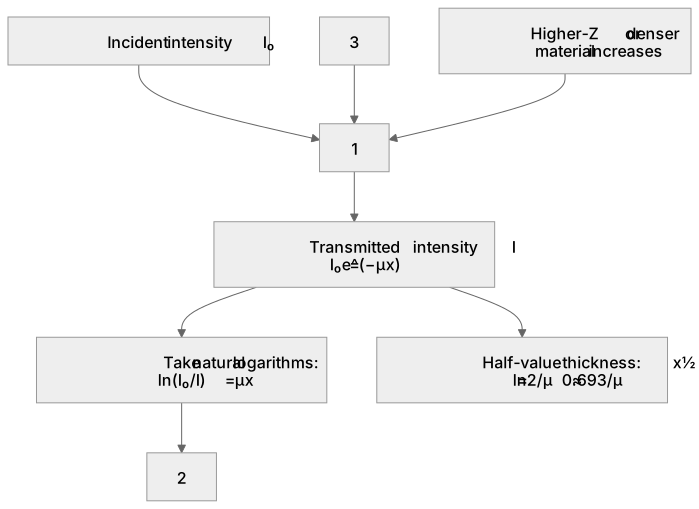
1Box 1
2Box 2
3Box 3
There is more to this lesson
The full lesson goes on to check your understanding and help you earn the marks. Create a free account to carry on, with your progress saved.
A week of Premium from your first lesson · Then the free plan continues · No card, no charge
Test your understanding of Nuclear fission and fusion: (d) attenuation of X-rays; I I e x 0 = n - , where n is the attenuation
Active recall beats re-reading. Take an instant quiz now to test what you’ve learned and lock it into long-term memory.
A week of Premium from your first lesson · Then the free plan continues · No card, no charge