OCR · A-Level · Physics
Course version: H556 · Version from Sept 2015
(f) binding energy of nuclei using ΔE = Δm c² and masses of nuclei
Full specification wording
Nuclear fission and fusion: (f) binding energy of nuclei using ΔE = Δm c² and masses of nuclei
Binding energy is the energy needed to separate a nucleus into its individual protons and neutrons, or released when the nucleus forms.
Checked against the OCR H556 specification (opens in a new tab) on .
- Point 6 of 18
- 2 key terms
Study notes
From the checked teaching notes for this specification point.
The idea
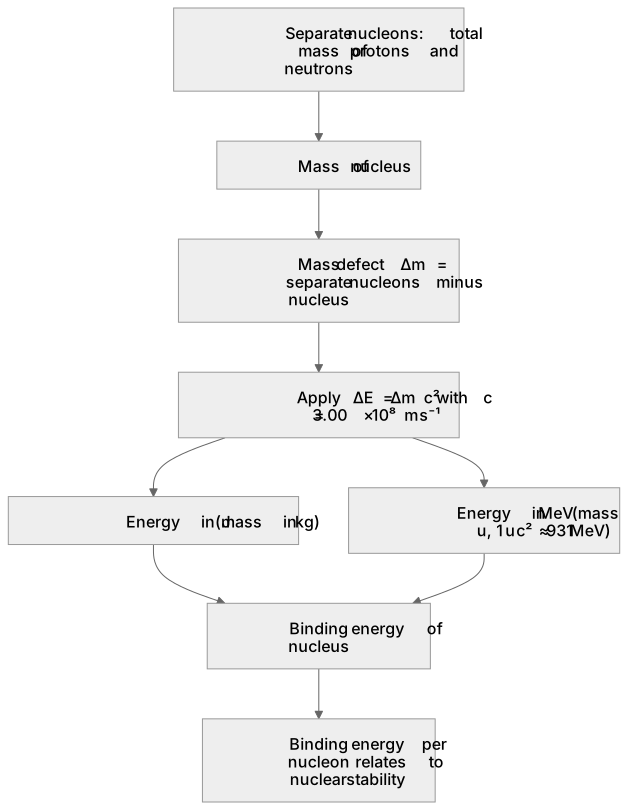
Binding energy is the energy needed to separate a nucleus into its individual protons and neutrons, or released when the nucleus forms. The mass defect Δm is the difference between the total mass of the separate nucleons and the actual nuclear mass; this missing mass appears as binding energy via ΔE = Δm c². Use c = 3.00 × 10⁸ m s⁻¹, so 1 u = 1.66 × 10⁻²⁷ kg converts to about 1.49 × 10⁻¹⁰ J, or roughly 931 MeV. Work in kg and J, or in u and MeV, but never mix units. Binding energy per nucleon peaks near iron-56, explaining why fusion of light nuclei and fission of heavy nuclei both release energy.
What earns the marks
- State that binding energy is the energy required to separate a nucleus into its constituent protons and neutrons.
- Define mass defect Δm as the difference between the sum of the masses of the separate nucleons and the mass of the nucleus.
- Apply ΔE = Δm c² with c = 3.00 × 10⁸ m s⁻¹, keeping mass in kg and energy in J.
- Convert between u and kg using 1 u = 1.66 × 10⁻²⁷ kg, and recognise 1 u c² ≈ 931 MeV.
- Relate binding energy per nucleon to nuclear stability, with a maximum near iron-56.
Common mistakes and how to put them right
Using the mass of the nucleus minus the sum of nucleon masses, giving a negative Δm.
Put it right by taking the separate nucleons minus the nucleus so Δm is positive.
Forgetting to square c, so ΔE is far too small.
Put it right by computing c² = 9.00 × 10¹⁶ m² s⁻² before multiplying by Δm.
Mixing units, for example mass in u with c in m s⁻¹.
Put it right by converting mass to kg first or by using the u-to-MeV conversion consistently.
Exam tips
- Write the equation ΔE = Δm c² before substituting so the method is visible.
- Check the sign of Δm: it must be positive for a bound nucleus.
- If the answer is requested in MeV, divide the energy in J by 1.60 × 10⁻¹³ J MeV⁻¹.
Try the lesson
The start of the Nuclear fission and fusion: (f) binding energy of nuclei using ΔE = Δm c² and masses of nuclei lesson, made from checked teaching notes for this specification point.
Listen
Binding energy is the energy needed to separate a nucleus into its individual protons and neutrons, or released when the nucleus forms. The mass defect Δm is the difference between the total mass of the separate nucleons and the actual nuclear mass; this missing mass appears as binding energy via ΔE = Δm c². Use c = 3.00 × 10⁸ m s⁻¹, so 1 u = 1.66 × 10⁻²⁷ kg converts to about 1.49 × 10⁻¹⁰ J, or roughly 931 MeV. Work in kg and J, or in u and MeV, but never mix units. Binding energy per nucleon peaks near iron-56, explaining why fusion of light nuclei and fission of heavy nuclei both release energy. A strong answer earns marks for these points. State that binding energy is the energy required to separate a nucleus into its constituent protons and neutrons. Define mass defect Δm as the difference between the sum of the masses of the separate nucleons and the mass of the nucleus. Apply ΔE = Δm c² with c = 3.00 × 10⁸ m s⁻¹, keeping mass in kg and energy in J. Convert between u and kg using 1 u = 1.66 × 10⁻²⁷ kg, and recognise 1 u c² ≈ 931 MeV. A common slip: Using the mass of the nucleus minus the sum of nucleon masses, giving a negative Δm. Instead, taking the separate nucleons minus the nucleus so Δm is positive. Exam tip: Write the equation ΔE = Δm c² before substituting so the method is visible.
See it
Key words
Say what each word means before you turn the card.
Binding energy
Try answering aloud or in your head before turning the card.
Mass defect
Try answering aloud or in your head before turning the card.
See every definition
- Binding energy
- The energy needed to separate a nucleus into its individual protons and neutrons, or released when the nucleus forms.
- Mass defect
- The difference between the total mass of the separate nucleons and the actual nuclear mass, which appears as binding energy via ΔE = Δm c².
Label the diagram
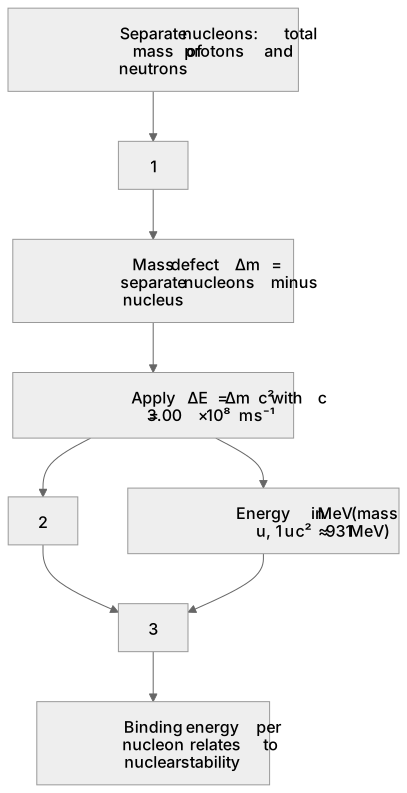
Some boxes have lost their names. Pick the right name for each number.
1Box 1
2Box 2
3Box 3
There is more to this lesson
The full lesson goes on to check your understanding and help you earn the marks. Create a free account to carry on, with your progress saved.
A week of Premium from your first lesson · Then the free plan continues · No card, no charge
Test your understanding of Nuclear fission and fusion: (f) binding energy of nuclei using ΔE = Δm c² and masses of nuclei
Active recall beats re-reading. Take an instant quiz now to test what you’ve learned and lock it into long-term memory.
A week of Premium from your first lesson · Then the free plan continues · No card, no charge