OCR · A-Level · Physics
Course version: H556 · Version from Sept 2015
Nuclear fission and fusion: (g) induced nuclear fission; chain reaction
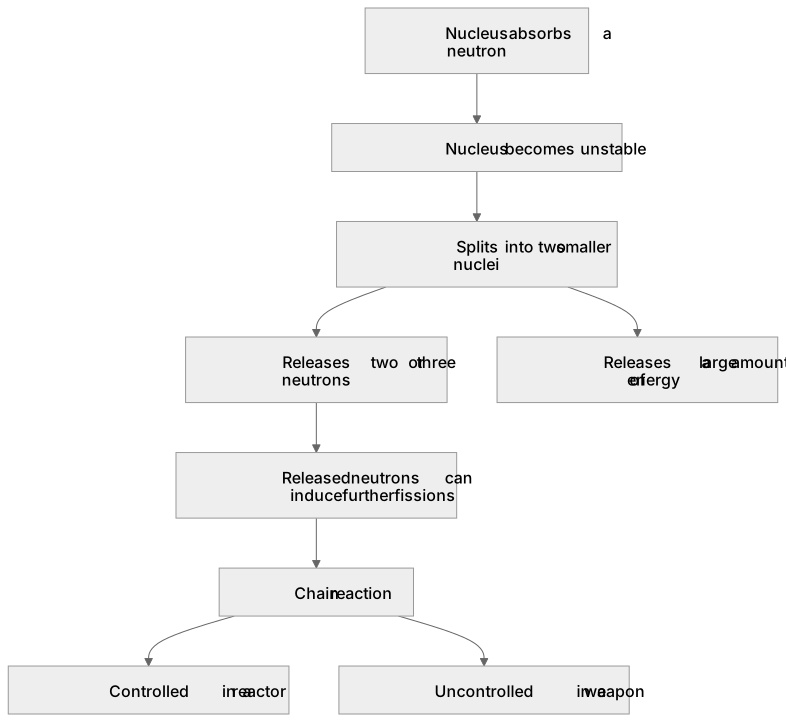
Induced fission occurs when a nucleus absorbs a neutron and becomes unstable, splitting into two smaller nuclei plus two or three further neutrons and releasing energy.
Checked against the OCR H556 specification (opens in a new tab) on .
- Point 7 of 18
- 2 key terms
Study notes
From the checked teaching notes for this specification point.
The idea
Induced fission occurs when a nucleus absorbs a neutron and becomes unstable, splitting into two smaller nuclei plus two or three further neutrons and releasing energy. A typical example is uranium-235 absorbing a slow neutron to form uranium-236, which splits into fragments such as barium-141 and krypton-92 with three neutrons. Because each fission releases more neutrons, these can induce further fissions, giving a self-sustaining chain reaction. The energy released comes from the difference in binding energy per nucleon between the heavy parent and the lighter products. In a reactor the chain reaction is controlled so that on average only one neutron from each fission goes on to cause another.
What earns the marks
- Describe induced fission as absorption of a neutron by a nucleus, making it unstable so it splits into two smaller nuclei.
- State that each fission releases two or three neutrons and a large amount of energy.
- Explain that released neutrons can induce further fissions, producing a chain reaction.
- Recognise that the energy released arises from the increase in binding energy per nucleon of the products compared with the parent.
- Distinguish a controlled chain reaction in a reactor from an uncontrolled one in a weapon.
Common mistakes and how to put them right
Saying fission is the same as radioactive decay.
Put it right by noting that induced fission requires neutron absorption, whereas decay is spontaneous.
Claiming the products have greater total mass than the parent.
Put it right by stating the products have slightly less mass, the difference appearing as energy.
Assuming every released neutron causes another fission.
Put it right by explaining that some escape or are absorbed without fission, so control is needed.
Exam tips
- Use the term 'slow neutron' or 'thermal neutron' when describing fission of uranium-235.
- Balance nucleon numbers and proton numbers in the fission equation to check the products.
- Link the chain reaction to the multiplication of neutrons rather than to a single fission event.
Try the lesson
The start of the Nuclear fission and fusion: (g) induced nuclear fission; chain reaction lesson, made from checked teaching notes for this specification point.
Listen
Induced fission occurs when a nucleus absorbs a neutron and becomes unstable, splitting into two smaller nuclei plus two or three further neutrons and releasing energy. A typical example is uranium-235 absorbing a slow neutron to form uranium-236, which splits into fragments such as barium-141 and krypton-92 with three neutrons. Because each fission releases more neutrons, these can induce further fissions, giving a self-sustaining chain reaction. The energy released comes from the difference in binding energy per nucleon between the heavy parent and the lighter products. In a reactor the chain reaction is controlled so that on average only one neutron from each fission goes on to cause another. A strong answer earns marks for these points. Describe induced fission as absorption of a neutron by a nucleus, making it unstable so it splits into two smaller nuclei. State that each fission releases two or three neutrons and a large amount of energy. Explain that released neutrons can induce further fissions, producing a chain reaction. Recognise that the energy released arises from the increase in binding energy per nucleon of the products compared with the parent. A common slip: Saying fission is the same as radioactive decay. Instead, noting that induced fission requires neutron absorption, whereas decay is spontaneous. Exam tip: Use the term 'slow neutron' or 'thermal neutron' when describing fission of uranium-235.
See it
Key words
Say what each word means before you turn the card.
Neutron-induced fission
Try answering aloud or in your head before turning the card.
Chain reactions
Try answering aloud or in your head before turning the card.
See every definition
- Neutron-induced fission
- A nucleus absorbs a neutron and becomes unstable, splitting into two smaller nuclei plus two or three further neutrons and releasing energy.
- Chain reactions
- Because each fission releases more neutrons, these can induce further fissions, giving a self-sustaining chain reaction.
Label the diagram
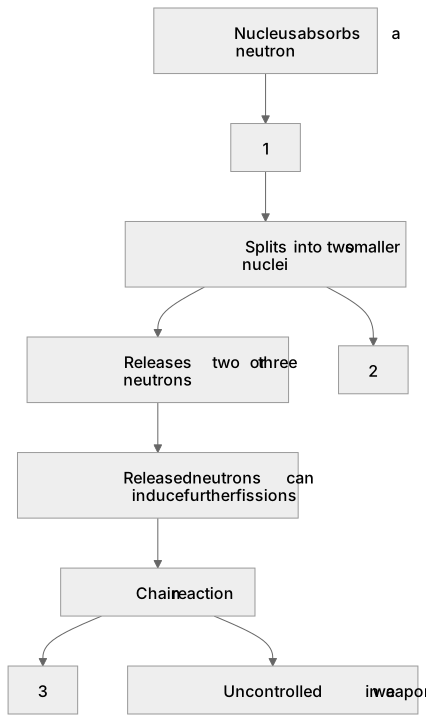
Some boxes have lost their names. Pick the right name for each number.
1Box 1
2Box 2
3Box 3
There is more to this lesson
The full lesson goes on to check your understanding and help you earn the marks. Create a free account to carry on, with your progress saved.
A week of Premium from your first lesson · Then the free plan continues · No card, no charge
Test your understanding of Nuclear fission and fusion: (g) induced nuclear fission; chain reaction
Active recall beats re-reading. Take an instant quiz now to test what you’ve learned and lock it into long-term memory.
A week of Premium from your first lesson · Then the free plan continues · No card, no charge