OCR · A-Level · Physics
Course version: H556 · Version from Sept 2015
Planetary motion: (a) Kepler’s three laws of planetary motion
Kepler's three laws describe how planets move around the Sun.
Checked against the OCR H556 specification (opens in a new tab) on .
- Point 1 of 5
- 4 key terms
Study notes
From the checked teaching notes for this specification point.
The idea
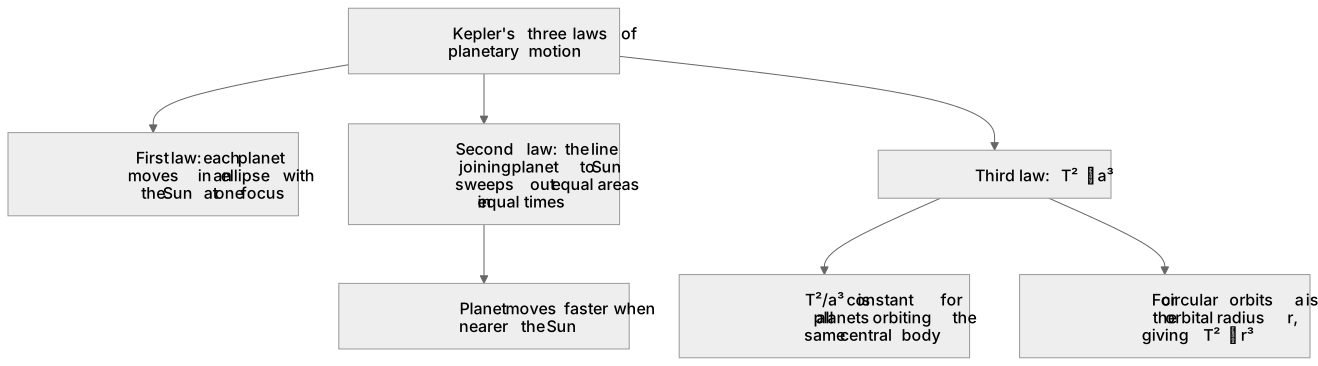
Kepler's three laws describe how planets move around the Sun. The first law states that each planet moves in an ellipse with the Sun at one focus. The second law states that the line joining a planet to the Sun sweeps out equal areas in equal times, so a planet moves faster when nearer the Sun. The third law states that the square of the orbital period T is proportional to the cube of the semi-major axis a: T² ∝ a³, or T²/a³ is constant for all planets orbiting the same central body. For circular orbits a is the orbital radius r, giving T² ∝ r³. These laws are empirical but follow from Newton's law of gravitation and centripetal force.
What earns the marks
- States Kepler's first law: planets move in ellipses with the Sun at one focus.
- States Kepler's second law: the radius vector from Sun to planet sweeps equal areas in equal times.
- States Kepler's third law: T² ∝ a³ for planets orbiting the same central mass.
- Explains that the second law implies a planet's orbital speed is greatest at perihelion and least at aphelion.
- Applies T² ∝ r³ to circular orbits, where the semi-major axis equals the orbital radius.
Common mistakes and how to put them right
Describing planetary orbits as perfect circles.
Put it right: Kepler's first law requires ellipses with the Sun at one focus.
Stating the third law as T ∝ a³ or T² ∝ a².
Put it right: The correct relationship is T² ∝ a³.
Claiming the Sun is at the centre of the ellipse.
Put it right: It is at one focus, not the geometric centre.
Applying T² ∝ a³ to planets orbiting different stars without accounting for the different central masses.
Exam tips
- Learn all three laws with their precise wording, since multiple-choice questions often test one law at a time.
- Use the constant form T²/a³ when comparing two planets orbiting the same body.
- Remember that the second law is about equal areas in equal times, not equal distances or equal speeds.
- Link the third law to Newton's law of gravitation to show it is not an independent assumption.
Try the lesson
The start of the Planetary motion: (a) Kepler’s three laws of planetary motion lesson, made from checked teaching notes for this specification point.
Listen
Kepler's three laws describe how planets move around the Sun. The first law states that each planet moves in an ellipse with the Sun at one focus. The second law states that the line joining a planet to the Sun sweeps out equal areas in equal times, so a planet moves faster when nearer the Sun. The third law states that the square of the orbital period T is proportional to the cube of the semi-major axis a: T² ∝ a³, or T²/a³ is constant for all planets orbiting the same central body. For circular orbits a is the orbital radius r, giving T² ∝ r³. These laws are empirical but follow from Newton's law of gravitation and centripetal force. A strong answer earns marks for these points. States Kepler's first law: planets move in ellipses with the Sun at one focus. States Kepler's second law: the radius vector from Sun to planet sweeps equal areas in equal times. States Kepler's third law: T² ∝ a³ for planets orbiting the same central mass. Explains that the second law implies a planet's orbital speed is greatest at perihelion and least at aphelion. Exam tip: Learn all three laws with their precise wording, since multiple-choice questions often test one law at a time.
See it
Key words
Say what each word means before you turn the card.
Elliptical planetary orbits
Try answering aloud or in your head before turning the card.
Equal areas in equal times
Try answering aloud or in your head before turning the card.
Period–semi-major-axis relationship
Try answering aloud or in your head before turning the card.
Newtonian derivation of Kepler's laws
Try answering aloud or in your head before turning the card.
See every definition
- Elliptical planetary orbits
- Each planet moves in an ellipse with the Sun at one focus, not at the geometric centre.
- Equal areas in equal times
- The line joining a planet to the Sun sweeps out equal areas in equal times, so a planet moves faster when nearer the Sun.
- Period–semi-major-axis relationship
- The square of the orbital period T is proportional to the cube of the semi-major axis a, so T²/a³ is constant for all planets orbiting the same central body.
- Newtonian derivation of Kepler's laws
- These laws are empirical but follow from Newton's law of gravitation and centripetal force.
Label the diagram
Some boxes have lost their names. Pick the right name for each number.
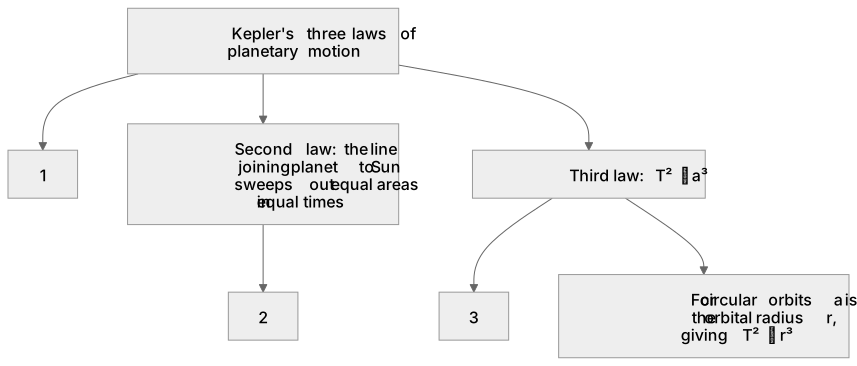
1Box 1
2Box 2
3Box 3
There is more to this lesson
The full lesson goes on to check your understanding and help you earn the marks. Create a free account to carry on, with your progress saved.
A week of Premium from your first lesson · Then the free plan continues · No card, no charge
Test your understanding of Planetary motion: (a) Kepler’s three laws of planetary motion
Active recall beats re-reading. Take an instant quiz now to test what you’ve learned and lock it into long-term memory.
A week of Premium from your first lesson · Then the free plan continues · No card, no charge