OCR · A-Level · Physics
Course version: H556 · Version from Sept 2015
(b) the centripetal force on a planet is provided by the gravitational…
Full specification wording
Planetary motion: (b) the centripetal force on a planet is provided by the gravitational force between it and the Sun
A planet moving around the Sun follows a curved path, so it must have a centripetal acceleration directed towards the Sun.
Checked against the OCR H556 specification (opens in a new tab) on .
- Point 2 of 5
- 4 key terms
Study notes
From the checked teaching notes for this specification point.
The idea
A planet moving around the Sun follows a curved path, so it must have a centripetal acceleration directed towards the Sun. The only significant force acting on the planet is the gravitational attraction between the planet and the Sun, so this gravitational force provides the required centripetal force. Equating the two for a circular orbit gives GMm/r² = mv²/r, which simplifies to v² = GM/r. Combining this with v = 2πr/T leads to T² = 4π²r³/(GM), which is Kepler's third law. This shows that the gravitational force is not an additional force but the same force that supplies the centripetal requirement.
What earns the marks
- States that the gravitational force between planet and Sun acts towards the Sun and provides the centripetal force.
- Writes the gravitational force as GMm/r² and the centripetal force as mv²/r or mω²r.
- Equates the two expressions to derive v² = GM/r for a circular orbit.
- Combines v = 2πr/T with v² = GM/r to obtain T² = 4π²r³/(GM), linking to Kepler's third law.
- Explains that no separate centripetal force exists; gravity alone fulfils that role.
Common mistakes and how to put them right
Treating centripetal force as an extra force in addition to gravity.
Put it right: It is the resultant of the gravitational force.
Using the planet's mass incorrectly in v² = GM/r.
Put it right: The planet's mass cancels, leaving the Sun's mass M.
Forgetting that the gravitational force acts towards the Sun, which is the direction of the centripetal acceleration.
Mixing up the masses in GMm/r², using the planet's mass for M instead of the Sun's mass.
Exam tips
- Start from the force equation GMm/r² = mv²/r and cancel m before substituting numbers.
- Check that M is the mass of the central body (the Sun) and m is the orbiting body (the planet).
- Use v = 2πr/T when the period is given rather than the orbital speed.
- State clearly that gravity provides the centripetal force, not that it is balanced by another force.
Try the lesson
The start of the Planetary motion: (b) the centripetal force on a planet is provided by the gravitational force between it and the Sun lesson, made from checked teaching notes for this specification point.
Listen
A planet moving around the Sun follows a curved path, so it must have a centripetal acceleration directed towards the Sun. The only significant force acting on the planet is the gravitational attraction between the planet and the Sun, so this gravitational force provides the required centripetal force. Equating the two for a circular orbit gives GMm/r² = mv²/r, which simplifies to v² = GM/r. Combining this with v = 2πr/T leads to T² = 4π²r³/(GM), which is Kepler's third law. This shows that the gravitational force is not an additional force but the same force that supplies the centripetal requirement. A strong answer earns marks for these points. States that the gravitational force between planet and Sun acts towards the Sun and provides the centripetal force. Writes the gravitational force as GMm/r² and the centripetal force as mv²/r or mω²r. Equates the two expressions to derive v² = GM/r for a circular orbit. Combines v = 2πr/T with v² = GM/r to obtain T² = 4π²r³/(GM), linking to Kepler's third law. Exam tip: Start from the force equation GMm/r² = mv²/r and cancel m before substituting numbers.
See it
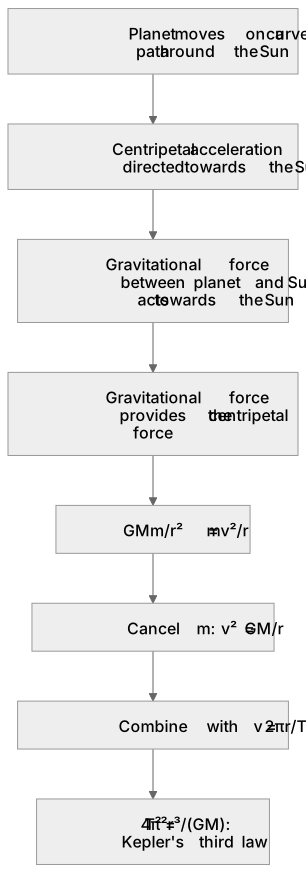
Put it in order
Put these steps in the order they happen.
- 1. GMm/r² = mv²/r
- 2. T² = 4π²r³/(GM): Kepler's third law
- 3. Cancel m: v² = GM/r
- 4. Planet moves on a curved path around the Sun
- 5. Centripetal acceleration directed towards the Sun
- 6. Combine with v = 2πr/T
- 7. Gravitational force between planet and Sun acts towards the Sun
- 8. Gravitational force provides the centripetal force
Key words
Say what each word means before you turn the card.
Gravitational force as the centripetal force
Try answering aloud or in your head before turning the card.
Circular orbital motion
Try answering aloud or in your head before turning the card.
Derivation of Kepler's third law
Try answering aloud or in your head before turning the card.
Mass of the central body determining orbital speed
Try answering aloud or in your head before turning the card.
See every definition
- Gravitational force as the centripetal force
- The gravitational attraction between the planet and the Sun acts towards the Sun and provides the required centripetal force.
- Circular orbital motion
- A planet moving around the Sun follows a curved path, so it must have a centripetal acceleration directed towards the Sun.
- Derivation of Kepler's third law
- Combining v = 2πr/T with v² = GM/r leads to T² = 4π²r³/(GM), which is Kepler's third law.
- Mass of the central body determining orbital speed
- In v² = GM/r the planet's mass cancels, leaving the Sun's mass M.
Label the diagram
Some boxes have lost their names. Pick the right name for each number.
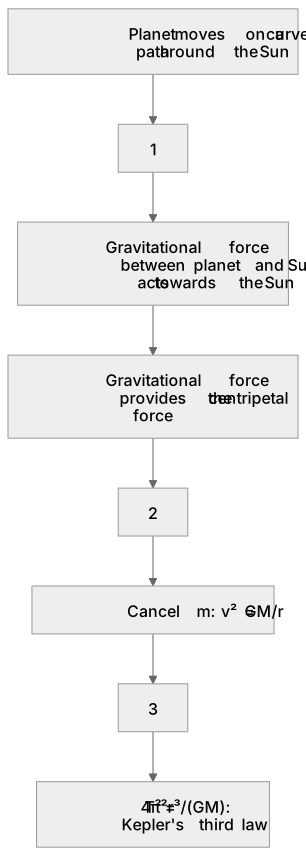
1Box 1
2Box 2
3Box 3
There is more to this lesson
The full lesson goes on to check your understanding and help you earn the marks. Create a free account to carry on, with your progress saved.
A week of Premium from your first lesson · Then the free plan continues · No card, no charge
Test your understanding of Planetary motion: (b) the centripetal force on a planet is provided by the gravitational force between it and the Sun
Active recall beats re-reading. Take an instant quiz now to test what you’ve learned and lock it into long-term memory.
A week of Premium from your first lesson · Then the free plan continues · No card, no charge