OCR · A-Level · Physics
Course version: H556 · Version from Sept 2015
Planetary motion: (c) the equation T² = (4π²/GM)r³
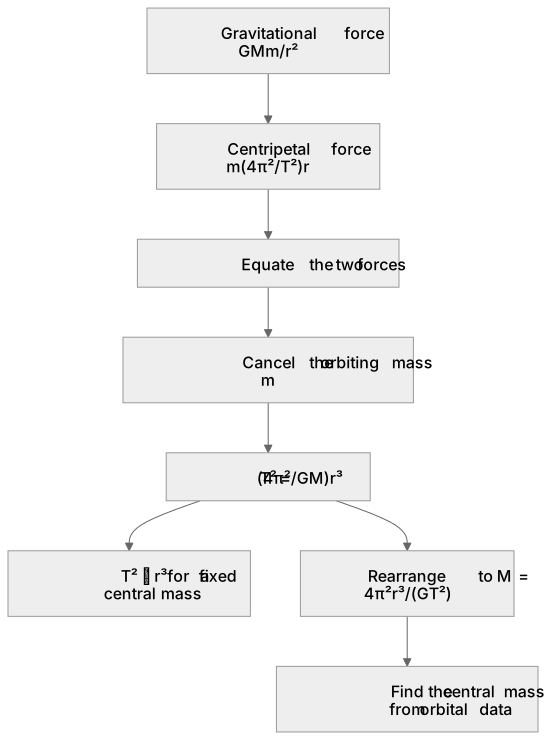
This equation links a satellite's orbital period T to its orbital radius r around a central mass M. It comes from equating gravitational force GMm/r² to centripetal force m(4π²/T²)r.
Checked against the OCR H556 specification (opens in a new tab) on .
- Point 3 of 5
Study notes
From the checked teaching notes for this specification point.
The idea
This equation links a satellite's orbital period T to its orbital radius r around a central mass M. It comes from equating gravitational force GMm/r² to centripetal force m(4π²/T²)r. The mass m cancels, giving T² = (4π²/GM)r³. The equation shows T² is directly proportional to r³ for a given central body. For example, a satellite orbiting Earth at radius r has M equal to Earth's mass, not the satellite's mass. Rearranging gives M = 4π²r³/(GT²), which allows astronomers to find the mass of a planet or star from the orbit of a moon or satellite. The equation assumes a circular orbit and that the central mass is much larger than the orbiting mass.
What earns the marks
- Equate gravitational force GMm/r² to centripetal force m(4π²/T²)r.
- Cancel the orbiting mass m to obtain T² = (4π²/GM)r³.
- Identify M as the mass of the central body, not the orbiting body.
- Use M = 4π²r³/(GT²) to determine the central mass from orbital data.
- Recognise that T² ∝ r³ for a fixed central mass.
Common mistakes and how to put them right
Using the satellite's mass for M instead of the central body's mass.
Put it right by using the mass of the body being orbited.
Forgetting to square the period when substituting into the equation.
Put it right by ensuring T is in seconds and squared.
Mixing units, such as using km for r and hours for T.
Put it right by converting r to metres and T to seconds before calculation.
Exam tips
- Write down the equation exactly as given before substituting numbers.
- Check that r is the orbital radius from the centre of the central body, not the altitude above its surface.
- Use standard SI units: metres for r, seconds for T, kilograms for M.
Try the lesson
The start of the Planetary motion: (c) the equation T² = (4π²/GM)r³ lesson, made from checked teaching notes for this specification point.
Listen
This equation links a satellite's orbital period T to its orbital radius r around a central mass M. It comes from equating gravitational force GMm/r² to centripetal force m(4π²/T²)r. The mass m cancels, giving T² = (4π²/GM)r³. The equation shows T² is directly proportional to r³ for a given central body. For example, a satellite orbiting Earth at radius r has M equal to Earth's mass, not the satellite's mass. Rearranging gives M = 4π²r³/(GT²), which allows astronomers to find the mass of a planet or star from the orbit of a moon or satellite. The equation assumes a circular orbit and that the central mass is much larger than the orbiting mass. A strong answer earns marks for these points. Equate gravitational force GMm/r² to centripetal force m(4π²/T²)r. Cancel the orbiting mass m to obtain T² = (4π²/GM)r³. Identify M as the mass of the central body, not the orbiting body. Use M = 4π²r³/(GT²) to determine the central mass from orbital data. A common slip: Using the satellite's mass for M instead of the central body's mass. Instead, using the mass of the body being orbited. Exam tip: Write down the equation exactly as given before substituting numbers.
See it
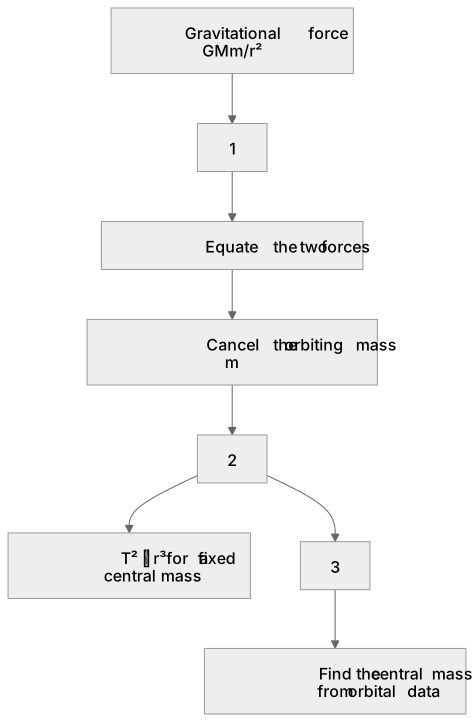
Label the diagram
Some boxes have lost their names. Pick the right name for each number.
1Box 1
2Box 2
3Box 3
There is more to this lesson
The full lesson goes on to check your understanding and help you earn the marks. Create a free account to carry on, with your progress saved.
A week of Premium from your first lesson · Then the free plan continues · No card, no charge
Test your understanding of Planetary motion: (c) the equation T² = (4π²/GM)r³
Active recall beats re-reading. Take an instant quiz now to test what you’ve learned and lock it into long-term memory.
A week of Premium from your first lesson · Then the free plan continues · No card, no charge