OCR · A-Level · Physics
Course version: H556 · Version from Sept 2015
(e) the concept of gravitational fields as being one of a number of forms…
Full specification wording
Point and spherical masses: (e) the concept of gravitational fields as being one of a number of forms of field giving rise to a force.
A field is a region where a force acts on a suitable object.
Checked against the OCR H556 specification (opens in a new tab) on .
- Point 5 of 5
- 4 key terms
Study notes
From the checked teaching notes for this specification point.
The idea
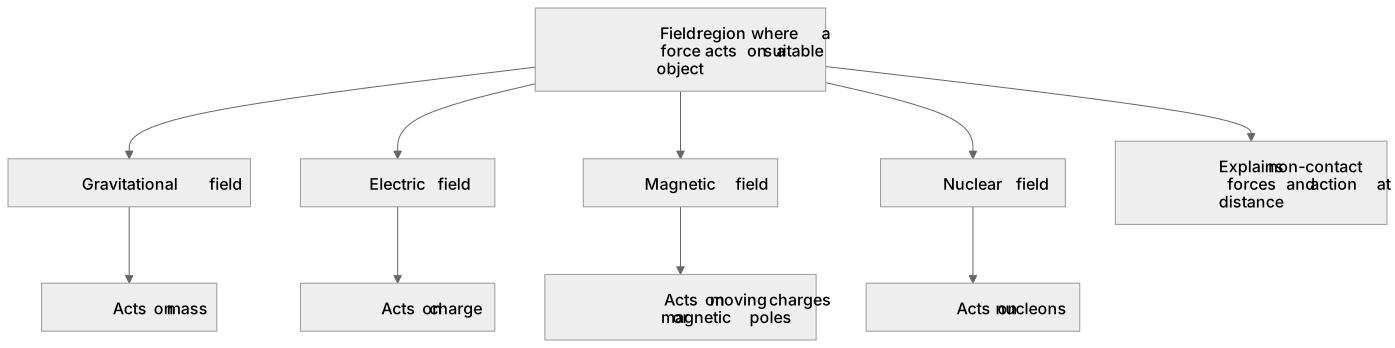
A field is a region where a force acts on a suitable object. Gravitational fields are one of several types of field, such as electric, magnetic and nuclear fields. Each field gives rise to a force on a property: gravitational fields act on mass, electric fields on charge, magnetic fields on moving charges or magnetic poles. The concept of a field allows forces to be described without contact, explaining action at a distance. Gravitational fields are always attractive and extend infinitely, though their strength decreases with distance.
What earns the marks
- A field is a region where a force is exerted on a suitable object.
- Gravitational fields act on mass and always produce an attractive force.
- Other field types include electric fields (act on charge), magnetic fields (act on moving charges or magnetic poles) and nuclear fields (act on nucleons).
- The concept of a field explains non-contact forces and action at a distance.
- Gravitational field strength decreases with distance from the mass, following an inverse-square law for a point mass.
Common mistakes and how to put them right
Misunderstanding: gravitational fields are the only type of field.
Put it right: There are electric, magnetic and nuclear fields, each acting on different properties.
Misunderstanding: gravitational fields can be repulsive.
Put it right: Gravitational fields are always attractive.
Misunderstanding: fields require a medium to act.
Put it right: Fields act through empty space; they do not need a medium.
Misunderstanding: gravitational field strength is the same everywhere.
Put it right: It decreases with distance from the mass.
Exam tips
- Link each field type to the property it acts on: mass for gravitational, charge for electric, moving charge or pole for magnetic.
- Remember that gravitational fields are always attractive and have infinite range.
- Use the field concept to explain non-contact forces.
Try the lesson
The start of the Point and spherical masses: (e) the concept of gravitational fields as being one of a number of forms of field giving rise to a force. lesson, made from checked teaching notes for this specification point.
Listen
A field is a region where a force acts on a suitable object. Gravitational fields are one of several types of field, such as electric, magnetic and nuclear fields. Each field gives rise to a force on a property: gravitational fields act on mass, electric fields on charge, magnetic fields on moving charges or magnetic poles. The concept of a field allows forces to be described without contact, explaining action at a distance. Gravitational fields are always attractive and extend infinitely, though their strength decreases with distance. A strong answer earns marks for these points. A field is a region where a force is exerted on a suitable object. Gravitational fields act on mass and always produce an attractive force. Other field types include electric fields (act on charge), magnetic fields (act on moving charges or magnetic poles) and nuclear fields (act on nucleons). The concept of a field explains non-contact forces and action at a distance. A common slip: Misunderstanding: gravitational fields are the only type of field. Instead, there are electric, magnetic and nuclear fields, each acting on different properties. Exam tip: Link each field type to the property it acts on: mass for gravitational, charge for electric, moving charge or pole for magnetic.
See it
Key words
Say what each word means before you turn the card.
Field
Try answering aloud or in your head before turning the card.
Gravitational field
Try answering aloud or in your head before turning the card.
Action at a distance
Try answering aloud or in your head before turning the card.
Types of field
Try answering aloud or in your head before turning the card.
See every definition
- Field
- A region where a force is exerted on a suitable object.
- Gravitational field
- One of a number of forms of field giving rise to a force, acting on mass and always producing an attractive force.
- Action at a distance
- Non-contact forces explained by the concept of a field, which acts through empty space without needing a medium.
- Types of field
- Electric fields act on charge, magnetic fields on moving charges or magnetic poles, and nuclear fields on nucleons.
Label the diagram
Some boxes have lost their names. Pick the right name for each number.
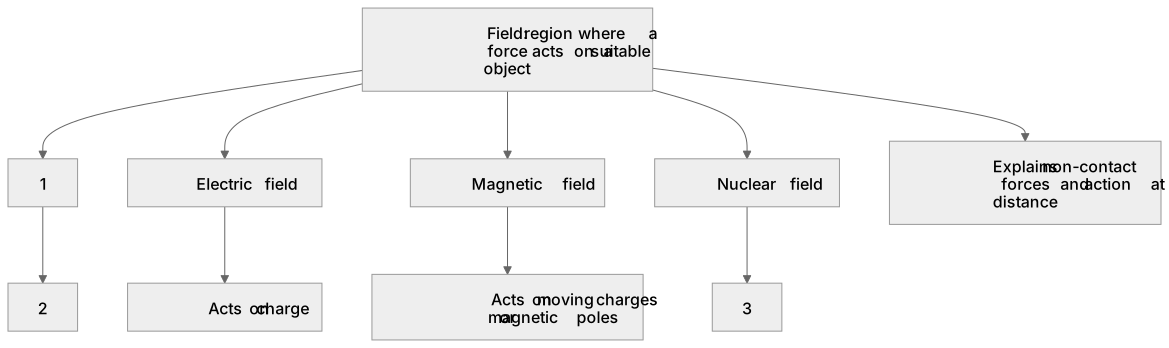
1Box 1
2Box 2
3Box 3
There is more to this lesson
The full lesson goes on to check your understanding and help you earn the marks. Create a free account to carry on, with your progress saved.
A week of Premium from your first lesson · Then the free plan continues · No card, no charge
Test your understanding of Point and spherical masses: (e) the concept of gravitational fields as being one of a number of forms of field giving rise to a force.
Active recall beats re-reading. Take an instant quiz now to test what you’ve learned and lock it into long-term memory.
A week of Premium from your first lesson · Then the free plan continues · No card, no charge