OCR · A-Level · Physics
Course version: H556 · Version from Sept 2015
Practical skills: (a) use of appropriate analogue apparatus to record
This statement covers choosing and reading analogue apparatus to record measurements.
Checked against the OCR H556 specification (opens in a new tab) on .
- Point 1 of 11
- 4 key terms
Study notes
From the checked teaching notes for this specification point.
The idea
This statement covers choosing and reading analogue apparatus to record measurements. Analogue instruments include metre rules, vernier callipers, micrometers, thermometers, ammeters, voltmeters and stopwatches with dials. To use them well you identify the scale division, estimate to a fraction of the smallest division where sensible, and read perpendicular to the scale to avoid parallax. Appropriate means the instrument's range and resolution suit the quantity: a micrometer for a wire diameter, a metre rule for a pendulum length.
For example: A metre rule with 1 mm divisions lets you record a length to the nearest millimetre, with an estimated fraction if the scale allows.
What earns the marks
- Identify the smallest scale division and state the resolution of the analogue instrument.
- Read the scale perpendicular to avoid parallax error.
- Estimate between divisions where the scale permits, and record the value with a sensible number of significant figures.
- Select an analogue instrument whose range and resolution match the quantity being measured.
- Check and allow for zero error before recording readings.
Common mistakes and how to put them right
Reading the scale at an angle, which causes parallax error.
Put it right: View perpendicular to the scale.
Quoting more decimal places than the scale resolution supports.
Put it right: Record to the nearest sensible fraction of a division.
Using an instrument whose range is too small for the quantity.
Put it right: Choose apparatus that can measure the full expected value.
Exam tips
- State the resolution of the instrument alongside the reading.
- Repeat readings and average to reduce random error.
- Check for zero error and subtract it if present.
Try the lesson
The start of the Practical skills: (a) use of appropriate analogue apparatus to record lesson, made from checked teaching notes for this specification point.
Listen
This statement covers choosing and reading analogue apparatus to record measurements. Analogue instruments include metre rules, vernier callipers, micrometers, thermometers, ammeters, voltmeters and stopwatches with dials. To use them well you identify the scale division, estimate to a fraction of the smallest division where sensible, and read perpendicular to the scale to avoid parallax. Appropriate means the instrument's range and resolution suit the quantity: a micrometer for a wire diameter, a metre rule for a pendulum length. For example, a metre rule with 1 mm divisions lets you record a length to the nearest millimetre, with an estimated fraction if the scale allows. A strong answer earns marks for these points. Identify the smallest scale division and state the resolution of the analogue instrument. Read the scale perpendicular to avoid parallax error. Estimate between divisions where the scale permits, and record the value with a sensible number of significant figures. Select an analogue instrument whose range and resolution match the quantity being measured. Exam tip: State the resolution of the instrument alongside the reading.
See it
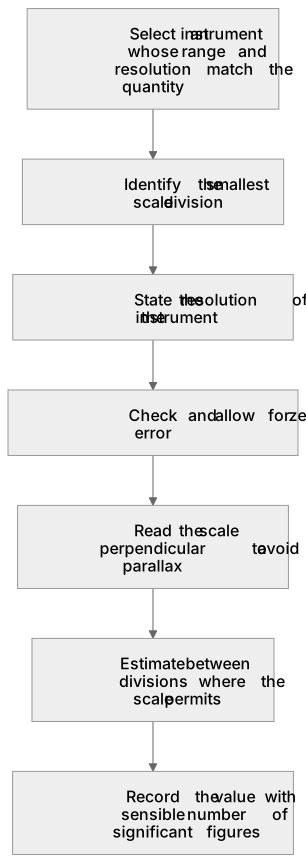
Put it in order
Put these steps in the order they happen.
- 1. Record the value with a sensible number of significant figures
- 2. Estimate between divisions where the scale permits
- 3. State the resolution of the instrument
- 4. Read the scale perpendicular to avoid parallax
- 5. Select an instrument whose range and resolution match the quantity
- 6. Identify the smallest scale division
- 7. Check and allow for zero error
Key words
Say what each word means before you turn the card.
Analogue measurement
Try answering aloud or in your head before turning the card.
Resolution and precision
Try answering aloud or in your head before turning the card.
Parallax avoidance
Try answering aloud or in your head before turning the card.
Apparatus selection
Try answering aloud or in your head before turning the card.
See every definition
- Analogue measurement
- Using analogue instruments, such as metre rules, vernier callipers, micrometers, thermometers, ammeters, voltmeters and stopwatches with dials, to record a value.
- Resolution and precision
- Identifying the smallest scale division of an instrument and recording the value with a sensible number of significant figures, estimating between divisions where the scale permits.
- Parallax avoidance
- Reading the scale perpendicular to it so that parallax error is avoided.
- Apparatus selection
- Choosing an analogue instrument whose range and resolution match the quantity being measured, such as a micrometer for a wire diameter or a metre rule for a pendulum length.
Label the diagram
Some boxes have lost their names. Pick the right name for each number.
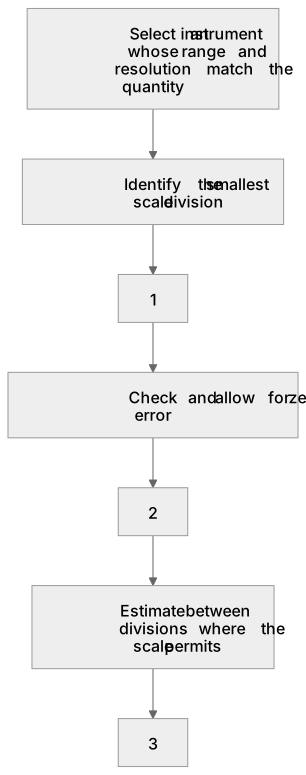
1Box 1
2Box 2
3Box 3
There is more to this lesson
The full lesson goes on to check your understanding and help you earn the marks. Create a free account to carry on, with your progress saved.
A week of Premium from your first lesson · Then the free plan continues · No card, no charge
Test your understanding of Practical skills: (a) use of appropriate analogue apparatus to record
Active recall beats re-reading. Take an instant quiz now to test what you’ve learned and lock it into long-term memory.
A week of Premium from your first lesson · Then the free plan continues · No card, no charge